Frontispiece
![[frontispiece]](../gifs/sibly1.jpg)
This digital edition prepared by Joseph H. Peterson, 2000. Updated: Dec 10, 2024.
License CC-BY 4.0.
https://creativecommons.org/licenses/by/4.0/
Ebenezer Sibly (1751-1800), famous 18th century British astrologer, is probably best known for his famous horoscope for the birth of the USA, published in 1787. The first three books of his New and Complete Illustration of the Occult Sciences are devoted to astrology, including many horoscopes for famous persons.
The text included here, Book 4, deals with other occult sciences. One of the few sources that Sibly names is Emanuel Swedenborg, whose Heaven and Hell first appeared in 1758. Other sources, while not named, can be identified. Much of the material was taken from the (expanded) 1665 edition of Reginald Scot's Discoverie of Witchcraft, including the information on Pah-li-Pah and other spirits (pp. 1093 ff). The engraving of magical instruments (p. 1102) was redrawn from those found in Scot. The incenses appropriate for the planets (p. 1109) were in the anonymous appendix to Scot, and ultimately derived from Agrippa's De Occulta Philosophia, Book I, chap. 44.
Sibly's engraving of Edward Kelley (or Kelly) raising a dead person in a graveyard has been reproduced frequently, including A. E. Waite's Book of Ceremonial Magic who used it as his frontispiece. Kelley's companion, sometimes erroneously identified as John Dee, is presumably Paul Waring. It should be noted that his accounts of Dee and Kelley are erroneous in many points. (See Weaver's Funeral Monuments, 1631, p. 45-6, upon which Sibly's account is based.)
Of particular interest is the account of Thomas Perks' encounters with foot-and-a-half-high beings who "gather intelligence" and travel between the earth and a globe in the air. This most closely resembles modern reports of alien encounters.
From the descriptions provided, it is likely that the book used by Thomas Perks was in fact (pseudo-?) Agrippa's Fourth Book of Occult Philosophy.
A copy of the letter is in the British Library catalogue.
Title:                A Copy of a Letter sent to the Right Reverend
                      ... Edward Lord Bishop of Gloucester from a clergyman,
                      ... giving an account of one T. Perks,
                      ... and a conversation had with familiar spirits.
 Main heading:        FOWLER. Edward. Bishop of Gloucester
 Additional headings: PERKS. Thomas
 Publication details: Bristol, 1704. 8o.
 Shelfmark:           3504.aaa.40.(8.)
Original page numbers are noted in this font:
[1059]
Pages are also given HTML anchors for easy reference (e.g. sibly4.htm#p1059).
ILLUSTRATION
OF THE
OCCULT SCIENCES:
OR THE
Art of foretelling future Events and Contingencies,
BY THE
ASPECTS, POSITIONS, and INFLUENCES, of the HEAVENLY BODIES.
FOUNDED ON
Natural Philosophy, Scripture, Reason, and the Mathematics.
IN FOUR PARTS.
AN Enquiry into, and Defence of, Astrology; with an interesting Discourse on Natural and Occult Philosophy -- in which the Wisdom and Omnipotence of God; the intellectual Faculties of Angels Spirits, and Men; the Order, Harmony, Sympathy, and wonderful Properties, of the Celestial and Terrestrial Worlds; the Signs, Influences, and Effects, of the Heavenly Bodies upon all animal, vegetable, and mineral, Subtances; the Number of the Spheres; the Method of erecting the Horoscope to cast Nativities; and the Doctrine of Horary Questions; are clearly exemplified and explained.
EXAMPLES for acquiring a Practical Knowledge of Astrology, with Rules for calculating, rectifying, and judging, Nativities; by which the Reader is enabled to discover, with Precision and Accuracy, every material Incident of his future Life and Fortune. Illustrated by a variety of new, entertaining, and curious, Questions, lately resolved, upon every material Occurrence in public and private Life. With a Collection of the most remarkabl Nativities tha have been cast for Kings, Princes, and other eminent Men, by the most celebrated, Professors of this science, in all Ages of the World; with astonishing Instances of their exact Completion.
METEOROLOGICAL Astrology defined and explained: Wherein certain Rules are laid down for prejudging the Revolutions, Vicissitudes, and Misfortunes, with which every Part of the habitable World may be occasionally threatened. General Effects produced by great Conjunctions, Eclipses, Transits, Comets, Blazing Stars, and other extraordinary Phænomena; with the Art of calculating Eclipses, Tides, and Weather, for any Number of Years to come. To which is added, a Collection of improved TABLES, contrived to answer all the Purposes of Astronomical Calculations.
The Distinction between Astrology and the Diabolical Practice of Exorcism; in which the Methods used for raising up and consulting Spirits are laid open, with various instances of their Compacts with wicked Men. Account of Apparitions and Spirits; including a general Display of the Mysteries of Witchcraft, Divination, Charms, and Necromancy. Compiled from a series of intense Study and Application, and founded on real Examples and Experience.
- ARGOL. ASTR. Lib. ii. c. 8.
The Sun, Moon, and Stars, hath God distributed unto all Nations under Heaven. They declare the Glory of God, and shew forth his Handywork: Day and Night do continually tell of them, and their Voice is heard in all Languages, and their Words are gone into the Ends of the Earth. -- Deut. iv. 19. Psal. xix. 1-5.
By E. SIBLY, M.D. F.R.H.S.
Embellished with Curious COPPER-PLATES.
LONDON:
PRINTED FOR THE AUTHOR, AND SOLD BY CHAMPANTE AND WHITROW, JEWRY-STREET, ALDGATE; AND AT THE BRITISH DIRECTORY-OFFICE, AVE-MARIA LANE.
ILLUSTRATION
OF THE ASTROLOGICAL AND
OCCULT SCIENCES.
PART THE FOURTH.
CONTAINING THE
DISTINCTION between ASTROLOGY
AND THE
WICKED PRACTICE OF EXORCISM.
WITH A GENERAL DISPLAY OF
WITCHCRAFT, MAGIC, AND DIVINATION,
FOUNDED UPON THE
EXISTENCE OF SPIRITS GOOD and BAD, and their
AFFINITY with the Affairs of this WORLD.
By E. SIBLY, M.D. of the King's College in Aberdeen; and Fellow of the
Harmonic Philosophical Society in Paris.
LONDON:
PRINTED FOR THE PROPRIETOR; AND SOLD BY CHAMPANTE AND WITHROW, JEWRY-STREET, ALDGATE; AND AT THE BRITISH DIRECTORY OFFICE, AVE-MARIA-LAND.
FROM what has been premised in the foregoing parts of this work, it will now become manifest to every unprejudiced reader, that Astrology and Magic, how much soever they have been confounded with each other, and considered by the vulgar as one and the same doctrine, are nevertheless two very opposite and distinct pursuits. The one not only supposes, but in truth is, an attainment of the contingencies and events of futurity, from a natural cause implanted in the motion and influence of the spheres, which it is at once honourable and praiseworthy to study; the other, an acquirement of particular events to come, or mischiefs to be performed by means of occult spells, diabolical incantations, the agency of spirits, or confederacy with the devil. This constitutes what is termed Magic, Exorcism, Witchcraft, and Divination, very aptly termed, "The Black Art," which it shall be the principal object of the following pages to illustrate; as well to give the reader some rational idea of that very ancient but mischievous practice, as to clear the sublime contemplation and study of the stars from the gross imputations it hath on that account sustained.
I have no doubt but the greater part of my readers, and perhaps the bulk of mankind at this day, totally disbelieve the possibility of witchcraft, magic, or divination; because, they deny the very existence of spirits, the agency of the devil, and the appearance of ghosts or spirits of deceased men, upon which belief the practice of the black art entirely depends. But however incredulous the wisest critic may be, as to what has been related on this subject, certain it is, that such spirits really do exist, and that confederacy and compact with them was in former times [1060] no uncommon thing. Blackstone seems to have established this fact in a very satisfactory manner, where he speaks of the laws formerly provided in this country against magicians and witches, and those who held confederacy with spirits; which to disbelieve, would not only be found to militate against numerous important passages of Scripture, but would call in question the express words of our Saviour himself, and give the lie to authors and attestators of the first reputation and character. Indeed, the force of Revelation, and the doctrine of Christ, depend entirely upon our opinion of the existence of spirits; for that, being confessed or doubted, either affirms or denies the eternity of the soul.
Those persons, who have taken pains to contemplate the nature and structure of man, will have no difficulty to believe, from the principles of reason and common sense, that a soul, essence, or spirit, absolutely exists within his body, totally independent of all material functions or desires; that flies in his face upon the commission of every unjust or improper act, and that leads the human ideas to a state of being, infinitely beyond the bounds of the terrestrial globe, and unconstrained by the limits of time. This applies to the essence, soul, or spirit, of man; whereas the body, being compounded of the elements of this world, is swayed, ruled, and eventually overcome, by them, in proportion as the elements operate upon one another, so as to produce diseases, imbecility, and death.
As it is agreed by all authors, and admitted in the creed of all sects and persuasions of people, that before the fall, the seasons and elements were in one unalterable state of perfection and harmony; to the condition of man was not then under the power of the elements, but he was cloathed with purity and immortality as with a garment. The external gross elements had then no sway; and the astral powers, instead of inflaming his desires, contributed unto him the influences of like unto like, forming an union of delectable ideas between soul and body, which led to the unabated praise and adoration of his beneficent Creator. The pure elements were then congenial to his state of immortality, and the astral powers were turned upon his back, while innocence and incorruptibility smiled on his brow. His food was not limited to palpable matter, but was combined with the pure etherial spirit of the universe, which perfumed the air, and enriched the seat of paradise.
Such was the prime-eval happy state of Man. But departing from his innocency, by the secret insinuations infused into his mind by the fallen spirit Satan, he lusted after palpability in the flesh, turned his face to the elements, deserted his reason and his God, and fell from his ethereal [1061] state into all the perils mortality and death. Having no longer all powers under his subjection, he became subject to sidereal and elementary influx, with his understanding darkened, and his mental faculties abridged; which I have exhibited by the four figures in the annexed plate.
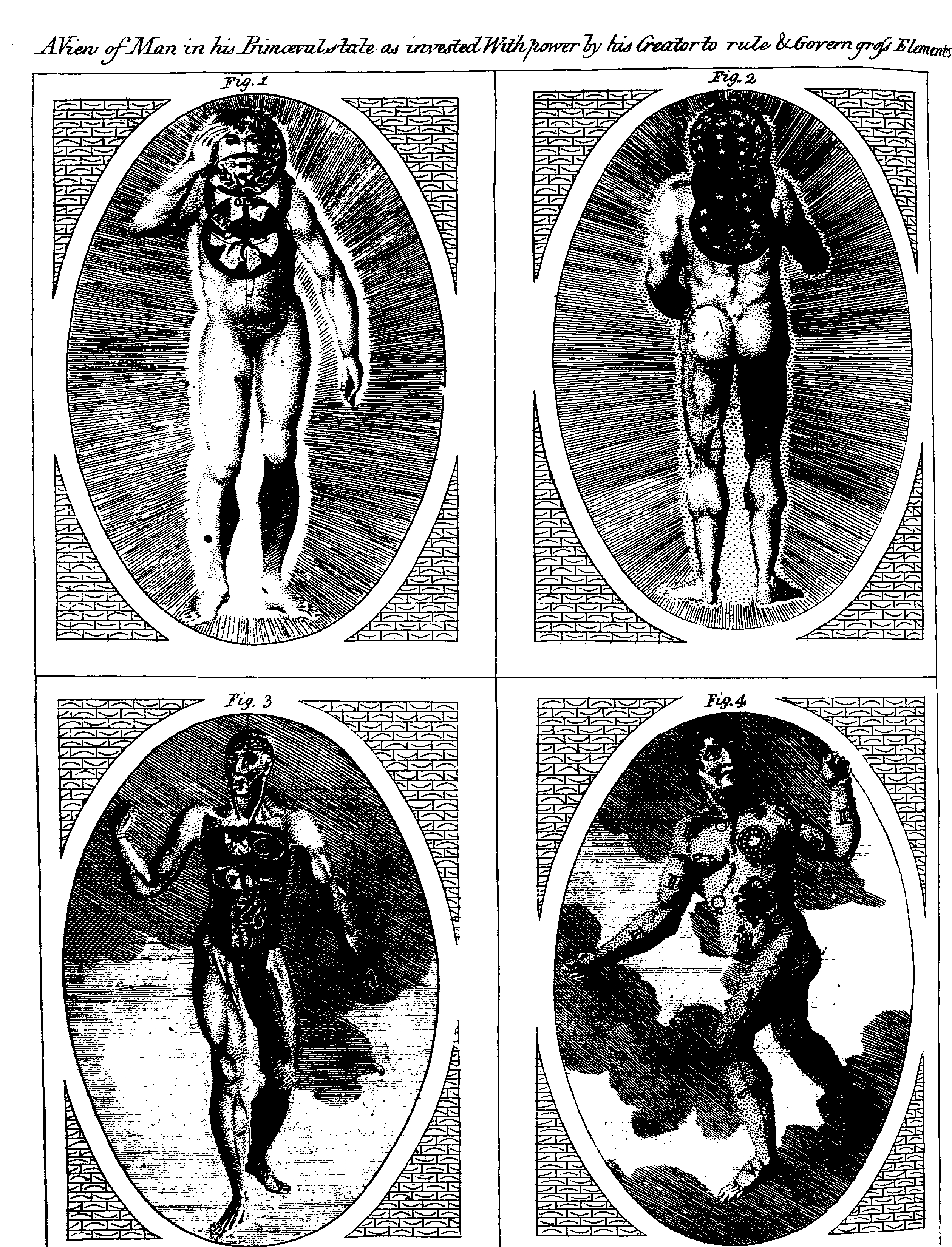
The first represents the prime-eval state of man, with his hand lifted up to his head, denoting the seat of comprehensive sensibility, to which the light of reason and sense flowed from the mirror of the Deity, in whose image he was formed. The second figure shews the elementary and astral influence in the prime-eval state of man, as having no action whatever internally, but falling on his exterior or back part; whilst his face, turned to the light, received the beatific vision of immortality and life from the gate of heaven. The third figure shews the internal action of the elementary and planetary influx after the fall, upon the vital parts of man, whence diseases and death follow in a direct and regular course. For, as the action of the stars on man are agents, and the elements of which he is composed patients, the same as in the outward world, so we find, as they are situated in the outward world at the time of birth, either as to strength or imbecility, so shall be the inward weakness or vigour of the vital parts of man born under them; and of such shall be the inbred quality of the disease thus implanted in our fallen nature to bring on corruptibility and death. The fourth figure is intended to shew a faint resemblance of an abandoned and more degenerated state of fallen human nature, when the will and passions of man are to vice, and contaminated with the gross or bestial quality of deadly sin and wickedness. He is led captive by an evil spirit, the agent of Lucifer, having his will darkened, and every spark of light extinguished, that could flow from the intellectual faculties of the soul, or from the collision of virtue and sense. Such are the men described by St. Paul in his Epistle to the Romans, chap. i. ver. 28, 29, 30.
In this action of the stars upon man, it leaves the will and the soul totally unconstrained; whilst the body or corruptible part only is influenced, which allures and attracts the will; and, as observation and experience shew us, too commonly leads it captive to all the excesses and intemperance of the passions. But, as this is the utmost effect the force of the stars, or the power of the elements, is found to produce in our nature; so the doctrine of astrology goes no further than to define and explain them through all the tracks of occult speculation and science. Whereas the art of magic, of divination, and exorcism, forms an alliance with the agents of the devil, lusts after compact with damned souls, and holds converse with the departed spirits of men.
[1062]
To illustrate this extraordinary practice of the ancients, I shall
here consider the nature of the world of: spirits, their quality
and office, and the affinity which they bear to this world, agreeable
to the doctrines laid down by those ancient authors, whose works
are now rarely to be seen, though sanctioned by the most remarkable
experiments, and confirmed by the strongest evidence that can
be collected at so distant a period.
The noble and learned Swedenbourg, whose nativity we have considered in the foregoing part of this work, has with great ingenuity explained the nature and situation of the departed spirits of men, after their recess from this life. The world of spirits, says this author, is neither heaven nor hell, but a place or state betwixt both, into which man immediately enters after death; and, after staying there a certain time, longer or shorter, according to what his past life had been in this world, he is either received up into heaven, or cast down into hell. It must be noted here, that this intermediate state has nothing in it of the probationary kind; for that is all over with the life of this world; but is a state of a separation or reducing every one to his own proper prevailing principle and, as such finally preparatory for an eternal happiness or misery.
In the world of spirits is always a very great number of them, as being the first sort of all, in order to their examination and preparation; but there is no fixed time for their stay; for some are translated to heaven and others configned to hell soon after their arrival; whilst some continue there for weeks, and others for several years, though none more than thirty, this depending on the correspondence or non-correspondence between the interior and exterior of men. As soon as they arrive in the world of spirits, they are classed according to their several qualities, inclinations, and dispositions. The evil, with such infernal societies as they had communication within this world, in the ruling passion; and the good, with such heavenly societies as they had communicated with, in love, charity, and faith. But, however they are diversely classed, they all meet and converse together in that world, when they have a desire so to do, who have been friends and acquaintances in this life; more especially husbands and wives, brothers and sisters, etc. But if they are, according to their different ways of life, of different inclinations and habits of mind, they are soon parted; and it may be observed, both concerning those who finally go to heaven, and those that go to hell, that, after their arrival in those two different kingdoms, they no more see or know one another, unless they are of like minds and affections. The [1063] reason why they meet and know one another in the world of spirits, and not so in heaven or hell, is because in the world of spirits they pass through the same state they were in in this life, and so from one to another; but afterwards all are fixed in one permanent state respectively according to the state of that love which prevails in them; in which one knows another from similarity of condition; for similitude joins, but dissimilitude separates.
As the world of spirits is a middle state with man, between heaven and hell, so it is also a middle place, having the hells underneath and the heavens above; all the hells are shut next to that world, except that some holes, or clefts, like those in rocks or caverns, are left open; and these so guarded, that none can pass through them but by permission, which is granted on particular occasions. Heaven likewise appears as fenced all round, so that there is no passing to any of the heavenly societies, but by a narrow way, which is likewise guarded. These outlets and inlets are what in scripture are called the doors and gates of heaven and hell.
The world of spirits appears like a valley, between mountains and rocks, here and there sinking and rising; the doors and gates opening to the heavenly societies are only seen by those who are in their preparation for heaven; nor are they to be found by any others. To every society in heaven, there is an entrance from the world of spirits, after passing which there is a way, which as it rises branches into several others: nor are the doors and gates of the hells visible to any but those that are going to enter therein, to whom they are then opened; at which time these appear like as it were dark and sooty caverns, leading obliquely down to the infernal abyss, where there are also more gates. Through these dark and dismal caverns exhale certain fœtid vapours, which are most offensive to the good spirits; but which the evil ones are greedily fond of; for, as were the evils which any one took most delight in when in this world, such is the stink corresponding thereto which most pleases him in the other; in which they may be aptly compared to those birds or beasts of prey, as ravens, wolves, and swine, which are attracted by the rank effluvia emitted from carrion and putrid carcasses.
There are also in every man two gates, the one of which opens towards hell, and to all that is evil and false proceeding therefrom; the other gate opens towards heaven, and to all that good and truth issuing thence. The infernal gate is open in those who are in evil, and they receive from above only some glimmering of heavenly light, just sufficient [1064] to serve them to think, reason, and talk, of heavenly things; but the gate of heaven stands open in those who are good and in truth. There are also two ways leading to the rational mind in man; the superior, or internal, by which good and truth are communicated from the Lord; and the inferior, or external, by which evil and falsehood are communicated from hell; and the rational mind is in the midst of these two ways; hence it is, that, as much of the heavenly light as any man receiveth into his mind, so far is he truly rational; and so much as he admits not of it, in such proportion he is not rational, however he may think himself so. These things, here offered, shew the correspondence that subsists between man and heaven and hell; for his rational mind, during the formation of it, corresponds to the world of spirits, things above it being in heaven, and things beneath it in hell; the former are opened and the latter (as to all influx of evil and falsehood) are shut, with respect to those who are in their preparation for heaven; but, on the other hand, the things from beneath are opened, and the things above are shut (as to all influx of good and truth) with respect to those who are in their preparation for hell; consequently the latter can only look down to the things beneath them, or to hell, and the former only to things above them, or to heaven. Now to look up is, by correspondence, to look to the Lord; who is the common center to which all heavenly things point their aspect and tendency; but to look downwards is to turn from the Lord to the opposite center of attraction, and consequently to all things of a hellish nature.
These considerations are applied only to the immediate after-state of the soul and spirit of man, as the consequence of the mortality of this world. Many there are, however, who entirely disbelieve the faculty of the soul, or the existence of the spirit; but whoever rightly considers the matter, cannot but know, that it is not the body, or material part, but the soul, or spiritual part, that thinks within him. Now the soul is his spirit, immortal in all its properties, and receptive of what is spiritual, as having a spiritual life, which consists in thinking and willing; consequently, the whole of the rational life appertains thereto, and not to the body, though manifested therein: for the body is only thoughtless matter, and an adjunct or instrument to the spirit of man, whereby it may manifest its vital powers and functions in this natural world, where all things are material, and, as such, void of life: it is indeed customary to ascribe action, motion, and power, to the body in the common forms of speaking; but to suppose that the properties belong to the instrument, and not solely to the principle that actuates it, is erroneous and absurd.
[1065]
As all vital power, both of acting and thinking, appertains solely
to the spirit, and in no wise to the body, it follows, that the
spirit is truly and properly the man, and that without its influence
and operation there is neither thought nor life from the crown
of the head to the sole of the foot: consequently, that the separation
of the body from the spirit, which we call death, takes nothing
from that which in reality constitutes the man. For man would
not be capable of thinking and willing, unless there were in him
a substance to serve as the subject of these operations; and to
suppose otherwise would be ascribing existence to non-entity,
as may appear from man's not being able to see without that organ
which is the subject of vision, or to hear without the organ of
hearing; these senses being nothing without such subjects of their
operations. Now thought is internal vision, or the sight of the
mind, as perception is the internal hearing; and these without
internal organized substances, as their proper subjects, cannot
exist: so that the spirit of a man has equally a form, and that
a human one, as also its sensory and senses, when divested of
its material body, as it had before; for all the perceptive life
of the eye and the ear, and of every other sense that appertains
to man, is not from his material body, but from his spirit and
the vital powers thereof, in all and singular the organs and parts
of his body: hence it is, that spirits see, hear, and feel, as
well as men, in the spiritual world*, though not in this natural
world after their separation from this mortal body. That the spirit
had natural sensations in this world, was owing to its union with
a natural or material body; but then also it had its spiritual
senses in various modes of thinking and willing.
[* To suppose a human spirit void of a human form and senses, is to annihilate the very idea of spirit; for as every essence has its proper form, and every form its own essence, (they being necessary corrolatives,) so every spirit has its body suited to the world it belongs to, according to that distinction laid down by the apostle: "There is a natural body, and there is a spiritual body:" and indeed, it is as rational to conclude, that a human spirit would have a human, organized, body, endued with spiritual senses in a spiritual world, as that the same spirit should be invested with a material organized body with natural senses in this natural world. It is to be lamented, and the more for its tendency to promote infidelity, that many of the learned, so called, have in a manner defined and refined spiritual nature into nothing, by divesting it of substantiality, to which it has a more peculiar right by far than matter; nor is the body of an angel less substantial in a proper sense of the word than a solid rock, though not according to the condition of material nature. Upon the whole, the common ideas of the vulgar and illiterate come much nearer to the truth and reality of heavenly things, than the vain conceits of such speculating sciolists.]
The foregoing doctrine is here offered, to convince the rational reader, that man, considered in himself, is a spirit, and that the corporal part of his composition annexed to him in this natural and material world is in order to his relation thereto, and what he has to do therein, but is not the man himself, but only designed to be instrumental to the operations of his spirit: but, as few are capable of receiving abstract reasonings, [1066] and many are apt to run them into matter of doubtful disputation, by arguments from fallacious appearances of sense, I chuse, for confirmation of the doctrine in hand, to appeal to truths founded on experience. Such as have confirmed themselves in the belief of the contrary side, are given to think, that, as the beasts have life and sensations as well as men, so they have both the same spirit and the same end; but, this is a gross error, as the spirit of a beast immensely differs from that of a man, as being destitute of that sublime principle of a heavenly life, by which the latter is made receptive of the divine influx, and capable of being exalted to a participation of the divine nature; and therefore it is that man is so highly privileged above the beasts, that he can think of God, and the things pertaining to his kingdom both in heaven and earth, and be led thereby to love the Creator, and to be united to him: now that which is in the capacity of such union is not liable to perish, like that which is not. For there is in every angel and in every man an inmost and supreme degree or part, which more immediately admits the divine influx from heaven, whereby all that is within man in the inferior degrees are orderly disposed and regulated. This inmost or supreme part of the spirit or soul may be called the Lord's entrance into angels and men, nay, his very habitation in them; and hereby it is that man is distinguished from the brute animals, which have it not, and is rendered capable of near communications with heaven in the inner man, of believing in the Deity, of loving him, and of seeing him; nay, from hence it is that man is a recipient of understanding and wisdom, and also that he is endowed with a rational life, and an heir of immortality: but how or what the Creator operates, in this inmost recess or supreme part of man, exceeds the capacity of an angel to comprehend.
When the body of a man is no longer able to perform its natural functions corresponding to the thoughts and affections of his spirit, and which are derived to him from the spiritual; world, then he is said to die; which comes to pass when the lungs and the heart cease their respiratory and contractile motions; not that man then suffers extinction of life, but only is separated from that corporeal part of his composition which served him for an instrument of usefulness in this world; but he still continues a living man, and that in a proper and literal sense of the expression, inasmuch as man receives his denomination not from his body, but from his spirit, since it is the latter that thinks in him, and that thought, with affection, essentially constitute the man; so that, when any man is said to die, it means no more than that he passes from one world into another; and hence it is, that by Death in the Scripture, according to the internal sense of the word, is signified resurrection, and continuation of life.
[1067]
There is a very near communication and correspondence betwixt
spirit and respiration, and the motion of the heart (systole),
betwixt thinking and respiration, and betwixt the affection of
love and the heart; so that when these two motions cease in the
body, a separation presently ensues; for these two motions, viz.
that which is respiratory in the lungs, and that which is called
the systole or contractile power of the heart, are the two bonds
of union, which, when broken, the spirit is left to itself, and
the body, being destitute of life from the spirit, becomes cold
and putrefies. That so intimate a communication subsists between
the human spirit and respiration, and the heart, is, because all
the vital motions in this world depend thereon, not only in common,
but also in every particular part of the body.
The spirit of a man remains some little time in the body after all signs of life disappear, but not longer than till a total cessation of all power in the heart ensues, which varies according to the nature of the disease he dies of, for the motion of the heart continues long after in some, but not so in others; but, as soon as the total cessation of it happens, the resuscitation of man commences, and this by the sole power of the Lord. By resuscitation here is meant the liberation of the spirit of a man from his body, and the introduction of it into the world of spirits, and commonly called Resurrection. That the spirit of a man is not separated from his body before all motion and power in the heart entirely ceases, is because the heart corresponds to the affection of love, which is the very life of man, for it is from love that every one derives his vital heat; therefore, so long as this conjunction lasts, so long the correspondence continues, and it is from correspondency that the spirit actuates and communicates life to the body.
That the form of the spirit of a man is a human form, or, in other words, that the spirit is the true formed man, may be evinced from many articles, particularly from these, viz. that every angel is in a perfect human form, and also, that every man is a spirit as to his inner man; and that angels in heaven are from the human race. This also more evidently appears from man's being denominated man from his spirit, and not from his body, and because the corporeal form is an adjunct to the spirit after its form, and not contrariwise, the former being but the clothing of the latter. Moreover, the spirit is the sole moving power in man, acting upon and actuating every the most minute part of the body, insomuch that, when any part no longer derives vital influence therefrom, it presently dies. Now, the ruling powers, which govern the body as their subject, are the thought and the will; but these are from the spirit only, nay, constitute its very essence. The reason why we do not see any [1068] separate spirit, nor yet that of another man whilst in his body, in its human form, with our present organs of sight, is because these organs of vision are material, and therefore only capable of discerning objects of a material nature, whereas spiritual things must be seen by a spiritual eye*; but, when the corporeal sight is extinguished by the death of the body, and the spirit's eye is opened, then spirits appear to one another in their human form, not only in the spiritual world, but they also see the spirits of those who yet live here in the body.
[* It is to be noted here, that, when spirits are seen by any one in the body, they are not seen with the corporeal organs of vision, but by the spirit of the beholder abstractedly from the body, though the appearance is exactly the same in both cases, as implied in those words of the Apostle, where, speaking of his visions, he says, "Whether in the body, or out of the body, I cannot tell."]
That a human form is proper to a human spirit, follows from man's being created in the form of heaven, and also receptive of all things of a heavenly nature and order, consequently with the faculty of receiving understanding and wisdom; for, whether we express it by the words, faculty of receiving understanding and wisdom, or, the faculty of receiving heaven, it comes to one and the same thing. So that what has hitherto been said on this subject, may be understood by the rational man, from his view of causes and their effects, of premises and their consequences; but not so by the obstinately irrational, and that for many assignable reasons; but principally, because he is averse to all doctrines which are contrary to the false principles that he has adopted in the room of truths; and, he that has thus shut up his mind hath shut the gate of heaven against himself, so that no light from thence can illuminate his rational faculties; and yet that gate might be opened, if his will did not resist. This makes it evident, that they, who are in false thinking from an evil principle, might be possessed of a rational understanding, if they were in a willing disposition for it; and, that the reason why they are not so, is because they love the false above the true, as more agreeing with the evil they have adopted, and which they chuse to follow. It is to be observed, that to love and to will a thing is the same; for, what a man wills he loves, and what he loves that he also wills.
When the spirit of a man first enters into the world of spirits, which is soon after his resuscitation, (of which mention has been made, before,) he as yet retains the same face and voice that he had in this world, as being hitherto in his exterior state, that of his interior being yet unmanifested; and this is his first state after death: but some time after, his face becomes entirely changed, so as to correspond with the particular affection or love that possessed his spirit when in the body; for the face of a man's spirit differs greatly from that of his body, the latter being [1069] derived from his parents, but the former a correspondent to his predominant affection, of which it is the signature or image, and. which becomes appropriated to man in the other world, upon the manifestation of his interior state; for the spirit of a man, rightly considered, is the same with his predominant affection or love, and his face is the external form of it. This change respecting faces, in those who pass from hence into the other world, is founded on this law, that no dissimulation or counterfeiting is there allowed, but all must appear to be what they really are, and, consequently express their thoughts in their words, and their affections and desires in their looks and actions, so that the faces of all there represent their minds respectively. Hence it is, that, though all who knew one another in this world are alike mutually acquainted in the world of spirits, yet it is otherwise in heaven and hell.
The faces of hypocrites undergo not their proper change so soon as the faces of others, and that because they have by custom contracted a habit of forming their minds to a kind of imitation of good sentiments and affections, and therefore they appear not uncomely for some time; but as the disguise gradually wears off, and their inmost thoughts and affections manifest themselves, they appear more ugly than others. The hypocrites here spoken of, are such as know how to talk like angels upon divine subjects, and yet in their hearts exalt nature on God's throne, and disbelieve all heavenly truths, acknowledged in the Christian church.
It is to be observed, that the human form of every man after death is beautiful in proportion to the love he had for divine truths, and a life according to the same, for by this standard things within receive their outward manifestation and form, so that the deeper grounded the affection for what is good, the more conformable it is to the divine order in heaven, and consequently the more beauty the face derives from its influx. Hence it is, that the angels of the third or inmost heaven, whose love is of the third or highest degree, are the most beautiful of all the angels; whereas they whose love for divine things had been in a lower degree, or more external than that of the celestial or highest angels, possess an inferior degree of beauty; and the translucent lustre in their faces, as proceeding from a smaller degree of divine virtue within them, is comparatively dim; for, as all perfection rises in degrees from the inward to the inmost, so the external beauty, to which it gives life and vigour, has its degrees in the same proportion.
When a man passes from this natural world into the spiritual, which is at the time of his death, he takes with him all that belonged to him as [1070] man, and possesses every sense, both external and internal, that he possessed before. Thus, for instance, all in heaven have their sight, their hearing, and all their senses, in far greater perfection than when in this world, and also their minds more abundantly replete with wisdom: for they see by the light of heaven, which greatly exceeds that of this world, and they hear through the medium of a spiritual atmosphere to which that of our earth is not comparable. The comparative difference between these two senses there and here, is as that of a bright sky to a thick fog, or as the lustre of the meridian sun to the dusk of the evening. Now the light of heaven, which is divine truth, makes manifest the minutest things to the perception of angels; and, as their external corresponds to their internal or intellectual sight, so by mutual influx they co-operate in forming the high perfection of angelical perspicuity. In like manner their sense of hearing corresponds to their perception, both in the understanding and will; so that in the sound of the voice, and in the words of the speaker, they can trace the minute particulars of his affections and thoughts; in the sound what relates to his affections, and in the words what concerns his mind or thoughts; but it is to be observed, that the other senses of the angels are not in the same high degree of perfection with those of sight and hearing, and that because the latter are subservient instruments to their understanding and wisdom, and not so the others, which, if equal in power, would lessen their preference to intellectual delights over and above those of their spiritual bodies, as we find to be the case with men in this world, who, according to their greater relish and indulgence as to their grosser senses, have the less appetite and sensibility with respect to spiritual things.
A few words shall here be spoken concerning the cultivation of the rational faculty in man. Genuine rationality consists in truths, not in falsehoods. Now truths are of three kinds, civil, moral, and spiritual: civil truths relate to judicial matters, and such as respect public government, and, in a general consideration, justice and equity: moral truths have relation to the conduct of life with respect to societies and inferior connections; in general, to sincerity and rectitude; and in particular, to virtues of every class; but spiritual truths relate to the things of heaven, and of the church on earth; and in general to the good of love, and the truths of faith. There are three degrees of life in every man: the rational part in man is opened to the first degree by civil truths; to the second by moral truths; and to the third by spiritual truths. But let it here be observed, that man's rational part is not opened and formed merely by his knowing such truths, but by living according to them, when [1071] known, that is, by loving them with a spiritual affection, or the affection of his spirit, or, in other words, by loving justice and equity as such; sincerity and rectitude of manners as such, and good and truth as such; whereas, to love them only from external regards, is loving them for the sake of self, for one's own character, honour, or profit; and therefore such a love, as it terminates in self, gives not a man any right to the character of rational, as such a one uses truths as a lordly master uses his servants, viz. for his pleasure or interest; and, where this is the case, they make no part of the man, nor open so much as the first degree of life in him, but only have a place in his memory, like other scientifical ideas, under a material form, where they unite with the love of self in mere animal nature. Hence it may appear, how man becomes truly and properly rational, viz. in the third or highest degree, by the spiritual love of good and truth, or the things of heaven, and its representative the church; in the second degree, by the love of sincerity and rectitude; and in the first degree, by the love of justice and equity; which two last loves become spiritual by influx of the spiritual love of good and truth from the highest degree, by joining itself to the inferior loves, and forming in them its own likeness. There are three degrees in man corresponding to the three heavens; and, as the third or highest heaven does, as it were, sanctify the two inferior heavens by the descending influx of its celestial superior virtue, so the spiritual love of all that is good and true in man (corresponding to the third heaven) spiritualizes or sanctifies his virtues, though of an inferior class: thus, to give a cup of cold water to another is a little thing; but, when it is the most we can do, and love is in the doing of it, the act has in it the essence of Christian charity.
There are three states which man goes through after death, before he enters into heaven or hell; the first respects his exterior part; the second his interior; and the third is his state of final preparation. These states man passes through in the world of spirits; however, there are exceptions, as some are immediately after death taken up into heaven, or cast into hell; of the former class are they who are regenerated, and so prepared for heaven in this world, and that in so high a degree as to need only the putting off all their natural impurities, in order to be carried by the angels into heaven. On the other hand, such as have been internally evil, under the mask of externally apparent goodness, and so have filled up the measure of their iniquities by hypocrisy and deceit, using the cloak of goodness as a means whereby to deceive others; these are immediately cast into hell. There are also some who are committed to caverns immediately after their decease, and so separated from others in the world of spirits, but afterwards released, and remanded thither by turns; such are they who, under civil pretexts, dealt fraudulently with their neighbours; [1072] but the fore-mentioned are very few compared to the many classes of those who are detained in the world of spirits, in order to their preparation for heaven or hell, according to the established order of divine economy.
As to the first state before-mentioned, or that which respects the exterior, this man enters upon immediately after death. Every one's spirit has belonging to it properties exterior and interior; the former are those by which he governs and accommodates the corporeal functions in this world, more especially the face, speech, and bodily gestures, according to his social connexions; the latter are proper to his will and free thoughts, which are seldom made manifest by the face, speech, and outward behaviour, man being accustomed through education and example to counterfeit friendship, sincerity, and benevolence, and to conceal his true thoughts even from his infancy. Hence it is, that so many learn the external practice of morality and good manners, however different they may in reality be within, and so, mistaking custom for principle, know not themselves, nor enter into any examination concerning the matter.
As the life of men newly become spirits is so like to their natural life in this world, and as they are at first strangers to their new state, without knowing any thing more of heaven and hell than what they have learned from the letter of scripture, and their preachers; therefore, after wondering for some time at their being clothed with a body, and possessing every sense as in this world, and also at their seeing things under the like appearance as before, they find themselves urged by a desire of knowing what and where heaven and hell are: upon which they are instructed by their friends in things relating to eternal life, and are conducted to various places, and different societies, and some into cities, gardens, and beautiful plantations, and more particularly to see magnificent buildings, as such external objects suit with the present external state of their minds. Then they are led to inspect those interior sentiments and ideas, which they had in this life concerning the state of souls after death, and concerning heaven and hell, not without indignation to think of their own past ignorance, and also that of the church, in relation to these important subjects. Almost all in the world of spirits are desirous to know whether they shall go to heaven or not, and the greater part judge in favour of themselves as to this particular, especially such as had lived by the external rules of morality and civil obligation here; not considering that both good and bad do the same to outward appearance, as also do many good offices to others, and in like manner go to church, hear sermons, and bear a part in the public worship; not reflecting that these external [1073] acts, and this outward form of worship, avail nothing in themselves, considered separately from the disposition and principle of the; worshipper, and that it is the interior or inner man that stamps the character and value upon the outward work and form; but scarcely one in a thousand knows what is meant by the interior, and, even after being taught it, place all in the words and bodily service; and such is the greater part of those who at this day pass from the Christian world into the other.
The second state of man after death is called his interior state, as he then passes into the more recondite things of his mind, or of his will and thoughts, whilst the more external functions of it, as exercised in his first state, are then quiescent or dormant. Whoever carefully attends to the lives, words, and actions, of men, may soon find that every one has both his exterior and interior thoughts and intentions; thus, for example, the man of civil connections and manners forms his judgment of others by what he knows of them by character and conversation; and, though he should find them to be far otherwise than men of probity and worth, yet he does not speak and behave to them according to his real sentiments of them, but with something of seeming respect and civility: and this is still more strongly exemplified in the behaviour of persons addicted to dissimulation and flattery, who speak and act quite contrary to what they think and mean; and also in hypocrites, who can talk of God, of heaven, and spiritual things, and also of their country and neighbour, as if from faith and love, when at the same time they have neither the one nor the other, and love none but themselves. This evinces that there are thoughts in the same mind of two different complexions, the one interior, and the other exterior, and that it is common for men to speak from the latter, whilst their real sentiments in the interior are contrary thereto; and that these two arrangements of thoughts are of distinct and separate apartments in the mind, appears from the pains such persons take to prevent those that are interior from flowing into the exterior to manifestation. Now, man was so formed by his original creation, that both these were as one by correspondence and consent, as is the case now with the good, who both think and speak what is good and true; whereas, it the evil the interior and the exterior are divided, for they think evil, and speak good, thus inverting the order of things, whilst the evil is innermost, and the good outermost, the former exercising rule over the latter, and using its services for temporal and selfish ends, so that the seeming good which they say and do is corrupted and changed into evil, however the undiscerning may be deceived by its outward appearance. On the other hand, they who are in the good principle stand in the divine order of God's creation, whilst the good in their interior flows into the [1074] exterior of their minds, and thence into their words and actions. This is the state in which man was created, and thus they have communication with heaven, and have the Lord for their leader. Thus much may serve to shew, that man thinks from two distinct grounds, the one called the interior, the other the exterior; and, when we speak here of his thinking, we include likewise his faculty of willing, as his thoughts are from his will, neither can they exist separately.
After that man, now become a spirit, has gone through his first state, which is that of his exterior thoughts and will, he then passes into his second or interior state, and this he enters upon insensibly, which resembles that of a man in this world, who, finding himself at liberty from every restraint and dissipation, recollects himself, and enters into the most secret recesses of his soul. Now in this state of introversion, when he thinks freely from his inmost disposition and affections, he is properly himself, or in his true life. All without exception enter into this state in the other world, as proper to spirit, for the former is assumed and praised in accommodation to society and transactions in this world; and therefore, though it remains with man for some time after death, yet it is not long continued in, as not being suitable to the nature of a spirit, for the following reasons; first, because a spirit thinks and speaks from the governing principle of life without disguise; nay, the same is the case of man in this world, when he enters into his inmost self, and takes an intuitive view of his inward man, in which kind of survey he sees more in a minute than he could utter in an hour. Secondly, because in his conversation and dealings in this world, he speaks and acts under the restraint of those rules which society ha s established for the maintenance of civility and decorum. Thirdly; because man, when he enters into the interior recesses of his spirit, exercises rule over his outward economy, prescribing laws thereto, how to speak and act in order to conciliate the good will and favour of others, and that by a constrained external behaviour. These considerations may serve to shew, that this interior state of liberty is not only the proper state of the spirit of a man after death, but even in this life. When a spirit has passed into this second or interior state, it then appears outwardly what manner of man he had been in this world, as he now acts from his proper self; thus, if he had been a wise and good man before, he now manifests still higher degrees of rationality and wisdom in his words and actions, as being freed from those corporeal and earthly embarrassments which had fettered and obscured the inward operations of his mind, whereas the bad man evidences greater folly than before; for, whilst in this world, he fashioned his external behaviour by the rules of prudence, in order to save appearances; but, not being under the like restraints now, he gives full scope to his insanity.
[1075]
All who in this world lived uprightly; and preserved a good conscience,
walking in the fear of God, and in the love of divine truths,
applying the same to practical use, seem to themselves as men
awaked out of sleep, and as having passed from darkness to light,
when they first enter upon their second or interior state; for
they think from the light of pure wisdom, and they do all things
from the love of goodness; heaven influences their thoughts and
affections, and they are in communication with angels. But the
condition of the evil in this state is according to his particular
concupiscence. They who had been absorbed in self-love, so as
not to attend to the good uses of their respective offices and
functions, but discharged them only with a view to their own estimation
and honour, appear more stupid than others; for, in proportion
to the degree of self-love in any one is his distance from heaven,
and consequently from wisdom: but they, who to the evil of self-love
had added crafty devices, and by means thereof advanced themselves
to worldly honours, associate themselves to the worst of spirits,
and addict themselves to the magical arts, which are profane abuses
of the divine order, by means of which they molest and vex all
that pay them not honour; the praising of insidious wiles, and
to kindle strife and hatred, yield them the highest pleasure;
they burn with revenge, and long fore nothing more than to tyrannize
over all that submit not to their will; and all these wicked passions
they gratify as far as their evil associates give them assistance;
nay, so far does madness hurry them on, as to make them wish to
scale heaven, either to subvert the government of the holy kingdom,
or to cause themselves to be worshipped for gods therein. As to
those who in this world ascribed all creation to nature, and so
in effect denied a God, and consequently all divine truths, such
herd together in this state, calling every one a god who excelled
in subtlety of reasoning, and giving him divine honour. Such in
the world of spirits are seen in their conventicle worshipping
a magician, holding conferences concerning nature, and behaving
more like brute-beasts than human creatures, and among them some
who were dignitaries in this world, and had the reputation of
being learned and wise, and others of a different character. From
thus much we may gather what they are, the interior of whose minds
is shut against divine things, as theirs is, who receive no influx
from heaven through looking up to God and a life of faith.
The third state of man, or of his spirit, after death, is the state of instruction, which is appointed for those that go to heaven, and become angels; but not for those that go to hell, as such are not in a capacity of instruction, and therefore their second state is their last, and answers to the third in others, as it terminates in their total change into that prevailing love which constitutes their proper principle, and consequently [1076] into a conformity to that infernal society with which they have fellowship. When this is accomplished, their will and thoughts flow spontaneously from their predominant love, which, being infernal, they can only chuse the evil and false and reject all that apparent good and truth which before they had adopted, solely as means subservient to the gratification of their ruling passion. On the other hand, the good spirits are introduced from their second into their third state, which is that of preparation for heaven by the means of instruction; for none can be qualified for heaven, but through the knowledge of spiritual good and truth, and their opposites, evil and falsehood, which can only come from previous instruction. As to good and truth in a civil and moral sense, commonly called justice and sincerity, these may be learned from the laws of nations, and from conversation in virtuous company; but spiritual good and truth, as ingrafted principles in the heart, are only received by the teachings of a divine light: for though they are literally set forth in the scripture, and the doctrines of the Christian churches founded thereon, yet they only gain the efficacy of a vital principle from a celestial influence manifesting itself in a conscientious obedience to the divine laws, as promulgated in the written Word, and that in respect to the divine authority of them, and not from selfish and worldly motives; then a man is in the heavenly life, or in heaven, even whilst in this world.
The way of conveying instruction in the other world differs from that on earth, inasmuch as truths there are committed, not to the memory, but to the life; for the memory of spirits is in their life's principle, and they receive and imbibe only what is conformable thereto, for spirits are so many human forms of their own affections. As the nature of spirits is such, therefore they are continually inspired with an affection for truth for the uses of life; for the Lord has so ordered it, that every one should love the uses that accord with their particular gifts and qualities; which love is likewise heightened by the hope of their becoming angels; for in heaven all particular and singular uses have relation to the general use or good of the Lord's kingdom, and may be considered as so many parts of one whole so that the truths which they learn are both truths and the uses of truths conjunctly: thus the angelical spirits are prepared for heaven. The affection or love of truth for the purposes of use is insinuated into them many ways not known in this world, more particularly by various representations of use under such delightful forms as affect both their minds and senses with unspeakable pleasure; so that, when any spirit is joined to the society for which he was prepared, he then enjoys life most when he is in the exercise of its proper uses. Hence it may appear, that not the ideal knowledge of truths, as things without us, but an implantation [1077] plantation of them in the affections and life for the purpose of uses, is that which qualifies for the kingdom of Heaven.
After that the angels are duly prepared for heaven in manner described, which comes to pass in a short time, as spiritual minds are of quick comprehension, they are then clothed in angelical garments, which, for the most part, are white as of fine linen, and conducted to the way which leads up to heaven, and delivered to the guardian angels there: after which they are received by other angels, and introduced to different societies, where they partake of various delights: after this every one is led by the Lord's guidance to his particular proper society, and this by various ways, sometimes direct, sometimes otherwise, not known to any of the angels, but to the Lord only. Lastly, when they are come to their own society, their inmost thoughts and affections open and expand themselves, which meeting with the like returns of cordial sympathy from their fellow-angels, they are immediately known and received by them with a joyful welcome.
An equilibrium is necessary to the existence and subsistence of all things, and consists in the equality of action and re-action between two opposite powers, producing rest or equilibrium; and this according to an established law through the natural world, observed in the very atmospheres, in which the lower and denser air re-acts on the superincumbent columns; nay, even betwixt heat and cold, light and darkness, dry and moist; and the middle point is the temperature or equilibrium. The same law obtains throughout the three great kingdoms of this world, the mineral, vegetable, and animal; wherein all things proceed and are regulated according to action and re-action, or actives and passives, producing or restoring an equilibrium in nature. In the physical world, the agent and re-agent are called power and conatus; and in the spiritual world, life and will, as being living power and conatus; and here the equilibrium is called liberty. Thus there exists a spiritual equilibrium or liberty betwixt good and evil, by the action of one, and the re-action of the other; for example, in good men this equilibrium is effected by the action of the good principle, and the reaction of the evil principle; but, in bad men, evil is the agent, and good is but the re-agent. That there is a spiritual equilibrium betwixt good and evil, is because every thing appertaining to the vital principle in man, has relation to good or evil, and the will is the receptacle of both. There is likewise an equilibrium betwixt true and false; but this depends on the equilibrium betwixt good and evil, according to their kinds respectively. The equilibrium betwixt truth and falsehood is similar to that which is betwixt light and darkness (umbram), [1078] which operates, according to the heat and cold therein, on the subjects of the vegetable kingdom; for that light and darkness have no such operation in themselves alone, but only through the heat in them, may appear from the similarity there is betwixt the light and darkness in winter and in spring. The comparison of truth and falsehood with light and darkness is from correspondency; for truth corresponds to light, and falsehood to darkness; and heat to the good of love. Spiritual light also is the same with truth; and spiritual darkness is the same with falsehood.
There is a perpetual equilibrium betwixt heaven and hell; from the latter continually exhales and ascends a conatus of doing evil; and from the former continually emanes and descends a conatus (tendency to or will) of doing good. In this equilibrium is the world of spirits, which is situated in the midst betwixt heaven and hell; and this may appear from hence, that every man immediately after death enters into the world of spirits, and there continues in the same state in which he died; is examined and proved thereby, as a touchstone of his principles; and remains under the same free will, which all indicate an equilibrium; for such a spiritual equilibrium there is in every man and spirit, as observed before. The particular kind and tendency of this liberty or free will is well known by the angels in heaven, by the communication of thoughts and affections; and it appears visibly to the evangelical spirits, by the paths and ways which they chuse to walk in, as the good spirits take those which lead to heaven, and the evil spirits those which lead to hell; for such ways and walks have actually a visible appearance in that world; and this is the reason that the word way or ways in scripture signifies those truths which lead to good, and, in an opposite sense, those falsehoods which lead to evil; and hence also it is, that to go, walk, or journey, signify the progressions of life in the same sacred writings.
That evil continually exhales and ascends from hell, and that good continually flows and descends from heaven, is because every one is surrounded by a spiritual sphere, flowing or transpiring from his vital affections and thoughts; and consequently the same from every society celestial or infernal, and collectively from the whole heaven and the whole hell. This universal efflux of good from heaven originates in the Lord, and passes through the angels without any mixture of their property or selfhood; for this is suppressed in them by the Lord, who grants them to live in his own divine property; whereas the infernal spirits are in their property of selfish nature, or what only belongs to themselves, which, as unblessed with divine communications from the sole fountain of all good, is only evil in every one continually.
[1079]
The heavens, in the general, are distinguished into two kingdoms;
the one of which is called the celestial, the other the spiritual
kingdom. The hells likewise are distinguished into two kingdoms;
the one of which is opposite to the celestial, the other to the
spiritual. That which is opposite to the celestial is in the west,
and they who belong to it are called genii; and that which is
opposite to the spiritual kingdom is in the north and south, and
they who belong to it are called evil spirits. All in the celestial
kingdom excel in love to the Lord, and all that are in the hells
opposite to that kingdom are under the prevailing power of self-love;
all that belong to the spiritual kingdom are distinguished in
excellence by love to their neighbour, and all that are in the
hells opposite to this kingdom are slaves to the love of the world;
so that love to the Lord and the love of self are in the same
diametrical opposition to each other as the love of our neighbour
and the love of the world. Effectual provision is made by the
Lord, that no power of evil, from the hells that are in opposition
to the celestial kingdom, may reach the subjects of the spiritual
kingdom, as the consequence in that case would be the subversion
of the latter. Thus does the Lord keep the balance betwixt good
and evil in his own hand for the preservation of his kingdoms.
As good and evil, truth and falsehood, are of a spiritual nature, so also is that equilibrium in which consists the power of thinking and willing the one or the other, and the liberty of chusing or refusing accordingly. This liberty, or freedom of the will, originates in the divine nature, but is given to every man by the Lord for a property of his life, nor does he ever take it back again. This good gift to man is to the end that he may be regenerated and saved, for without free will there is no salvation for him; but that he actually possesses it, he may know from the operations of his own mind, and what passes inwardly in his spirit, he being able to think and chuse either good or evil, whatever restraints he may be under from uttering or acting the latter in respect to laws divine or human. Now this inward experience evinces, beyond a thousand arguments, that liberty belongs to man, as his spirit is his proper self, and it is that which freely thinks, wills, and chuses; consequently, liberty is to be estimated according to the inner man, and not from what he may be outwardly through fear, human respects, or other external restraints.
That man would not be capable of being reformed or regenerated without free will, is because he is by the original constitution of his nature born to evils of every kind, which must be removed in order to his salvation; and that can only be by his knowing, owning, renouncing, and abhorring, them. To this end, he must be instructed in the nature of [1080] good; for it is by good only that he can see the evil, but by evil he cannot see the good; accordingly, he must be early educated in the knowledge of spiritual truths, by teaching, by reading the scriptures, and by the preaching of the word, that so he may attain to a right understanding of what is good; as he is likewise to cultivate his mind with the knowledge of moral and civil truths from his intercourse with society in the different relations of life; all which imply the use and exercise of freedom. Another thing to be considered is, that nothing becomes appropriated to man, or can be called his own, that is not received into the affectionate part; other things he may apprehend or form an ideal knowledge of, but what enters not his will or love, which is the same thing, (for what a man wills he loves,) that makes no part of him, nor abides with him. Now, man being naturally prone to evil, he could not receive its contrary, the good, into his will or love, so as to become appropriated to him, unless he were endowed with liberty or freedom of will, seeing that the good is opposite to the evil of his nature.
As man is possessed of liberty or free will, in order to be capable of regeneration, therefore he can have communication in spirit with heaven or with hell; for evil spirits from the one, and angels from the other, are present with him; by the former he possesses his own evil; by the latter he is in the principle of good from the Lord; and herein stands his equilibrium or liberty. Not that this conjunction of man with heaven or hell is an immediate conjunction, but mediate only, and that through the spirits that belong to the world of spirits; for these are the spirits that attend on man, and not any immediately from heaven or hell. By the evil spirits belonging to the world of spirits, man joins himself to hell; and by the good spirits of the same world he has communication with heaven; for the world of spirits is intermediate between heaven and hell, and constitutes the true equilibrium. Let it be observed, as touching those spirits that are appointed to be man's associates here, that a whole society may hold communication with another society, and also with any individual wheresoever, by means of any emissary spirit, which spirit is called, The subject of many. The case is similar with respect to man's communication with the societies in heaven and in hell, by the intervention of his associate spirit from the world of spirits. The good spirits belonging to the world of spirits, being in their final preparation for the angelical state, are called angelical spirits; and, as they have immediate communication with the heavenly angels, so has man, through them, a mediate communication with the same. And the bad spirits vice versa. Thus all communications between man, and the highest and lowest in heaven and hell, are conducted through mediums adapted to his nature and states respectively.
[1081]
What has been delivered concerning heaven, the world of spirits,
and hell, will appear obscure to those who have no relish for
spiritual truths, but clear to such as take delight therein, more
especially to all who are in the love of truth for its own sake.
What we love, we readily receive and understand; and, where truth
is the object of our affections, it recommends itself to the mind
by the evidence it brings with it; for truth is the light, by
which all things are known and distinguished.
Such is the opinion of Baron Emanuel Swedenbourg, with respect to the spirits and departed souls of men. But the Magi, or wise men of the east, have defined spirits, good and bad, of a great variety of kinds and orders, whereof some are suited to the purposes of witchcraft and exorcism, and others not. The form and nature of spirits, say they, are to be considered according to the force to which each caterva doth belong; for some, being altogether of a divine and celestial nature, are not subject to the abominable conjurations and enchantments of vicious men; whilst others, of a diabolical and infernal nature, are not only ready upon all occasions to become subservient to exorcists and magicians, but are ever watching opportunities of exciting evil affections in the mind, and of stirring up the wickedly inclined to the commission of every species of iniquity and vice. As to the shapes and various likenesses of these wicked spirits or devils, it is generally believed, that, according to their different capacities in wickedness, so their shapes are answerable after a magical manner, resembling spiritually some horrid and ugly monsters, as their conspiracies against the power of God were high and monstrous when they fell from heaven. For the condition of some of them is nothing but continual horror and despair, whilst others triumph in fiery might and pomp, attempting to pluck the Almighty from his throne; but the quality of heaven is but from them, and they can never reach it, which as upon them as an eternal source of torment and misery. But that they are materially vexed and scorched in games of fire, is only a figurative idea, adapted to our external sense, and by no means to be literally understood; for their substance is spiritual, and their essence too subtil for any external torment. Their misery is unquestionably great and infinite; but not through the effect of outward flames; for their bodies are capable of piercing through wood and iron, stone, and all terrestrial things. Neither is all the fire or fuel of this world able to torment them; for in a moment they can pierce it through and through. The endless source of their misery is in themselves, and stands continually before them, so that they can never enjoy any rest, being absent from the presence of God; which torment is greater to them than all the tortures of this world combined together.
[1082]
The wicked souls that are departed this life, are also capable
of appearing again, and of answering the conjurations and magical
questions of exorcists, because, the quality of their minds, and
the bent of their inclinations, being similar to those of the
fallen angels or devils, it cannot be conceived that their torment
and pursuits hereafter are much different; for the Scripture saith,
that every one is rewarded according to his works; and,
that which a man sows, that he shall reap. Hence it follows,
that, as the damned spirits of departed men, while they lived
on earth, heaped up vanity, and loaded their souls with iniquity
and vice; so, when they enter the next world, the same abominations
which here they committed serve them to ruminate and feed upon,
and, the greater these offences have been, the greater is the
torment arising from them every moment. But very contrary to this
is the state of the righteous souls departed, who are entered
into eternal rest; and of the different degrees and orders of
the angelic host, which appertain to heaven, and have places in
the mansions of the blessed. Nor is it possible for any one, how
expert soever in magical experiments, to compel these blessed
spirits, of any degree, order, or quality, of creation, to be
exorcised, or called up, or made appear, at the will of the
magician, by any forms of convocation or communication, or
by the power of magical rites and ceremonies of any class or description
whatsoever. It may indeed be believed, and it is by most authors
admitted, that infinite numbers of the angelic host are employed
for the glory of God, in watching over and protecting the pursuits
of good men; but they are not subject to spells or conjurations
of any kind set on foot by the impious professors of the Black
Art.
Of a different opinion, however, are some of those who attempt to justify the magic art under sanction of the holy scriptures, and for this purpose instance the supplication of Saul to the witch of Endor. This passage undoubtedly serves to shew, how greatly the practice of exorcism reigned amongst the Jews, and proves the possibility of raising up spirits in those ancient times; but that the exorcist never meant to bring up the spirit or ghost of Samuel, but that of an evil dæmon to represent him, is apparent from her exclamations to Saul, when she accuses him of having deceived her; and is a convincing proof, that this particular instance, of the similitude of a blessed spirit being called up by a professor of spells and incantations, was owing to the immediate permission of the Deity, for the purposes of forwarding the Jewish dispensation, and manifesting his peculiar regard to the person of David, through whose loins the Messiah was to come.
Such spirits as are termed astral spirits, which belong to this outward world, and are compounded of the elemental quality, having their [1083] source from the stars, and being subject to a beginning and ending, may be solicited and brought into league with magicians and witches; and can also inform them of many wonderful and occult properties in nature, and of many important concerns relating to the state and affairs of men in this terrestrial world. This description of spirit is said to occupy various places of the earth; as woods, mountains, waters, air, fiery flames, clouds, stars, mines, sea-shores, ancient buildings and ruins, and places of the slain. They are capable of hunger, grief, passion, and vexation, being in some measure temporal, and compounded of the most spiritual part of the elements, into which they are eventually resolved, as ice into water; and have been more or less celebrated by historians and poets in all ages of the world.
There are likewise another species, called igneous or fiery spirits, that inhabit the burning mountains of Hecla, Vesuvius, Ætna, Poconzi, &c. which some authors have affirmed to be infernal spirits, and damned souls, who, for a term of years, are confined to these burning mountains for their iniquities. But the most received opinion is, that they are of a middle vegetative nature, and perishable, which, at the dissolution of the media natura, shall be again reduced into their primary æther. And from natural causes it may be easily demonstrated, that there is great correspondence betwixt such substances and the element of fire, by reason of the internal flagrant and central life proceeding from the quintessence of one only element, which upholds them in motion, life, and nourishment; as every natural and supernatural being is upheld and maintained out of the self-same root from whence it had its original. So the angels feed upon the celestial manna; the devils upon the fruits of hell, which is natural to the propensity of their appetites; the astral spirits upon the source of the stars, and the gas of the air; upon a principle that every thing is nourished by its mother, as infants at the breast, or chickens from the egg, &c. The proper nourishment of fiery spirits, however, is radical heat, and the influence of the airy region; nor is it to be wondered, at that they are so much delighted with the fiery quality, in regard of their affinity and near approach to the essence and quality of infernal spirits or devils, whose state and being is altogether damnable and deplorable; for, although they have not the ability of attaining either the heavenly or infernal quality, by reason that they are utterly void of the innermost centre, and may be rather termed monsters than rational animals, yet, because they are compounded of the outermost principle, such is their innate affinity and unity with the dark world or infernal kingdom, that they often become the devil's agents, to propagate his works upon the face of the earth. Thus by the instigation of infernal spirits, and [1084] their own promptitude, they often terrify men with nocturnal visions; provoke melancholy people to suicide; tempt drunkards and incendiaries to set houses on fire, to burn those who are in them, and allure careless servants and others to sound and incautious sleep; that such unlucky accidents might happen besides innumerable other ways they have of executing the devices of iniquitous spirits through malicious instigations, or secret stratagems, projected for the overthrow and destruction of mortal men; especially when the work to be effected by the devil is too hard for his subtle and spiritual nature to effect, because the same belongs to the outward source or principle to which these dubious spirits more immediately belong. For, being compounded of the fiery element, they are most officious in this kind of service, being such as the antecedent matter hath sufficiently demonstrated; but, according to their different ranks and orders, some of them are much more inveterate and malicious in their agency than the rest. These, as well as every other kind of astral spirits, are more or less obsequious to the kingdom of darkness; and the devil, it seems, can effect little or nothing without their assistance in this outward or elementary world, upon the passions of mankind; because their bodies are too crude for the direct conveyance of their influence, either in dreams, charms, visions, raptures, or other sort of alluring means. These fiery spirits are likewise apt for conjuration, and are always ready at the call of the magician, for the execution of any cruel or diabolical purpose.
Distinct from fiery spirits are a species which properly belong to the metallic kingdom, abiding in mountains, caves, dens, deeps, hiatas or chasms of the earth, hovering over hidden gold, tombs, vaults, and sepulchres of the dead. These spirits are termed by the ancient philosophers "protectors of hidden treasure," from a principle or quality in their nature whence they exceedingly delight in mines of gold and silver, and places of hidden treasure; but are violently inimical to man, and envy his benefit or accommodation in the discovery thereof; ever haunting those places where money is concealed, and retaining malevolent and poisonous influences to blast the lives and limbs of those who attempt to make such discoveries; and therefore extremely dangerous for magicians to exorcise or call up. It is recorded in several of the ancient British authors, that Peters, the celebrated magician of Devonshire, together with his associates, having exorcised one of these malicious spirits to conduct them to a subterranean vault, where a considerable quantity of treasure was known to be hid, they had no sooner quitted the magic circle, than they were instantaneously crushed into atoms, as it were in the twinkling of an eye. And in this particular we have too many fatal examples [1085] upon record, of the sudden destruction of those who by magical spells had called upon this description of spirits, for the purpose of discovering hidden gold; which examples seem to prove, that these spirits have more affinity with the infernal than with the astral hierarchy; and that they are the diabolical agents of Mammon bringing about all the evils of this world, which spring from an insatiable lust after gold; whence the saying in scripture, that "we cannot serve God and Mammon," and that "it is easier for a camel to pass through the eye of a needle than for a rich man to enter into the kingdom of heaven;" hyperbolically spoken, in reference to the innumerable sins and wickedness committed by mankind, for the sake of temporary wealth and riches! Hence too a reason offers, why, of all other subordinate spirits, these are the most pernicious to mortal men. The nature of them is so violent, that in the histories of the gold and silver mines abroad, it is recorded that whole companies of labourers have been destroyed by them at once; and that their delight is in tormenting, killing, and crushing to death, those who most greedily lust after and seek for such treasures. The richest and largest silver mine in Germany was haunted by one of these spirits, who sometimes used to appear in the shape of an he-goat, with golden horns, pushing down the workmen with uncommon violence; and at others in the shape of a horse, breathing fiery flames and pestilential vapours at his nostrils, till, by continual destruction, fear, and alarm, they were obliged to desist from working that mine any longer; and it continues shut to this day.
Thus far we have considered spirit subordinate, or such as properly belong to the elementary or outward world. We will now take a view of the infernal spirits or devils, and damned souls; which are to be classed according to their respective ranks and orders, exactly correspondent or opposite to the choirs and hierarchies of the angels, or blessed spirits, in heaven.
The origin of devils and infernal spirits, as scripture revelation hath confirmed and established, proceeded from conspiracy and rebellion in heaven, under the arch-fiend Lucifer, who was originally of the highest order of the angelic host; because it is written of him, "In Cherubim extentus, protegeus, posui te monte sancto Dei" -- Extended upon a Cherubim, and protecting, I have put thee in the holy mountain of God. And further, because it is also written, "Quomodo enim mane oriebaris, Lucifer" -- For then didst thou rise in the morning, O Lucifer. Various are the opinions as to the express occasion of his fall. Some say, it was for speaking, these words: "Ponem sedem meam in aquilone, similis ero [1086] altissimo" - I will put my seat in the North, and I will be like the most High. Others affirm, that it proceeded from his utterly refusing felicity, and holding the blessings of heaven in derision. Some again, because he asserted that all his strength proceeded from himself, and not from God. Others because he attempted to effect that by himself and his own strength, which was alone the proper gift of God. Other opinions say, That his condemnation proceeded from his challenging the place of the Messiah; whilst others insist, that it was because he impiously challenged the omnipotency of God, with whom he claimed equal power. But the Christian church in all countries agree, that it was for all these crimes put together, and many more; exclusive of his drawing aside the allegiance of other angels, and suborning the whole of his own legion in conspiracy, to attempt to pluck the Almighty from his Throne; whereupon a dreadful conflict ensued between Michael the archangel with the heavenly host on one side, and Lucifer and his rebellious tribes on the other, which ended in their total extermination from the mansions and light of heaven, to suffer eternal torment in the dark abodes of the infernal regions.
Here began the kingdom of darkness, and the devil's enmity to mortal man; who being created of a nature inferior to the angels, but, by a state of probation, capable of arriving to the same degree of excellence, and of filling up the vacancy in heaven, occasioned by the fall of Lucifer and his legions, it excited his envy still the more, and laid the ground of that ceaseless warfare, which, from the fall of Adam, to the present hour, hath existed between the king of darkness and the souls of men. And though this conflict is not conducted by outward and visible means, yet it is effected by secret snares and ambuscades, which take us at unawares, and when we are most off our guard. For the devil, while we feed, allures us to sin by gluttony; he thrusteth lust into our generation, and sloth into our exercise; into our conversation, envy, into our traffic, avarice; into our correction, wrath; into our government, pride; he putteth into our hearts evil cogitations; and into our mouths, lies. When we awake, he moveth us to evil works; when we sleep, to evil and filthy dreams; he provokes the jocund to lasciviousness, and the sad to despair; whence spring the various evils with which frail human nature is surrounded; and which nothing, but a full confidence in heaven, and the gospel dispensation, can alleviate or remove.
But, as to the locality or circumscription of the kingdom of darkness, it is far otherwise to be considered than the common and vulgar idea of it, which esteems the infernal habitation as a distinct chasm or gulph in a certain place, either above, under, or in the centre of, the earth, where [1087] innumerable devils and wicked souls inhabit, and are perpetually scorched and tormented with material flames of fire. This is the opinion which the vulgar are naturally addicted and prone to believe. But; if we rightly consider the kingdoms of heaven and hell, in respect of each other, we must look upon the similitude of light and darkness in this outward world which is not circumscribed, nor separate, as to locality, from one another; for, when the Sun rises, the darkness of the night disappears; not that it removes itself to some other place or country, but the brightness of the light overpowers and swallows it up, so that, though it disappears, yet it is as absolutely there as the light itself. The same similitude is also to be considered in the description of the habitations of good and evil beings, that they are really in one another, yet not comprehended of one another; neither indeed can they be, for the evil spirits, though they should remove ten thousand miles, yet are they in the same quality and source, never able to find out or discover where the kingdom of heaven is, though it be really through and through with the dark kingdom; but in another opposite quality, which separates and makes them eternal strangers to each other. A similitude hereof we have in the faculties of human life, considered with respect to the endowments of the soul in the just, and in the wicked; for to be good; pure, and holy, is really present as a quality in potentia with the depraved soul, although at that instant the soul be cloathed with abominations, so that the eye which should behold God, or goodness, is put out. Yet, if the soul would but come out of itself, and enter into another source, or principle, it might come to see the kingdom of heaven within itself, according to the Scripture and Moses, "the word is nigh thee, in thy heart, and in thy mouth."
True it is, that the devils, or fallen angles, cannot all alike manifest themselves in this astral world; because the nature of some of them approaches nearer to the external quality than others; so that, although properly the very innermost and outermost darkness be their proximate abode, yet they frequently flourish, live, move, and germinate, in the airy region. But, according to their fiery nature, it is very difficult for them to appear in this outward world, because there is a whole principle or gulph betwixt them, namely, they are shut up in another quality or existence, so that they can with greater difficulty find out the being of this world, or come with full presence into it, than we can remove into the kingdom of heaven or hell with our intellectual man. For, if it were otherwise, and the devils had power to appear unto mortals as they lift, how many towns, cities, &c. would be destroyed, and burnt to the ground! how many infants would be pluckt away in their innocence, and unoffending creatures be destroyed by their malicious power? Indeed [1088] few or none would escape with their lives, or possessions, or sound minds; whereas now all these enjoyments are free amongst mankind; which proves, that it is extremely hard for infernal spirits to appear in the third principle of this world; and as difficult as for a man to live under water, or fishes on the shore. Yet we must grant, that, when the imaginations and earnest desires of the wicked have stirred up the centre of hell within themselves, then the devil hath access to this world in their desires, and continues here to vex and torment them, so long as the strength of those desires remain, which was the first attractive cause.
The cause of the paucity of appearances of evil spirits in these days, is the fulness of time, and the brightness of Christianity, dispelling the mists of heresy and idolatry, as the Sun doth the fogs, which vanish on its appearance; not by any violence or compulsion, but from a cause implanted in the nature of things and their opposites. Even so the kingdom of light, as it overspreads the soul in power and dominion, closes up the centre of darkness, and scatters the influences of the devil before it, who becomes as it were entirely passive as to the works and will of man. In the time of the law, when the wrath and jealousy of the Father had the dominion in the kingdom of nature, infernal spirits had more easy access to mankind than they now have; for, before the incarnation of Christ, the anger of God was unappeased, and had more dominion over the soul of man, which was then at greater distance from the divine goodness; consequently the devils could with more facility spring up in the element of wrath, and manifest themselves in this outward principle; because the very idea and basis of hell is founded on the wrath of God, which is the only channel by which the devil is conveyed into this world. So, when the miracles of Christ began to manifest themselves in the world, the multiplicity of diabolical appearances, and possessed with the devil, began insensibly to decay and vanish. It is true, that the greatest instances known of the temptations and power of Satan, were exercised in that space of time betwixt the incarnation and crucifixion of our Saviour; yet it is as certain, that the devil knew he had but a short time longer to uphold his kingdom here, and therefore he employed all his strength and forces to torment those captive and miserable souls to whom Christ came to preach deliverance. But, after the partition-wall was broken down, and the vail of Moses, and the wrath of God, were removed, there was a sensible and visible decay of Satan's power in the world; so that, though it be possible, even in these days, by a renunciation of the salvation of Christ, and by becoming a disciple of the devil, to hold correspondence with, or to be wholly possessed by, him; yet these things happen so rarely, and [1089] require so depraved a state of mind and conduct, that, whenever they are pretended so to be, there is great room to doubt the truth of such assertions, though apparently well authenticated.
But, notwithstanding that the coming of Christ hath thus curtailed the power of the devil over all Christian countries, yet such nations as never embraced the Christian faith, but pursue the ancient superstition and idolatry, are still deluded and bewitched by him, because, the centre of truth and light never having been awakened in them, the power of Satan easily prevails to seduce them to worship things visible, instead of the true God: for, where most darkness and superstition is found, whether in religion or personal understanding, there his power is always most predominant. Thus it is now with the miserable inhabitants of the greatest part of Asia, and the uncultivated and ferocious parts of Africa and America; yet we have hopes that the goodness of Providence, in his own fit and appointed season, will, through some favourable channel, communicate the light of the gospel to those miserable beings, whereby the shocking idea of feeding on human flesh, of devoting one another to destruction and slavery, and of pursuing the insinuations and works of the devil, may be totally abolished, and every part of the habitable globe be united in the acknowledgment of one God, of one Saviour, and of one liberal, candid, and impartial, Christian persuasion.
As to the different shapes and forms of the devils, it is suggested by Scripture, and admitted by all writers upon the subject, that they were answerable in monstrosity and hideousness to the superior rank they held in heaven, and to the enormity of the offence which was the cause of their fall. Thus in Revelation, Lucifer, as the Leader and prime apostate, is termed the great dragon, and king of the devils. And hence it is conceived, that those who belonged to the supreme hierarchies in heaven, and were the foremost to rebel, were, immediately on their expulsion from the realms of bliss, transformed from angels of splendour and glory, to devils in the shape of dragons, crocodiles, serpents, tygers, and the like; so that the most perverse and potent among the devils possess the most ugly and frightful of the beastial shapes, but a thousand times more terrific and frightful than can possibly be conceived from the most ferocious of those animals. In this consideration, however, there is a material distinction to be made between the apostate angels and the damned souls, which have deserted God in this world, and become inhabitants of the infernal regions in the other. For the most part, these unhappy creatures retain the human shape, but with aspects dismal and melancholy, and expressive of the unspeakable torments they are doomed to suffer; for [1090] in themselves they rest not, neither are they capable of the shortness or duration of time, nor of the alternate courses of day and night. The sins and wickedness they committed in this life is the source of their continual torment, which gnaw and corrodes them, rising and boiling up continually in their minds, without rest or intermission. All the refrigeration they have, is by intercourse with the devils, when the height of wickedness stirs them up to blasphemies against God, and towering up above heaven and omnipotence in their adulterated and deluded imaginations, which, figuratively speaking, serves as sport and pastime amongst one another, but of short and certain duration. Not that this is of the smallest advantage, or the least mitigation of their torments; for pain discontinued returns the greater; neither would vexation be vexation, if it had no respite nor forbearance that the contrary might be also manifest, nam contraria juxta se posita majus elucescunt. Yet is their torment exceedingly different; so that the suffering of one in respect to that of another is but a mere dream or phantasy. -- I mean, amongst the damned souls, and not the devils; for the pain and torment of the devils is greater than the greatest of the lost souls by many million degrees, according to the course of nature and reason; for that which falls highest suffers most, and optima corrupta fiunt pessima.
But wonderful and manifest are the torments which lost souls endure, according to the various lusts and licentiousness they indulged in whilst they lived upon earth, or died in without expiation or repentance. The cruel murderers, who died in the boiling source of blood and envy, suffer the greatest torment, because they are continually murdering in their imaginations, and seeking, like dreaming men, to effect what the want of the correspondent organ will not permit them to do. For, according to scripture; and the wisest authors upon this subject, the principal torment and misery of damned souls proceeds from their continually wishing and willing; whence they generate ideas and representations, founded in impossibility, which is the source of their continual aggravation, disappointment, and misery. By the same reasoning, those who dies in lust and gluttony, lasciviousness and inebriety, are overwhelmed with correspondent torments, though much inferior to the first. They are continually imagining their former pleasures in the magia as in a dream, which, when they awake, torments them cruelly; as with us, when we awake from a frightful dream, and find it: is only a dream, our pleasure is more susceptible -- whereas, with them, the case is reversed; for, as their time is spent in eternal torment, so their dreams of bliss, when they awake, or become more sensible to their misery, but aggravates their misfortunes and gives fresh poignancy to the torments they [1091] endure. Such souls in whom the boiling source of anger and revenge hath had a dwelling or receptacle here, if they depart this life in their sins, do likewise endure a most dreadful kind of torment, which arises continually as a biting worm and hungry fire, to double and accumulate an excess of despair upon them. Those also, who reigned in pride and ostentation upon earth, treading under foot the meek and humble in heart, are tortured with the utmost reverse of their desires, which are ever uppermost in their infatuated imaginations. They are ever seeking to pull the Almighty from his throne, and towering up in the pride of their hearts, hoping to gain the kingdom of heaven to insult and boast in. But the quality of the beatific source is utterly occult and estranged from them, so that they can never find, taste, hear, nor see, it, though it be wrapt round and round with their own peculiar source and principle. This adds eternally to their misery, and rises upon their senses with horrible pangs and bitter gnawings, like the irksome and vexatious pains and achs of man's body, only a thousand times more acute and insupportable. The nature also of their habitation is such, that their punishment is exceedingly aggravated that way; because the extremity of the four elements is there converted into a whole principle of wrath and torment. The excess of cold and heat, drought and moisture, are alternately raging amongst them by intercourse; nor is there any light or lustre within their courts, but that which is emitted from their fiery eyes, or flaming nostrils, as a deadly glance or glimmering, which serves only to render the momentary glance of their miserable habitation ten times more disgusting and intolerable. And, as every kind of being feeds upon something proper to its own nature or element, whether it be plant, animal, or metallic production, so the devils are neither destitute of meat nor drink, according to their own kingdom and quality, having fruits springing up and growing before them, of hellish, sour, and poisonous, natures, which are real and palpable to them, and not imaginary or typical, though to us magical and invisible. Neither is this at all to be wondered at, if we consider the nature of man's soul in media natura; for, if it feed not upon the internal and substantial Word, which is the very head of life itself, it must and will of necessity ruminate on something else, viz. the fruits of iniquity; which it takes in and swallows up, even as an ox drinks the water; so that to the soul the sin becomes palpable, glutting, and satiating, from which it never can be freed, but by works of expiation and repentance. Also, in the astral source, when called up by magical spells and incantations, or otherwise, they are not destitute of food, but receive the influences of the air and water into their limbus, which they convert into food, according to their own poisonous quality; as of sweet and wholesome herbs the filthy toads and other venomous reptiles form their poison, converting them into a nature [1092] like their own. And so likewise these infernal spirits, considered in respect of the four elements, have a tone or language peculiar to themselves which they exercise and speak amongst another, as mortals do; but they have utterly lost the dignity of their sounds according to the eternal nature, and are totally corrupted in their pronunciation or dialect, since they fell from their first celestial glory; so that their articulation is harsh, doleful, fierce, and terrible, like the fruits they feed upon and place they dwell in. This deprivation is very apparent in the kingdom of this world, in the divided languages of every region, according to the constellation under which they are situated; the true and magical language of nature; notwithstanding the industrious lexicographers, still remaining hidden from the knowledge of every country in the habitable world.
Thus far I have endeavored to illustrate the causes, natures, and punishments, of infernal spirits; which, notwithstanding, is a subject so intricate and copious in itself, by reason of the variety of their qualities in the source of darkness, wherein they live, move, eat, breathe, and inhabit, having qualities, actions, and passions, innumerable, and which are to mankind almost utterly unknown and incomprehensible. So that to attempt an ample demonstration of the matter would require deeper speculation than the subject deserves, or that I am master of; particularly as the inhabitants of that gloomy kingdom are never in one regular stay, continuance, or property, but from one hour to another are continually floating and changing; like the swiftness of the winds, or the gliding along of running waters, which pass away as a thought, and are no more remembered. So it is with the devils and damned spirits in that lachrymable state of darkness, where their existence is a continual anguish and torment, shifting from the pangs of one sorrow to the bitterness of another, unto all eternity!
Now according to the spirit of Christian Revelation, there hath been always opposed to the machinations of the devil and his imps upon earth, who "go about like roaring lions seeking whom they may devour," a certain description of good and holy spirits, whose province it is to watch over the affairs of men, and to guard them from the invisible assaults of the devil, exclusive of the ministration of God's holy angels, which hath been manifested in a thousand different instances in Scripture; but whose appearances and manifestations to the eyes of mortal man, never has been, nor can be, permitted, but on the most important dispensations of divine Providence. The received opinion however is, as to the former doctrine, that there is, according to the disposition of the mind or soul, a good or evil Genius, that accompanies invisibly every [1093] person born into the world. Their office is principally that of forewarning the persons they attend of any imminent impending danger, sometimes by inward instinct, or by outward appearances; and sometimes by dreams in the night. These Genii change their quality and office as the person or party change their's; if from good we degenerate to evil, then by degrees the good Genius is estranged from us, and an evil Demon naturally succeeds, according to that sympathy of things, wherein each draws after it that which is its like. There have been likewise defined, by the learned Doctors and Rabbi's who have written on this intricate subject, seven good angels, who watch over and superintend the general affairs of mankind, and who are ever ready to forward, by intellectual association, mental instigation, or strong nocturnal visionary manifestation, the general prosperity and success of all men's affairs, who are governed by the laws of integrity and religion, and who are, by some one or other of these means, allured or prompted to such particular conduct or determination, as shall tend ultimately to their honour and preferment, to the good of society, and to the glory of God and true religion, which is the grand office of these seven good spirits to promote. And opposed to these are seven evil Spirits or Demons proper to the infernal world, whose office is to infuse evil into those men's minds who are naturally so addicted, and who never fail to join in association, though invisibly, with depraved persons of every description, whose passions they influence, and whose desires they lead to the commission of all the abominations of this world. The names of the seven good angels or spirits are, 1. Jubanladace, distinguished in the dominion of thrones as the appointed guardian of all public and national enterprises, where the good of society and the honour of God are unitedly concerned. He is delineated in all the brightness of a celestial messenger, bearing a flaming sword, girded about the loins, with an helmet on his head; and this is the magical character, by which he is distinguished, and which is worn by many as a lamin round the neck, for a preservative against putrid infection and sudden death.
The second is Pah-li-Pah, one of the celestial powers, whose peculiar office it is to guard and forewarn such as are virgins and uncontaminated youth against all the evils of debauchery and prostitution; and to elevate the mind to a love of virtue, honour, and revealed religion. He personifies the character of an illustrious angel, of a bright but most complacent countenance; and is known by the following magical symbol, [1094] which is worn about the neck of virgins as a protection from all the assaults of evil demons, and is said to be infallible against the powers of seduction.

The third is Nal-gah, devoted to the protection of those who are assaulted by evil spirits or witches, and whose minds are sunk in fearful and melancholy apprehensions of the assaults of the devil, and the power of death. His proper office is to fortify the mind, and to lead the senses to a contemplation of the attributes of God, and the joys of heaven, the reward of all good works. His appearance is represented as perfectly celestial, having a crown of gold upon his head, with a shield and spear in his hands, for the protection of those over whom he presides. The following is his magical character, which is worn round the neck as a preservation against witchcraft and suicide.
The fourth is Maynom, one of the Powers who hath the ability of subservient administration and protection; that is, at one and the same time to be present with many. His presence must be sought by humility and prayer. -- The fifth good Genius is Gaonim, an angel of celestial brightness, who hath the peculiar ability of rendering his pupil invisible to any evil spirits whatsoever, as often as attacked by them. -- The sixth is Halanu, the guardian and promoter of all good and great ideas, by whom Bezaliah and Aholiab were divinely inspired for the structure of the tabernacle. -- The seventh is Ramah-umi, the genius of geometrical proportion, and the power of numbers; the secrets and extent of which are not yet half known, even to the most favoured of those whose capacities are enlightened by his superior aid.
Now the office of the seven evil dæmons or spirits is to counteract and destroy the effect of the good; for, as the power and capacity of the good proceeds from the omnipotence of God in the quality of heaven, so is the force of the evil Genii, in the infernal quality, made correspondent thereto, from a principle of contraries; for, it is to be noted, that these seven evil angels, before their fall, enjoyed the same places and degrees of glory that now belong to the seven good angels or Genii; so that, as [1095] their office is to instruct and allure mankind to the pursuit of every thing that is good, great, virtuous, and honorable, it is the business of the others, to tempt and seduce the mind to a pursuit of whatever is vile, vicious, and abominable, and that may be instrumental in extending the kingdom of darkness and the power of the devil. The names of these seven evil spirits or Genii stand upon record as follow; 1. Panalcarp, in the likeness of a crocodile with two heads. 2. Baratron, appearing like a magician in a solemn priestly habit. 3. Sondennah, in the caparison and similitude of an Indian huntsman. 4. Greizmodal, in the fawning shape of a large spaniel dog. 5. Ballisargon, in the similitude of a covetous miser, lusting after gold; he is the grand enticer to thieving and robbery, and usually brings his followers to an ignominious and destructive end. 6. Morborgran, who, under various likenesses of a friendly serving man, induces the worst examples of hypocrisy and deceit. -- This dæmon, it is said, was the constant attendant of Judas Iscariot. The 7th is Barman, ready to enter into league with any conjuror, witch, or wizzard; but who most commonly possesses the soul of whomsoever he is in league with. These good and evil spirits, it seems, are the most easy to be invoked or called up, agreeable to the desires and situation of the magician's mind and inclination, because they are most near and familiar to the actions and pursuits of men, and officially attendant upon them.
Different from every species of all the foregoing orders of spirits, are the ghosts and apparitions of deceased persons, which have been known for many years to survive and continue; particularly where the deceased person hath departed this life in discontent, melancholy, or unquiet mind; for in these cases they have been often known to return again, and without a desire of causing terror and alarm to houses and families, seek only for an opportunity of disburthening themselves, that at length they may come into their desired rest. Such persons as are secretly murdered, or that secretly murder themselves, are most apt to appear again, wandering near the place where the catastrophe happened, till the radical moisture of the body be totally consumed. After which, according to the opinion of Paracelsus, and many other learned writers; they can appear no more, but are resolved into their first being or astrum, after a certain term of years, when the humidum radicale becomes exsiccate and dried up, according to the vigour or force of that first attraction, which was the only cause of their returning. And hence was derived the custom of urns and funeral piles amongst the Romans, who used to reduce the corpses of their deceased friends into ashes, lest their ghosts should return and wander; which it was supposed they could not do when the body was burnt, and all moisture totally exterminated and consumed thereby.
[1096]
The manner and seasons wherein apparitions or ghosts appear are
as various as they are uncertain. Sometimes, before the person
to whom they properly belong departs this life, they will by external
visible presentation of themselves, forewarn him of the time or
day wherein death shall approach him. Sometimes the apparition
of a person will appear to its beloved friend, husband, wife,
or relation, at many thousand miles distance, to acquaint them
of its departure from this life, whilst otherwise the party would
be totally ignorant of the event. And it has often been known,
that when no one individual of the kindred or family of the deceased
person has been visited or disturbed by it, or even made sensible
of its appearing, yet to some of its most intimate or beloved
acquaintance it discovers itself, and importunes them to perform
some ceremony or promise, that it may be admitted into rest. At
other times it discovers some treasure, which was hidden by the
deceased party; or else some murder which it had committed. But
the most frequent cause of their returning, is when the party
himself hath been privately murdered; for such is the poisonous
malice and rancorous spirit of murderers, that innocent blood,
thus inhumanly spilt, crieth up to heaven, and the departed spirit
cannot rest till the murder be made manifest to the world, after
which discovery it is received into rest. This is the reason why,
for many years together, ghosts continue to be seen in one particular
place, ever watching for fit opportunity to discover or make known
the cause of its appearing; but which is often attended with great
difficulty and delay, as well on account of the natural timidity
of human beings, as for want of the proper organs of corporeal
voice and touch in the spirit, which being no part of their quality
or essence, is procured with great difficulty, and at best but
inarticulate, doleful, and in broken accents. That this is true,
the usual manner of their appearance in a great measure proves;
for all that they are able to effect, if they have been murdered,
is to appear near the place where the body lies, and to seem as
if they sunk down or vanished in the same; or else to appear in
the form of a murdered corpse, with mangled body, and bleeding
wounds, dishevelled hair, and convulsive countenance; but it is
rarely known that such apparitions have plainly spoken, or uttered,
by words, either the time and place of their murder, or the cause,
manner, or person's name; unless the perpetration of the deed
be marked with circumstances uncommonly horrid and execrable,
in which cases, I am told, the remembrance of the same doth so
much more powerfully operate upon the faculties of the apparition,
as to enable it to frame the similitude of a voice, so as to discover
the fact, and give some leading clue to detect and punish the
wicked perpetrator.
[1097]
But, to give a reason why apparitions are so seldom seen, and
why those which do appear cannot without man's assistance accomplish
their design, it may easily be conceived, that all spirits, or
spiritual substances, of what denomination soever, have their
life, breath, and vital motion, in another source, very different
from the elements of this external world; and consequently, that
their manifestation and continuance in this source, whenever they
appear, must be both painful and irksome; as it would be for a
man to continue with his head under water, or for the inhabitant
of the watery element to be placed upon dry land. But it is only
the apparitions of persons thus suddenly taken off in their sins,
or of such as die in confirmed and habitual wickedness, that,
in the natural course of things, are subject to return into the
terrestrial source, and manifest themselves to human eyes. For
if those who die in perfect peace, with minds divested by true
repentence of every turbulent and sinful desire, enter at once
into their desired rest, without the possibility of returning
to this sublunary world again, but in the capacity of angels of
light, to execute the divine missions of the Deity.
In the writings of Plato, there are many strange and singular representations of the apparitions or departed souls of men, with accounts of their torments and purgations, the cause of their returning; what their nature and employment are, their substance and property, food and nourishment; from all which that great philosopher and historian was induced to believe, that, when the spirits of good and exemplary men returned, it was to persons of a like habit and disposition with themselves, warning them in their sleep of certain dangers or malevolent designs forming against them; or else conveying heavenly doctrines, or ingenious inventions to their mind, for the honour of religion or the good of society. And in like manner, if the ghost of a wicked and execrable character returned, it was to those of a profligate and abandoned course of life, whom it instigates, asleep or awake, to the invention and exercise of notorious villanies, to blasphemies against God, and to sedition, rapine, and murder, amongst men. The disciples of Pythagoras established an opinion not very different from this. They held that there was a continual traduction and transmigration of souls from one state to another, till they became deified at last; and that they frequently appeared to persons of the same bent of mind and inclination, to instruct and forewarn them. It was also the opinion of many great and wise philosophers, that the Oracles of old proceeded from such spirits as had been the ghosts or departed souls of wise and excellent men; as the oracle of Apollo, the oracle of Pallas, or Minerva, and the like. And, upon the whole, the variety of examples, throughout the writings of wise and learned men, in [1098] all ages of the world, in all countries, and in the sacred as well as the profane history, of the various appearances of ghosts and apparitions of departed men, as well as of spirits of other kinds and properties, afford the strongest inducement to our belief of their existence and agency in this sublunary world, than we should, in this more learned and enlightened age, be otherwise so willing to admit as an article of our belief. But, seeing these things are absolutely so, we will now give some particulars of the mode and manner in which magicians and other professors of the Black Art obtain an intercourse with them; from which it will appear, that the Science of Astrology is an art founded in philosophy and mathematical demonstration, and totally unconnected with any agency, but what proceeds from second causes under God and Nature; whereas the other is a wicked confederation with evil spirits, which ought to be discouraged and suppressed by the utmost exertions of the iron arm of the law.
To the honour of the present century, we have had but few instances of persons openly and publicly entering into compact with spirits, or of professing to resolve questions in futurity by means of their agency; but, prior to that æra, it was no uncommon thing; and those, who had an opportunity of blending classical learning and scientific speculation with it, were esteemed the most elevated characters of their day, and were frequently honoured with the protection and confidence of princes and other men of rank and fortune. I shall here mention a few of those characters who were esteemed the most considerable magicians of their time.
Appollonius Tayaneus, in the time of the Emperor Domitian, from the wonderful and miraculous things he did through the agency of spirits, added to so great an appearance of sanctity and simplicity, with which his exterior was endowed by nature, occasioned all ranks of people to regard him with a mixture of reverential awe and respect. Even the Christians, who lived within the circle of his fame, thought him something more than human, and looked up to him with confidence and esteem. From a variety of circumstances, and accounts in different authors, it appears that this singular character had not only the faculty of knowing what was transacting at many hundred miles distance, but had the means also of being conveyed almost instantaneously from one place to another, where he was seen, known, and conversed with many of his acquaintance. It is also recorded of him, that, at the instant the Emperor Domitian was assassinated at Rome, he spoke of it in a public assembly at Ephesus, and declared the mode and manner of his death; which, upon enquiry, was found to happen at the precise moment of time he spoke of it, and in the exact manner he had described.
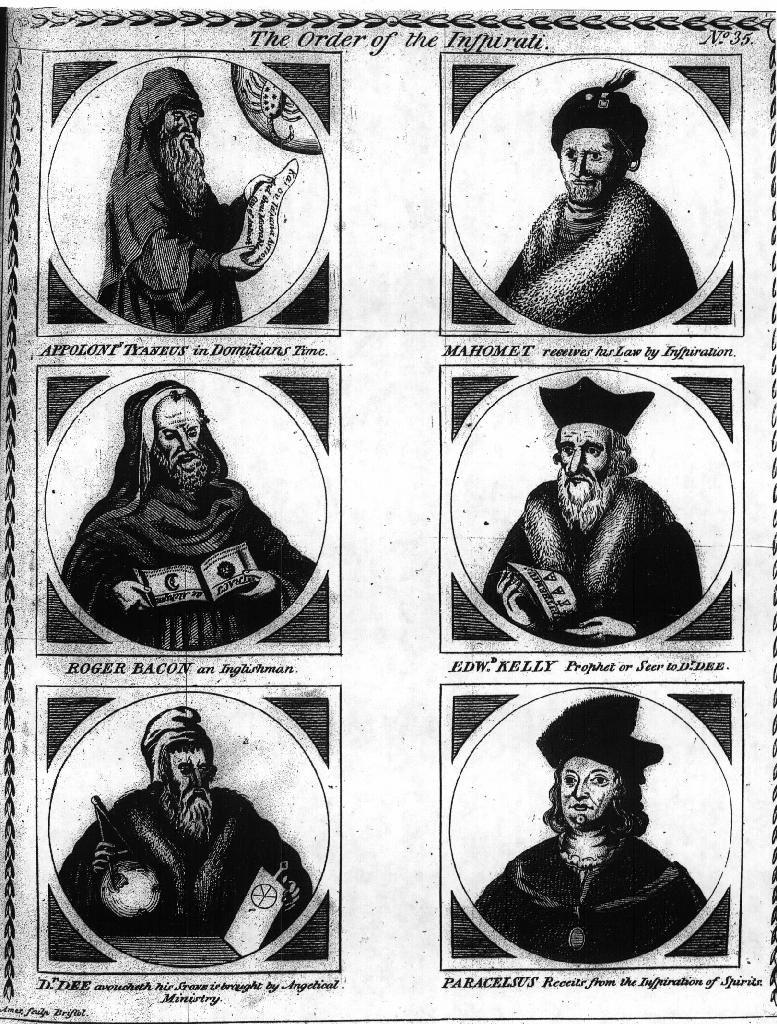
[1099]
Doctor Dee was another very extraordinary character of
the same class, and a native of this island. He was not only a
famous magician, but a great author, having written upwards of
forty-eight different volumes, the first of which was published
in 1594 [Dee's first book was actually Propaedeumata Aphoristica
(1558). See A Letter.
-JHP]. A full account of his conversation and intercourse with
spirits is now extant, written with his own hand, and esteemed
a very curious and singular performance. His company and acquaintance
was much sought by the Emperor Charles V. and by Ferdinand his
brother; and, during his travels over the continent, he had not
only every respect and attention paid him, but his company was
courted by all the learned and religious people wherever he went.
He was certainly one of the most learned men of the age in which
he lived, and had collected a library of upwards of 4,000 volumes
of curious and valuable writings, mostly upon physical, theological,
and occult, subjects, which he had the misfortune to see burnt
by the fury of a mob, who assailed his house, and conspired against
his life, under an idea that by magical spells and incantations
he had altered the natural course of the weather, and brought
on storms, hurricanes, tempests, and, continual rain, in order
to ruin the harvest, and destroy the fruits of the earth. Yet
he bore the torrent and fury of this infatuated, multitude with
the greatest composure, saying, "They would see their
error soon enough to treat him with greater kindness hereafter
than their persecution was now cruel." And so it happened;
for, having by means of his confederacy with spirits foretold
and detected a fatal conspiracy against his country, he was then
as much honoured and caressed as he had before been stigmatized
and abused by the hasty multitude. He wrote the mathematical preface
to Euclid's Elements, and has left tables of the harmony
and extent of numbers infinitely beyond the capacity of the present
times, though so much more learned and refined.
Edward Kelly was also a famous magician, and the companion and associate of Dr. Dee, in most of his magical operations and exploits; having been brought in unison with him (as the Doctor himself declares, in the preface to his work upon the ministration of spirits) by mediation of the angel Uriel. But Dr. Dee was undoubtedly deceived in his opinion, that the spirits which ministered to him were executing the divine will, and were the messengers and servants of the Deity. Throughout his writings on the subject, he evidently considers them in this light, which is still more indisputably confirmed by the piety and devotion he invariably observed at all times when these spirits had intercourse with him. And further, when he found his coadjutor Kelly was degenerating into the lowest and worst species of the magic art, for the purposes of fraud and avaricious gain, he broke off all manner of connexion with him, and [1100] would never after be seen in his company. But it is believed, that the doctor, a little before his death, became sensible that he had been imposed upon by these invisible agents, and that all their pretences of acting under the auspices of the angel Uriel, and for the honour and glory of God, was but mere hypocrisy, and the delusions of the devil. Kelly, being thus rejected and discountenanced by the doctor, betook himself to the meanest and most vile practices of the magic art; in all which pursuits, money and the works of the devil appear to have been his chief aim. Many wicked and abominable transactions are recorded of him, which were performed by witchcraft, and the mediation of infernal spirits ; but nothing more curious, or more apropos to the present subject, than what is mentioned by Weaver, in his Funeral Monuments. He there records, that Edward Kelly the magician, with one Paul Waring, who acted in capacity of companion and associate in all his conjurations, went together to the Church-yard of Walton Ledale, in the country of Lancaster, where they had information of a person being interred, who was supposed to have hidden or buried a considerable sum of money, and to have dies without disclosing to any person where it was deposited. They entered the church-yard exactly at twelve o'clock at night; and, having had the grave pointed out to them the preceding day, they exorcised the spirit of the deceased by magical spells and incantations, till it appeared before them, and not only satisfied their wicked desires and enquiries, but delivered several strange predictions concerning persons in that neighbourhood, which were literally and exactly fulfilled. It was vulgarly reported of Kelly, that he outlived the time of his compact with the devil, and was seized at midnight by some infernal spirits, who carried him off in the sight of his own wife and children, at the instant he was meditating a mischievous scheme against the minister of his parish, with whom he was greatly at enmity.
The character of Mahomet is too well known throughout all the world, as the institutor of the Turkish Alcoran, to need much comment from me in this place. It is sufficient if I only remark, that all his wonderful miracles were wrought by the aid and confederacy of familiar spirits, which he called the ministration of angels from heaven, from whence he pretended to have been sent, to perform the commands of the Deity, and to correct and reform the manners and religion of mankind. He had the peculiar address to establish this idea amongst his contemporaries, and to lay the foundation of the present faith at Constantinople, and throughout the vast extent of the Turkish territory.
Roger Bacon, was another very famous associate with familiar spirits, and performed many astonishing exploits through their means. He was born [1101] at Ilchester, in Somersetshire, where he studied philosophy, alchemy, and astrology; and wrote several learned and ingenious books, the manuscripts of which are now preserved as valuable curiosities in the British Museum. I attempted to make some interesting extracts from them, for the further amusement and information of my readers in this part of my work; but I was prevented from going on with my plan, under an idea that the information it would convey might be productive of mischievous consequences to society, by pulling too much in the power of evil-minded and vindictive men.
Paracelsus was a great cabalist, physician, astrologer, and magician, and appears to have been intimately acquainted with all the secret and occult properties of nature. He was the first we know of who ever treated upon animal magnetism; and his performances in that line were such as to astonish the world, and to draw upon him the united gratulations of the diseased and infirm. His method, notwithstanding it is so clearly laid down by himself, and demonstrated by a variety of pleasing examples in his works, has lain dormant till the present time; and now it begins again, under the successful endeavours of a few persevering individuals, to convince mankind that the secret and occult properties of nature are not yet half known or understood; nor their advantages received with that thankfulness and regard, which ought incessantly to be poured forth to the great Author of our being, for the blessings that may so easily be derived from them. This was the opinion and nearly the words of Paracelsus himself, who hath been recorded by all our biographers as a learned, judicious, and ingenious, philosopher. Yet his having been so much addicted to magical rites and ceremonies, and having had familiarity with spirits and devils, and performed so many wonderful conjurations through their means, caused him to have been ever supposed to have done by the agency of spirits what was really the true and genuine effects of nature only.
As to the particular forms, manner, method, rites, ceremonies,
consecrations, time, place, and ability, requisite to call up
and enter into compact or familiarity with spirits, it is neither
safe nor prudent, nor consistent with the well-being of society
in general, that I should dwell so extensively upon it, or give
such explanations, as to put a weapon into the hands of the blood-thirsty
or revengeful, to despite their enemies or neighbours, or to enable
those, who are prone to such dealings from idle curiosity, completely
to put in execution this species of league with the devil or his
subordinate agents; which is as strictly forbidden by the word
of God as by the laws of the land. Let it suffice, therefore,
that I only
[1102]
give such an outline of it, as may enable the
inquisitive reader sufficiently to judge of its merits, without
enabling the viciously-inclined to adopt its practice.
Magicians and conjurors, who have written upon and followed the
Black Art, contend, that it is possible to raise up and hold an
intercourse with spirits, and make them subservient to their commands,
without any absolute compact or bargain with the devil, either
for body, soul, or works; though they are ready to admit, that
such a snare is eventually intended for them, by their officiousness
upon every occasion, and they are as willing to believe that it
has induced many of its practitioners to form such a league. Many
instances indeed have been adduced in proof of this, where, at
the expiration of a certain term, the devoted wretch has been
carried off in the height of his sins and wickedness, by some
of the infernal messengers. Such is recorded to have been the
case with several in this island; such also was the case with
Lewis Gaufridi, a French priest, who, to be revenged of
some of his superiors for not promoting him to the extent of his
ambition, compacted with the devil for fourteen years power, to
commit whatever detestable works he pleased, without detection
or discovery. So likewise, a certain execrable character, who
a few centuries back over-ran this country, was at length publicly
taken off in fire -and flame, before the eyes of a vast multitude,
having covenanted for body, soul, and works. It is to be noted,
that, where a compact is formed, the devil, or familiar spirit,
is ever at hand, and ready to obey the magician's will, without
ceremony or trouble; but, where no such league or compact exists,
and the magician is desirous of bringing up or constraining
some particular spirit or ghost to appear before him, there are
many rites and ceremonies to be performed. In the first place
they are to fix upon a spot proper for such a purpose; which must
be either in a subterraneous vault, hung round with black, and
lighted by a magical torch; or else in the centre of some thick
wood or desert, or upon some extensive unfrequented plain, where
several roads meet; or amidst the ruins of ancient castles, abbies,
monasteries, &c. or amongst the rocks on the sea-shore; in
some private detached church-yard, or any other solemn melancholy
place, between the hours of twelve and one in the night, either
when the moon shines very bright, or else when the elements are
disturbed with storms of thunder, lightning, wind, and rain; for,
in these places, times, and seasons, it is contended, that spirits
can with less difficulty manifest themselves to mortal eyes, and
continue visible with the least pain, in this elemental external
world.
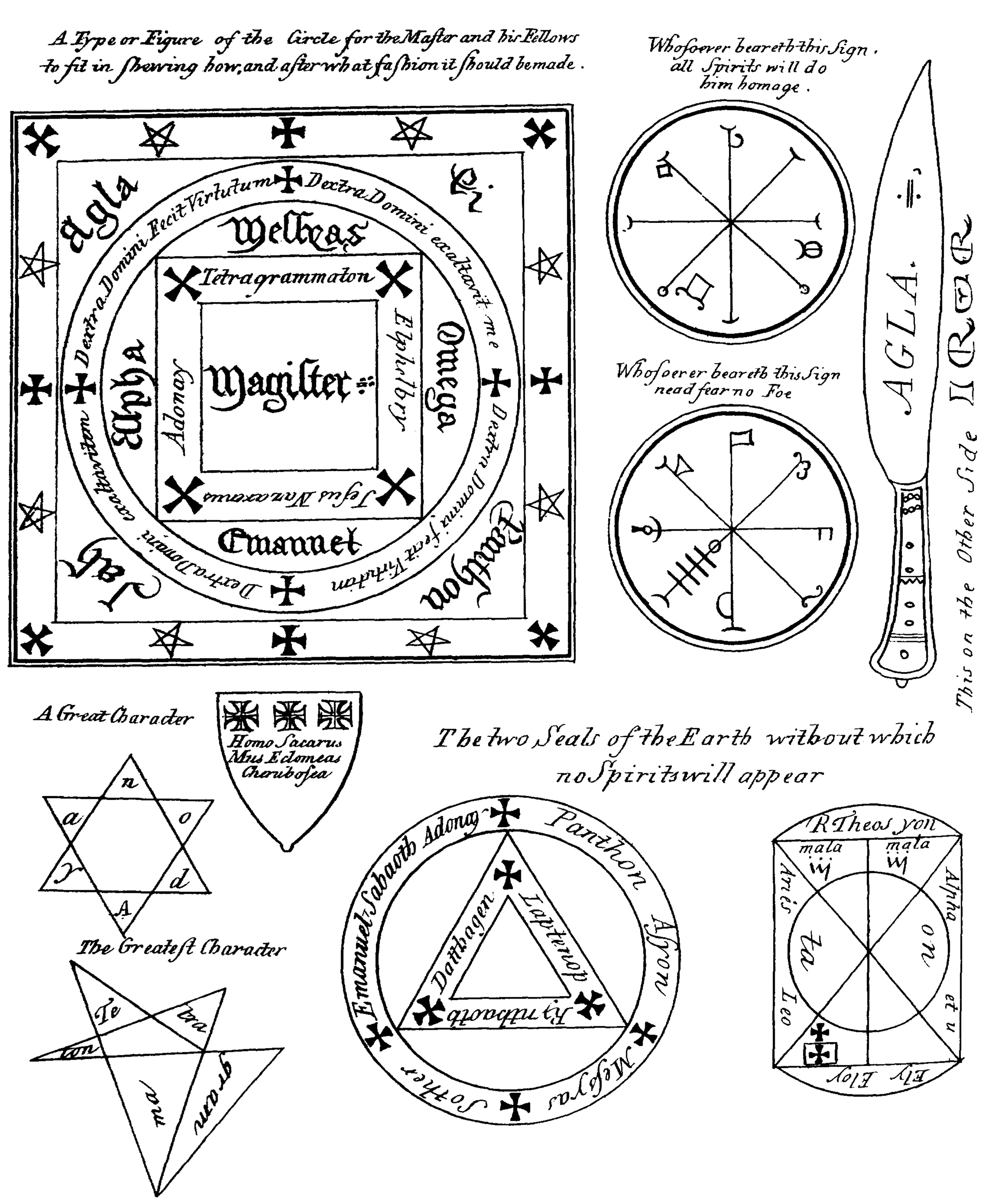
When the proper time and place is fixed on, a magic circle is to be formed, within which, the master and his associate, (for in all these [1103] cases there must be two persons) are carefully to retire. The dimensions of the circle is as follows: a piece of ground is usually chosen nine feet square, at the full extent of which parallel lines are drawn one within another, having sundry crosses and triangles described between them close to which is formed the first or outer circle; then, about half a foot within the same, a second circle is described; and within that another square correspondent to the first, the centre of which is the seat or spot where the master and associate are to be placed. The vacancies formed by the various lines and angles of the figure, are filled up with all the holy names of God, having crosses and triangles described betwixt them, agreeable to a sketch I have given in the annexed plate, where likewise I have projected the form of magic seals, pentacles, &c. &c. just to give the reader an idea of what is meant, whenever we have occasion to speak of them in the following discourse. The reasons assigned by magicians, and others for the institution and use of circles, is, that of much ground being blessed and consecrated by such holy words and ceremonies as they make use of in forming it, hath a secret force to expel all evil spirits from the bounds thereof; and, being sprinkled with pure sanctified water, the ground is purified from all uncleanness; besides, the holy names of God being written over every part of it, its force becomes so powerful, that no evil spirit hath ability to break through it, or to get at the magician or his companion, by reason of the antipathy in nature they bear to these sacred names. And the reason given for the triangles is, that if the spirit be not easily brought to speak the truth, they may by the Exorcist be conjured to enter the same, where, by virtue of the names of the Essence and Divinity of God, they can speak nothing but what is true and right. The circle therefore, according to this account of it, is the principal fort and shield of the magician, from which he is not, at the peril of his life, to depart, till he has completely dismissed the spirit, particularly if he be of a fiery or infernal nature. Instances are recorded of many who perished by this means; particularly Chiancungi, the famous Egyptian fortune-teller, who in the last century was so famous in England. He undertook for a wager, to raise up the spirit Bokim, and, having described the circle, he seated his sister Napala by him as his associate. After frequently repeating the forms of exorcism, and calling upon the spirit to appear, and nothing as yet answering his demand, they grew impatient of the business, and quitted the circle, but it cost them their lives; for they were instantaneously seized and crushed to death, by that internal spirit, who happened not to be sufficiently constrained till that moment, to manifest himself to human eyes. -- The usual form of consecrating the circle is as follows:
I, who am the servant of the Highest, do, by the virtue of his Holy Name Immanuel, sanctify unto myself the circumference of nine feet round about me, + + + from the east, Glaurah; from the west, Garron; from the north, Cabon; from the south, Berith; which ground I take for my proper defence from all malignant spirits, that they may have no power over my soul or body, nor come beyond these limitations, but answer truly, being summoned, without daring to transgress their bounds. Worrh. worrah. harcot. Gambalon. + + +.
The proper attire or pontificalibus of a magician, is an ephod made of fine white linen, over that a priestly robe of black bombazine, reaching to the ground, with the two seals of the earth, drawn correctly upon virgin parchment, and affixed to the breath of his outer vestment. Round his waste is tied a broad consecrated girdle, with the names Ya, Ya, + Aie, Aaie, + Elibra + Elohim + Sadai + Pah Adonai + tuo robore + Cinctus sum +. Upon his shoes must be written Tetragrammaton, with crosses round about; upon his head a high-crown cap of sable silk; and in his hands an holy Bible, printed or written in pure Hebrew. When all these things are prepared, the circle drawn, the ground consecrated, and the exorcist securely placed within the circle, he proceeds to call up or conjure the spirit by his proper name, under a form somewhat similar to the following:
I exorcise and conjure thee, thou spirit of (here naming the spirit), by the holy and wonderful names of the Almighty Jehovah, Athanato + Aionos + Dominus sempiternus + Aletheios + Sadai + Jehovah, Kedesh, El gabor + Deus fortissimus + Anapheraton, Amorule, Ameron +++ Panthon + Craton + Muridon + Jah, Jehovah, Elohim pentasseron + + trinus et unus + + +I exorcise and conjure, I invocate and command, thee, thou aforesaid spirit, by the power of angels and archangels, cherubim and seraphim, by the mighty Prince Coronzon, by the blood of Abel, by the righteousness of Seth, and the prayers of Noah, by the voices of thunder and dreadful day of judgment; by all these powerful and royal words abovesaid, that, without delay or malicious intent, thou do come before me here at the circumference of this consecrated circle to answer my proposals and desires, without any manner of terrible form, either of thyself or attendants; but only obediently, fairly, and with good intent, to present thyself before me, this circle being my defense, through his power who is Almighty, and hath sanctified the name of the Father, Son, and Holy Ghost. Amen.
After these forms of conjuration, and just before appearances are expected, the infernal spirits make strange and frightful noises, howlings, tremblings, flashes, and most dreadful shrieks and yells, as forerunners of [1105] their presently becoming visible. Their first appearance is generally in the form of fierce and terrible lions or tygers, vomiting forth fire, and roaring hideously about the circle; all which time the Exorcist must not suffer any tremor or dismay; for, in that case, they will gain the ascendancy, and the consequences may touch his life. On the contrary, he must summon up a share of resolution, and continue repeating all the forms of constriction and confinement, until they are drawn nearer to the influence of the triangle, when their forms will change to appearances less ferocious and frightful, and become more submissive and tractable. When the forms of conjuration have in this manner been sufficiently repeated, the spirits forsake their beastial shapes, and endow the human form, appearing like naked men of gentle countenance and behaviour. Yet is the magician to be warily on his guard that they deceive him not by such mild gestures; for they are exceedingly fraudulent and deceitful in their dealings with those who constrain them to appear without compact; having nothing in view but to suborn his mind, or accomplish his destruction. But with such as they have entered into agreement with they are frequent and officious; yet they more or less require certain oblations, which are frequently made to them, such as fumigations, odours, offerings or sacrifices of blood, fire, wine, ointments, incense, fruits, excrements, herbs, gums, minerals, and other ingredients; by which, from a magical cause, they have more influence and authority over the degenerated souls of men, and can insinuate into their inmost source and affection, piercing even through their bones and marrow, till they have so habituated them to their service, that it becomes their daily and sole delight to accomplish every villainy and abomination which the malicious and subtle instigations of Satan might purpose to lead them. So that the Exorcist must be greatly upon his guard, and when he has compleated the exorcism, and made such enquiries as he wished to obtain from the spirit, he must carefully discharge him by some form or ceremony like the following:
Because thou hast diligently answered my demands, and been ready to come at my first call, I do here licence thee to depart unto thy proper place, without injury or danger to man or beast; depart, I say, and be ever ready at my call, being duly exorcised and conjured by sacred rites of magic; I charge thee to withdraw with quiet and peace; and peace be continued betwixt me and thee, in the name of the Father, Son, and Holy Ghost. Amen.
After this ceremony is finished, the spirit will begin to depart, resuming again the shrieks and noises, with flashes of fire, sulphur, and smoke, which the magician is to endure with patience, until it is entirely gone off, [1106] and no signs whatever of such a procedure left. Then he may venture to withdraw from the circle, repeating the Lord's Prayer, after which he may take up the various utensils, and, having destroyed all traces of the circle, may return in safety to his proper home.
But if, instead of infernal or familiar spirits, the ghost or apparition of a departed person is to be exorcised, the process is materially different. The person being fixed on, whose apparition is to be brought up, the magician, with his assistant, must repair to the church-yard or tomb where the deceased was buried, exactly at midnight; as the ceremony can only be performed in the night, between the hours of twelve and one. The grave is first to be opened, or an aperture made, by which access may be had to the naked body. The magician having described the circle, and holding a magic wand in his right hand, while his companion or assistant beareth a consecrated torch, he turns himself to all the four winds, and, touching the dead body three times with the magical wand, repeats as follows:
By the virtue of the holy resurrection, and the torments of the damned, I conjure and exorcise thee, spirit of N. deceased, to answer my liege demands, being obedient unto these sacred ceremonies, on pain of everlasting torment and distress:
Then let him say,
Berald, Beroald, Balbin gab gabor agaba; arise, arise, arise, I charge and command thee.
After which forms and ceremonies, the ghost or apparition will become visible, and will answer to any questions put to it by the Exorcist.
But if it be desired to put interrogatories to the spirit of any corpse that hath hanged, drowned, or otherwise made away with itself, the conjuration must be performed while the body hangs, or on the spot where it is first found after the suicide hath been committed, and before it is touched or removed by the coroner's jury. The ceremony is as follows: the Exorcist binds upon the top of his wand a bundle of St. John's wort, or milliès perforatum, with the head of an owl; and, having repaired to the spot where the corpse lies, at twelve o'clock at night, he draws the circle, and solemnly repeats the following words:
By the mysteries of the deep, by the flames of Banal, by the power of the east, and the silence of the night, by the holy rites of Hecate, I conjure and exorcise thee, thou distressed spirit, to present thyself here, and reveal unto me the cause of thy calamity, why thou didst offer violence to thy own liege life, where thou art now in being, and where thou wilt hereafter be. He then, gently smiting [1107] the carcase nine times with the rod, he says, I conjure thee, thou spirit of this N. deceased, to answer my demands that I am to propound unto thee, as thou ever hopest for the rest of the holy ones, and ease of all thy misery; by the blood of Jesu which he shed for thy soul, I conjure and bind thee to utter unto me what I shall ask thee.
Then, cutting down the carcase from the tree, they lay his head towards the east; and, in the space that this following conjuration is repeating, they set a chaffing-dish of fire at his right hand, into which, they pour a little wine, some mastic, and gum-aromatic, and lastly, a viol full of the sweetest oil, having also a pair of bellows, and some unkindled charcoal to make the fire burn bright at the instant of the carcase's rising. The conjuration is thus:
I conjure thee, thou spirit of N. that thou do immediately, enter into thy ancient body again, and answer to my demands, by the virtue of the holy resurrection, and by the posture of the body of the Saviour of the world, I charge thee, I conjure thee, I command thee on pain of the torments and wandering, of thrice seven years, which I, by the force of sacred magic rites, have power to inflict upon thee; by thy sighs and groans, I conjure thee to utter thy voice; so help thee God and the prayers of the holy church. Amen.
Which ceremony being thrice repeated, while the fire is burning with mastic and gum-aromatic, the body will begin to rise, and at last will stand upright before the Exorcist, answering with a faint and hollow voice, the questions propounded unto it: why it destroyed itself, where its dwelling is, what its food and life is, how long it will be 'ere it enter into rest, and by what means the magician may assist it to come to rest: also, of the treasures of this world, where they are hid: moreover, it can answer very punctually of the places where ghosts reside, and how to communicate with them; teaching the nature of astral spirits and hellish beings, so far as its capacity reacheth. All which when the ghost hath fully answered, the magician ought, out of commiseration and reverence to the deceased, to use what means can possibly be used for the procuring rest unto the spirit. To which effect he must dig a grave, and filling the same half full of quick lime, and a little salt and common sulphur, put the carase naked into it; which experiment, next to the burning of the body into ashes, is of great force to quiet and end the disturbance of the astral spirit.
But in this, and in all cases where the ghosts or apparitions of deceased persons are raised up and consulted, great caution is to be observed by the [1108] magician to keep close within the circle; for, if the magician, by the constellation and position of the stars at his nativity, be in the predicament of those who follow the Black Art for iniquitous purposes, and are so distinguished by the positions of their radical figure of birth, it is very dangerous for such men to conjure any spirits without describing the circle after the form already given, and wearing up on their breast, or holding in their hand, the Pentacle of Solomon. For the ghosts of men deceased can easily effect sudden death to the magician born under such a conformation of the planets, even whilst in the act of being exorcised; and, it is yet more remarkable, that the genethliacal figures of all persons who are naturally addicted to the pursuit of magical incantations and familiarity with spirits, do almost without exception portend sudden death, or infamous termination of their existence.
![[plate: inspirati]](../gifs/sibly4f.jpg)
Such are the rites, ceremonies, and modes, by which Exorcists and Magicians obtain familiarity with spirits, and carry on a visible and palpable correspondence with the devil. But, besides. these means of working wonders, they have others of an invisible or occult property, as charms, spells, periapts, and the like, which operate both on the body and mind, by the agency of some secret power, which the patient can neither feel nor comprehend. They are of various names, forms, and qualities, according to the use for which they are intended: first, Amulets, which are moulded and engraved in the form of money or coin, under certain forms of consecration; and are hung about the neck in certain planetary hours, for the purpose of provoking to love and familiarity with some certain person desired. Secondly, Spells or Charms, consisting of various forms of words, and magical characters, written on virgin parchment, either with human blood, or ink of a particular quality, and consecrated under certain magical forms and ceremonies, to be worn as periapts to cure diseases, to drive away evil spirits, to preserve from pestilence and infection, to make the party valiant and intrepid, and for a thousand other purposes. Thirdly, Corselets, which are the ancient Danish charm, being a kind of necklaces composed of thunder-stones, upon which are engraven certain magical characters, which resist all noxious influences, and all danger from thunder and lightning. Pentacles are a fourth sort of appendix, which conjurors and magicians use, being made with five corners, corresponding to the five senses of man, with their virtue and operation inscribed upon the five corners respectively. They are composed of fine linen doubled up, and done with cerecloth between. This figure the magician holds in his hand, lifting it up from the skirt of his garment to which it is annexed, whenever spirits that are raised become stubborn and rebellious, refusing to conform to the rites [1109] and requisitions of exorcism, and offering menacing looks and actions to the magician; but, when these Pentacles are held out to the spirits, with the words Glauron, Amor, Amorula, Beor, Beorka, Beroald, Anepheraton, inscribed upon them, they become exceedingly tortured and amazed, and are more mild and tractable. There is likewise another sort of charm called Telesms, which is used by magicians when they perform any conjuration or exorcism by moon-light in the mountains or valleys; upon which occasions they usually bury them towards the north, east, west, and south, within a hundred yards of the place where the circle is described; for these Telesms have the occult power of preventing any living creature coming near them until the incantation be performed, except the spirit itself whose presence they ardently desire, and are preparing to summon before them.
But, to make fiery and infernal spirits more familiar, magicians have classed them into seven distinct orders, answerable to the nature and qualities of the seven planets; under which they respectively make offerings to them of aromatic fumigations, previous to invoking or calling them up; whereby they conceive the information or assistance required from them will be more easily and expeditiously obtained. Thus the fumigation for spirits under Saturn, are made of frankincense-tree, pepper-wort roots, storax, and galbanum; by these the spirits Marbas, Corban, Stilkon, Idas, &c and all of the first order in the astringency, are appeased and provoked, when the fumes are put upon a Tripod in the hour of Saturn according to the planetary division. For Spirits under Jupiter, they take lignum aloes, ashtree-keys, benjamin, storax, peacocks-feathers, and lapis lazuli, mixing the same with the blood of a stork, a swallow, or a hart; the brains being also added: the fumes are kindled in Jupiter's hour, and in a place appropriate to his nature. They make fumigations unto such spirits of the order of powers as are under Mars, in the planetary division, with aromatic gum, bdellium, euphorbium, load-stone, hellebore white and black, and an addition or sulphur to make them into an amalgama, with man's blood, and the blood of a black cat; which mixtures are said to be so exceeding magical, that, without any other addition, they say, this fumigation is able of itself to make spirits under Mars appear before the Exorcist. To the spirits under Sol, being of the order of thrones, they likewise suffumigate saffron, musk, laurel, cinnamon, ambergrise, cloves, myrrh, and frankincense, musk, and the balsamic tree mixed up together with the brains of an eagle, and the blood of a white cock, being made up like pills, or little balls, and put upon the Tripod. The fumigations appropriate to spirits under Venus, are roses, coral, lignum aloes, and spermaceti, made up with sparrows brains, and blood [1110] of pigeons. To those under Mercury, they fumigate frankincense, mastic, cinquefoil, incorporated with the brains of a fox and the blood of a magpye. To spirits under Luna, fumigations are offered of frogs dried, white poppy-seed, bulls eyes, camphire, and frankincense, incorporated with goose's blood and fluxus muliebris. These are the divisions of spirits under the seven planets, with their fumigations; neither can it be denied, but that, in many ceremonies of this kind, there is great inherent virtue, according to the doctrine of sympathy and antipathy, whereby every thing is drawn by its like in the idea, whether by words or actions, according to, the saying, In verbis, herbis, & lapidibus, latet virtus; so that the ceremonies and charms, with other circumstances used by magicians, are doubtless prevalent to the accomplishment of that work which they undertake; to wit, the calling up and exorcising of infernal spirits by conjurations.
And as by natural reason every magical charm or receipt had its first institution; in like manner have magicians disposed the matter and manner together with the times of their utensils and instruments, according to the principles of nature: as the hour wherein they compose their garments, must either be in the hour of Luna, or else of Saturn in the Moon's increase. Their garments they compose of white linen, black cloth, black cat-skins, wolves, bears, or swine's, skins. The linen, because of its abstracted quality for magic, delights not to have any utensils that are put to common uses. The skins of the aforesaid animals are by reason of the Saturnine and magical qualities in the particles of these beasts: their sowing thread is of silk, cat's gut, man's nerves, asses hair, thongs of skins from men, cats, bats, owls, and moles, all which are enjoined from the like magical cause. Their needles are made of hedge-hog prickles; or bones of any of the above-mentioned animals; their writing-pens are of owls or ravens, their ink of man's blood: their ointment is man's fat, blood, usnea, hog's grease, or oil of whales. Their characters are ancient Hebrew or Samaritan: their speech is Hebrew or Latin. Their paper must be of the membranes of infants, which they call virgin parchment, or of the skins of cats or kids. They compose their fires of sweet wood, oil, or rosin: and their candles of the fat or marrow of men or children: their vessels are earthern, their candlesticks with three feet, of dead men's bones: their swords are steel, without guards, the points being reversed. These are their materials, which they particularly choose from the magical qualities whereof they are composed. Neither are the peculiar shapes without a natural cause. Their caps are oval, or like pyramids with lappets on each side, and fur within; their gowns reach to the ground, being furred with white fox-skins, under which they have a linen garment reaching [1111] to their knee. Their girdles are three inches broad, and have, according to its use, many caballistical names, with crosses, trines, and circles, inscribed thereon. Their knives are dagger-fashion: and the circles by which they defend themselves are commonly nine feet in breadth, though the eastern magicians allow but seven; for both of which a natural cause is pretended, in the force and sympathy of numbers.
Such spells or charms as are compounded of some edible matter, with magical characters engraven upon them, are successfully given for agues, head-achs, epilepsy, fits of the mother, and the like; and it is remarkable that they operate with most effect on those patients who are ignorant of the charm, or its properties. There are also particular magical characters attributed to the planets, whereof Telesm, Periapts, Amulets, and Philtres, are composed by buryings under ground, writings, bindings, engravings, allegations, &c. which done in certain astrological hours are to conquer enemies, cure diseases, remove obstructions, provoke love, and preserve from evil both the body and the soul, which they contend are effected by the mediums of this kind, assisted by the force of imagination. But as for philtres, potions, love-cups, and the like, they unquestionably proceed from a natural cause, and ought not to be classed with the occult properties of charms. There are many natural, compositions of herbs and minerals, which have a surprising effect in themselves, without the least assistance from superstitious impressions, or the assistance of supernatural agency. For, in the commixture of bodies of a similar nature, there is a two-fold power and virtue; first, when the celestial properties are duly disposed in any natural substance, then under one form divers influences of superior powers are combined; and secondly, when from artificial mixtures and compositions of natural things, combined amongst themselves in a due and harmonical proportion, they agree with the quality and force of the heavens, under certain correspondent constellations. This proceeds from the occult affinity of natural things amongst themselves, by the force and sympathy of which many astonishing effects are produced.
In the writings of Paracelsus we find many surprising examples of the power of sympathy and antipathy, by means of images, telesms, and amulets, compounded of nothing more than natural ingredients. And he particularly describes an infallible method, by the image of any bird or beast, to destroy it, or to effect its death, though at a distance. So likewise, by the hair, fat, blood, excrements, or excrescences, of any animal, the diseases of that animal might be cured, and its life preserved or destroyed. This is seen in the armary unguent, and sympathetical powder; and [1112] there are multiplied instances and histories, both at home and abroad, of those who have been burnt, hanged, or otherwise punished, for the use of waxen images, which they compose in divers postures, under certain constellations, whereby the persons they are made to represent have been severely tormented, or macerated to death. For, according to the torment or punishment the magician, witch, or wizzard, may intend to inflict upon the object of their resentment, so they dispose the hour of the constellation, the quality of the compound, and the posture or semblance of the image; for, if they intend to consume and pine away the health and life of any person they are offended with, they mould his image in wax, of such an ominous form and aspect as may conduce to the extent of their design, making several magical characters upon the sides of the head, describing the characters of the planetary hour upon the breast of the image; the name of the persecuted person on its forehead; and the intended effect to be wrought upon him on its back. If they mean to produce violent pains and tortures in the flesh or sinews, they stick pins or thorns in divers places of the arms, legs, or breast, of the image. If to cast them into violent fevers and consumptions, they spend a certain hour every day to warm and turn the image before a doleful and lingering fire, composed of divers exotic gums and magical ingredients of sweet odours, and roots of particular shrubs, efficient and conducive to their purpose; and, when the whole operation has been performed, and the image is completed, it is astonishing to human comprehension what surprising effects they are capable of producing upon the body they are intended to represent; and the reader can only attain a competent idea of it, but by reading the accounts of the trials and confessions of many witches and wizzards [wizards], who suffered the law, in the last and commencement of the present century, for transactions of this kind; an incredible number of which are not only recorded in the notes and memorandums of the judges, but attested by a great variety of noblemen, gentlemen, clergy, physicians, apothecaries, and others, who have been eye-witness of these diabolical proceedings, and for which reason I shall on no account mention the most perfect and effectual part of the composition and preparation of these magical images, lest the evil-minded and malicious part of my readers should attempt to work abominable species of revenge upon the persons or property of their unsuspecting neighbours.
Thousands of other strange and uncouth inventions might be here described, according to the exact form in which tradition hath left them; but for the reason above assigned, the reader must be content with the general outline only. And, as the Europeans have the ability of effecting such astonishing things by the medium of images, telesms, periapts, &c. [1113] so the Tartars have a faculty of producing similar effects by bottles, wolves-skins, rods, basins, letters, or missives, unto certain familiar spirits, who are the agents in their magic rites. As to the old and favourite trick of witches in the last century, that of tying of the point, we have reason to hope it has long since died away; for, it is a charm which produces so strong an impediment to conjugal embraces, as totally to restrain the act of consummation betwixt married people; and the tying of this knot or ligament, under certain magical ceremonies or incantations, was so notorious, both in practice and effect, throughout England, France, Spain, Italy, and the eastern countries, that laws were enacted by the legislature in each of those kingdoms expressly to prohibit the performance of it, on pain of death. The form and manner of it is in part mentioned in the statutes, though by no means fit to be openly described here. The art of Transplantation is also reckoned amongst charms and sygils; and indeed, one part of it, viz. the transferring of diseases, is really magical, and was much in practice amongst witches and wizzards; and, I am confidently informed, is now frequently done in the more remote and unpolished parts of this island. The method is, by giving certain baits or preparations to any domestic animal, they remove fevers, agues, coughs, consumptions asthmas, &c. from any person, applying to them, for that purpose; or, they can transplant or remove them from one person to another, by burying certain images in their ground, or against their houses, with certain ominous inscriptions and Hebrew words; yet, though these things are supposed to be done by magic, yet the effects are derived more from the sympathies and antipathies in nature than from magical characters and conjurations; for many persons, without knowing any thing of the cause, how or why it is effected, more than the external form of words or touch, which is most simple, can remove diseases, take off warts and other excrescences, and perform many surprising cures at a distance from the patient, and even without seeing or knowing him; so, by a similar property in the sympathy and antipathy of nature, certain leaves, roots, or juices, rubbed upon warts, or carnuous substances, or upon the hands, breast, legs, or other diseased part of the body, and buried under ground, remove or cure the same; which experiments take effect according to the mediums, and their consumption and putrefaction in the mother earth, of which the human source is principally compounded. Nor is it to be wondered that natural things, being fitted to the times and constellations, and compounded of correspondent or sympathetic ingredients, should produce such effects without supernatural aid, or the agency of spirits. This is perfectly exemplified in that extraordinary preparation, called a magical candle, which, being lighted, foretels the death of the party of whose blood it was prepared. It is compounded after the following [1114] manner: they take a good: quantity of the venal blood luke-warm as it came out of the vein, which, being chemically prepared with spirits of wine and other ingredients, is at last made up into a candle, which, being once kindled, never goes out till the death of the party whose blood it is composed of; for, when he is sick, or in danger, it burns dim and troubled; and, when he is dead, it is quite extinguished; of which composition a learned philosopher hath written an entire tract, viz. De Biolychnio, or, the Lamp of Life.
In the simple operations of nature many wonderful things are wrought, which, upon a superficial view appear impossible, or else to be the work of the devil. These certainly ought to be considered in a far different light from magical performances, and should be classed among the surprising phænomenæ of nature. Thus lamps or torches made of serpents skins, and compounded of the fat and spirit of vipers, when lighted in a dark room, will, bring the similitude of snakes or serpents writhing and twisting upon the walls. So oil compounded of grapes, being put into a lamp, and lighted, will make the room appear to be full of grapes, though in reality it is nothing more than the idea or similitude. -- The same thing is to be done with all the plants and flowers throughout the vegetable system, by means of a chemical analysis, whereby a simple spirit is produced, which will represent the herb or flower from which it is extracted, in full bloom. And, as the process is easy, simple, pleasing, and curious, I will here state it in such a manner as might enable any person to put it in practice at pleasure.
Take any whole herb, or flower, with its root, make it very clean, and bruise it in a stone mortar quite small; then put it into a glass vessel hermetically sealed; but be sure the vessel be two parts in three empty: then place it for putrefaction in a gentle heat in balneo, not more than blood warm, for six months, by which it will be all resolved into water. Take this water, and pour it into a glass retort, and place a receiver thereunto, the joints of which must be well closed; distil it in a sand heat until there comes forth a water and an oil; and in the upper part of the vessel will hang a volatile salt. Separate the oil from the water, and keep it by itself, but with the water purify the volatile salt by dissolving, filtering, and coagulating. When the salt is thus purified, imbibe with it the said oil, until it is well combined. Then digest them well together for a month in a vessel hermetically sealed; and by this means will be obtained a most subtil essence, which, being held over a gentle heat of a candle, the spirit will fly up into the glass where it is confined, and represent the perfect idea or similitude of that vegetable whereof it [1115] is the essence: and in this manner will that thin substance, which is like impalpable ashes or salt, send forth from the bottom of the glass the manifest form of whatever herb it is the menstruum, in perfect vegetation, growing by little and little, and putting on so fully the form of stalks, leaves, and flowers, in full and perfect appearance, that anyone would believe the same to be natural and corporeal: though at the same time it is nothing more than the spiritual idea endued with a spiritual essence. This shadowed figure as soon as the vessel is taken from the heat or candle returns to its caput mortuum, or ashes again, and vanishes away like an apparition, becoming a chaos or confused matter. For more on the medicinal virtues of decoction of salt, or essence of herbs, flowers, roots, of seeds, see my new edition of Culpepper's Complete Herbal, just published, with notes, additions, and illustrations, in quarto, with upwards of 400 elegant engravings of British herbs, plants, and flowers, coloured to nature.
To make a vegetable more quickly yield its spirit, take of what vegetable you please, whether it be the feed, flowers, roots, fruit, or leaves, cut or bruise them small, put them into warm water, put upon them yeast or barm, and cover them up warm, and let them work three days, in the same manner as beer; then distil them, and they will yield their spirit very easily. Or else take of what herbs, flowers, seeds, &c. you please; fill the head of a still therewith, then cover the mouth with coarse canvas, and set on the still, having first put into it a proportionable quantity of sack or low wine; then give it fire, and it will quickly yield its spirit; but observe, that, if the colour of the vegetable is wanted, you must take some of its dried flowers, and fill the nose of the still therewith, and you will have the exact colour of the herb.
To elucidate this process with better effect, I have subjoined a plate of the elaboratory, where a person is in the act of producing these flowery apparitions, in which fig. 1. represents a stone pestle and mortar, wherein the herbs, &c. are to be bruised before they are placed for putrefaction. Fig. 2, 2. are glass vessels hermetically sealed, containing the bruised herbs for putrefaction. Fig. 3. an empty glass retort. Fig. 4. a retort filled with the essence of an herb, and put into a sand heat for distillation. Fig. 5. a glass receiver joined to the retort, to receive the oil and spirit. Fig. 6. a stool on which rests the receiver. Fig. 7. the furnance made with different conveniences either for sand heat, or balnea. Fig. 8. the furnace holes wherein the fire is placed. Fig. 9. a table whereon are placed the glass vessels hermetically sealed. Fig. 10. a vessel containing the representation or similitude of a pink in full bloom.
[1116]
Fig. 11. the representation of a sprig of rosemary. Fig. 12. the
representation of a sprig of baum. Fig. 13. a candlestick with
a candle lighted for the purpose of heating the spirit. Fig. 14.
a chemist in the act of holding the glass vessel over the lighted
candle, whereby fig. 15. represents the idea of a rose in full
bloom.
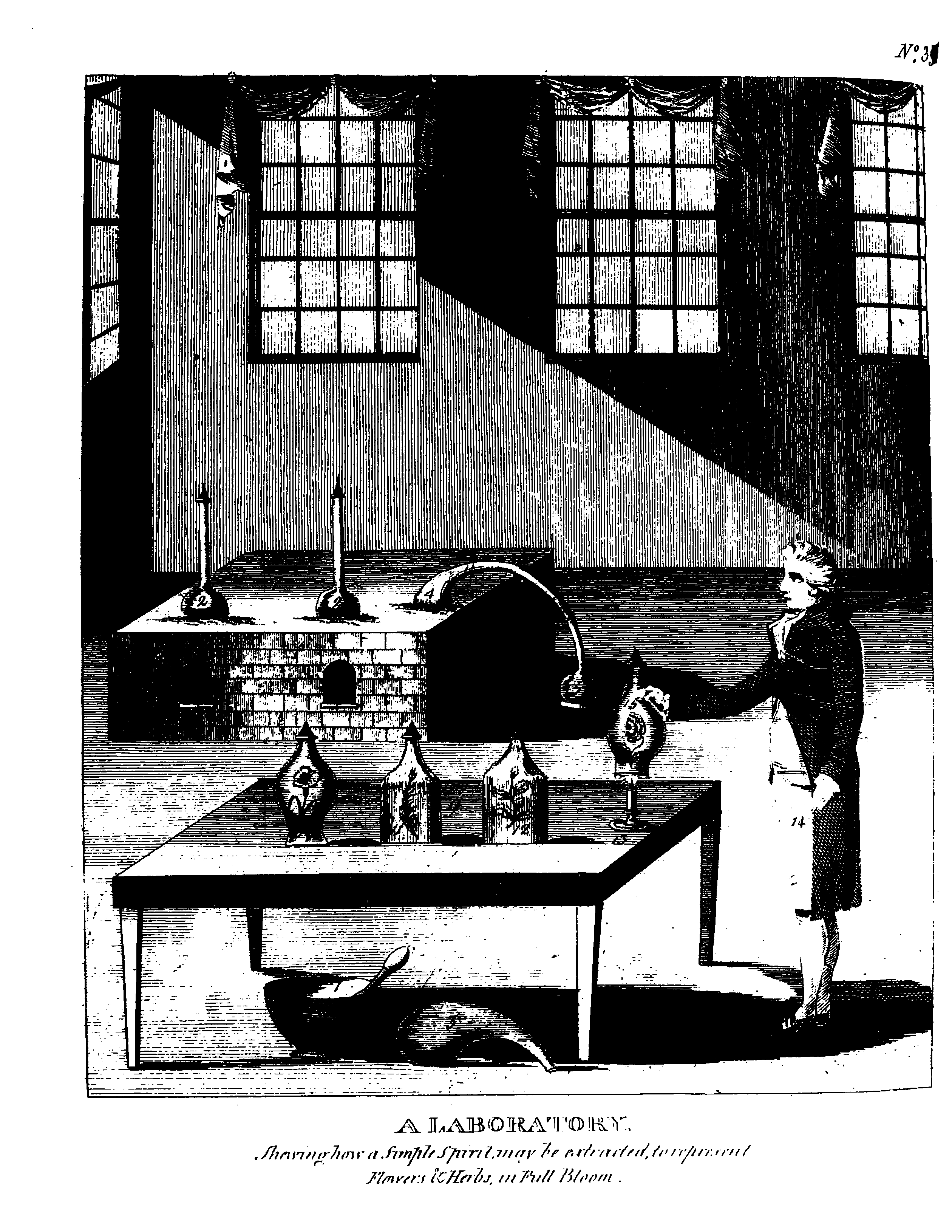
Now this effect, though very surprising, will not appear so much a subject of our astonishment, if we do but consider the wonderful power of sympathy, which exists throughout the whole system of nature, where everything is excited to beget or love its like, and is drawn after it, as the loadstone draws iron; the male after the female; the evil after the evil; the good after the good; which is also seen in wicked men and their pursuits, and in birds and beasts of prey; where the lamb delights not with the lion, nor the sheep in the society of the wolf; neither doth men, whose minds are totally depraved and estranged from God, care to adopt the opposite qualities, which are virtuous, innocent, and just. Without contemplating these principles, we should think it incredible that the grunting or squeaking of a little pig, or the sight of a simple sheep, should terrify a mighty elephant! and yet by that means the Romans put to flight Pyrrhus and all his host. One would hardly suppose that the crowing of a cock, or the sight of his comb, would abash a puissant lion; but experience has proved the truth of it to all the world. Who would imagine that a poisonous serpent could not live under the shade of an ash-tree; or that some men, neither deficient in courage, strength, or constitution, should not be able to endure the sight of a cat? and yet these things are seen and known to be so, by frequent observation and experience. The friendly intercourse betwixt a fox and a serpent is almost incredible; and how fond and loving the lizard is to man we read in every treatise on natural history; which is not far, if any thing, behind the fidelity of a spaniel, and many other species of dogs, whose sagacity and attention to their master is celebrated in an infinite variety of well-founded though incredible stories. The amity betwixt a castrel and a pigeon is remarked by many authors; particularly how furiously the castrel will defend a pigeon from the sparrow-hawk, and other inimical birds. In the vegetable system, the operation and virtue of herbs is at once a subject of admiration and gratitude, and which it were almost endless to repeat*.
* For the wonderful virtues and properties of herbs and plants, with their alimentary and medicinal qualities; and how to prevent or cure all diseases incident to the human body, at the least expense, and at the greatest certainty, see also my new edition of Culpeper's British Herbal, and Domestic Physician.
There is among them such natural accord and [1117] discord, that some will prosper more luxuriantly in another's company; while some, again, will droop and die away, being planted near each other. The lily and the rose rejoice by each other's side; whilst the flag and the fern abhor one another, and will not live together. The cucumber loveth water, but hateth oil; and fruits will neither ripen nor grow in aspects that are inimical to them. In stones likewise, in minerals, and in earth or mould, the same sympathies and antipathies are preserved. Animated nature, in every clime, in every corner of the globe, is also pregnant with similar qualities; and that in a most wonderful and admirable degree. Thus we find that one particular bone taken out of a carp's head will stop an hemorrhage of blood, when no other part or thing in the same creature hath any similar effect. The bone also in a hare's foot instantly mitigates the most excruciating tortures of the cramp; yet no other bone nor part of that animal can do the like. I might also recite infinite properties with which it has pleased God to endue the form and body of man, which are no less worthy of admiration, and fit for this place, had we but limits to recount them. Indeed I do not know a much more remarkable thing, (were it as rare as it is now shamefully prevalent,) or that would more puzzle our senses, than the effects of intoxication, by which we see a man so totally overthrown, that not a single part or member of his body can perform its function or office, and his understanding, memory, and judgment, so arrested or depraved, that in every thing, except the shape, he becomes a very beast! But we find, from observation, that however important, however wonderful, how inexplicable or miraculous, soever any thing may be; yet if it is common, or familiar to our senses, the wonder ceases, and our enquiries end. And hence it is, that we look not with half the admiration upon the sun, moon, and stars, that we do upon the mechanism of a globe, which does but counterfeit their order, and is a mere bauble, the work of men's hands! whence I might almost be justified in remarking, that, if Christ himself had continued long in the habit of working miracles, and had left that power permanent and hereditary in the church, they would have long since grown into contempt, and not have been regarded as events worthy of our attention.
From what has been premised, we may readily conclude that there are two distinct species of magic; one whereof, being inherent in the occult properties of nature, is called natural magic; and the other, being obnoxious and contrary to nature, is termed infernal magic, because it is accomplished by infernal agency or compact with the devil. Each of these we will consider separately, with the good and evil consequences likely; to result from them.
[1118]
Under the veil of natural magic, it hath pleased the Almighty
to conceal many valuable and excellent gifts, which common people
either think miraculous, or next to impossible. And yet in truth,
natural magic is nothing more than the workmanship of nature,
made manifest by art; for, in tillage, as nature produceth corn
and herbs, so art, being nature's handmaid, prepareth and helpeth
it forward; in which times and seasons are materially to be considered;
for annus, non arvus, producit aristas. And, though these
things, while they lie hid in nature, do many of them seem impossible
and miraculous, yet, when they are known, and the simplicity revealed,
our difficulty of apprehension ceases, and the wonder is at an
end; for that only is wonderful to the beholder whereof he can
conceive no cause nor reason, according to the saying of Ephesius,
miraculum solvitur unde videtur esse miraculum; yet we
often see persons take great pains, and put themselves to vast
expence, to discover these impalpable tracks of nature, from whence
pecuniary advantages seldom result; so that a man must not learn
philosophy to grow rich; but must get riches to learn philosophy.
There is unquestionably much praise due, and great industry required,
for obtaining a competent knowledge of natural magic; for to sluggards,
niggards, and narrow-minded men, the secrets of nature are never
opened, though the study of them is certainly conducive to the
glory of God, and to the good of society, by more visibly manifesting
the omnipotency of his works, and by skilfully applying them to
mans use and benefit. Many philosophers of the first eminence,
as Plato, Pythagoras, Empedocles, Democritus, &c. travelled
through every region of the known world for the accomplishment
of this kind of knowledge; and, at their return, they publicly
preached and taught it. But above all, we learn from sacred and
profane history, that Solomon was the greatest proficient in this
art of any either before or since his time; as he himself hath
declared in Ecclesiastes and the Book of Wisdom, where he saith,
"God hath given me the true science of things, so as to know how the world was made, and the power of the elements, the beginning, and the end, and the midst of times, the change of seasons, the courses of the year, and the situation of the stars, the nature of human beings, and the quality of beasts, the power of winds, and the imaginations of the mind; the diversities of plants, the virtues of roots, and all things whatsoever, whether secret or known, manifest or invisible."
And hence it was that the magi, or followers of natural magic, were accounted wise, and the study honourable; because it consists in nothing more than the most profound and perfect part of natural philosophy, which defines the nature, causes, and effects, of things.
[1119]
How far such inventions as are called charms, amulets, periapts,
and the like, have any foundation in natural magic, may be worth
our enquiry; because, if cures are to be effected through their
medium, and that without any thing derogatory to the attributes
of the Deity, or the principles of religion, I see no reason why
they should be rejected with that inexorable contempt which levels
the works of God with the folly and weakness of men. Not that
I would encourage superstition, or become an advocate for a ferrago
of absurdities; but, when the simplicity of natural things, and
their effects, are rejected merely to encourage professional artifice
and emolument, it is prudent for us to distinguish between the
extremes of bigoted superstition and total unbelief.
It was the opinion of many eminent physicians, of the first ability and learning, that such kind of charms or periapts as consisted of certain odoriferous herbs, balsamic roots, mineral concretions, and metallic substances, might have, and most probably possessed, by means of their strong medicinal properties, the virtue of curing or removing such complaints as external applications might effect. and which are often used with success, though without the least surprise or admiration; because the one appears in a great measure to be the consequence of manual operation, which is perceptible and visible to the senses, whilst the other acts by an innate or occult power, which the eye cannot see, nor the mind so readily comprehend; yet, in both cases, perhaps, the effect is produced by a similar cause; and consequently all such remedies, let them be applied under what form or stile they may, are worthy of our regard, and ought to excite in us not only a veneration for the simple practice of the ancients in their medical experiments, but a due sense of gratitude to the wise Author of our being, who enables us, by such easy means, to remove the infirmities incident to mankind. Many reputable authors, particularly A. Ferrarius, Alexander Trallianus, Ætius, Octavianus, Marcellus, Philodotus, Archigines, Philostratus, Pliny, and Dioscorides, contend that not only such physical alligations, appensions, periapts, amulets, charms, &c. which, from their materials appear to imbibe and to diffuse the medical properties above described, ought in certain obstinate and equivocal disorders to be applied, but those likewise which from their external form and composition have no such inherent virtues to recommend them; for harm they can do none, and good they might do, either by accident or through the force of imagination. And it is asserted, with very great truth, that through the medium of hope and fear, sufficiently impressed upon the mind or imagination, whether by charms, or any other Homerical contrivance or device, the most wonderful and instantaneous cures are sometimes wrought. They are called [1120] Homerical devices, or Homerica medicatio, because Homer was the first who discovered the blood to be suppressed, or its motion accelerated, by the force of imagination; and, that diseases were to be removed or terminated thereby. Of the truth of this we have the strongest and most infallible evidence in the hiccough, which is instantaneously cured by any sudden effect of fear or surprise; so likewise agues and many other maladies are removed; and to the same cause we might attribute the only certain cure known for the bite of a mad dog, which is the effect of fear and stagnation wrought upon the mass of blood by emerging the body in the sea. Nor are the instances few, where persons lying bed-ridden, and unable to move either hand or foot, have, through the sudden fright of fire, or the house falling in upon them, forgot their infirmity, and run away with as much activity as though no such malady had existed. Seeing, therefore, that such virtues lie hid in the occult properties of nature, united with the sense or imagination of man, where one is the agent, and the other the patient; where the one is active, and the other passive, without any compact with spirits, or dealings with the devil; we surely ought to receive them into our practice, and to adopt them as often as occasion seriously requires, although professional emolument and pecuniary advantage might in some instances be narrowed by it.
But, though I might be an advocate for such charms or occult remedies
as are in themselves perfectly innocent and simple, I by no means
wish to be understood, that I either approve or recommend any
thing bordering upon such inventions as are obviously founded
in magical confederacy, and act by the medium of aerial or infernal
spirits. To that mind, which has but slightly contemplated the
works of nature, it must be abundantly evident, that the great
and good God, which sustains and governs the universe, hath in
the works of creation mercifully afforded us a natural remedy
for all our infirmities; and it is repugnant to common sense,
and incompatible with religion and morality, nay, it would imply
a deficiency either in the goodness or power of the Deity, were
we for a moment to admit the necessity of charms, amulets, or
any other inventive cures or benefits to men, resulting from a
compact with spirits, in which all the powers and performances
of witchcraft had their beginning; and therefore we may without
the smallest hesitation, conclude that whatever hath its foundation
in such confederacy, let the external object or pretence be what
it may, it is not only contrary to nature, but highly offensive
to the Deity, and nearly allied to the shocking sin of idolatry,
by applying the works of God to the power of the devil. For this
reason, it is impossible to be too cautious how the use of such
description of charms or lamins are adopted
[1121]
where (instead
of natural medicaments) magical characters, incantations, and
nocturnal ceremonies, constitute the component parts. A very wise
and learned author, who has written largely upon this subject,
asserts, that in those very charms and signatures compacts themselves
are virtually contained, which evil spirits at first subtilly
devised or invented to blind men's eyes, that thereby they might
lead them less scrupulously into the snares of the devil. And
hence we have good ground to believe, that none are able absolutely,
and bona fide, to call up any spirits, without some such compact
first formed; and, that whosoever has so far ventured in the art
of magic or conjuration, hath, though to himself, perhaps, unknown,
compacted with and worshipped the devil, under some such form
of mystical words and characters, wherewith infernal charms and
amulets are composed; neither is it to be thought a matter of
surprise, that such a compact should unwittingly be made through
the medium of those mystical characters, which, with the devil's
aid, have in themselves a power to enchant, infect, allure, preserve,
or destroy. And, to shew in striking colours the danger of being
drawn away by such allurements, I shall instance the extraordinary
case of a very harmless and well-meaning young man, which was
published to the world at the commencement of the present century,
by the Bishop of Gloucester, in the following well-authenticated
letter to that prelate.
| MY LORD, | Bristol, August 2d, 1703. |
Being informed by Mr. Shute of your Lordship's desire that I should communicate to you what I had known concerning a certain person who was acquainted with spirits to his own destruction, I have made bold to give you the trouble of this letter, hoping my desire to gratify your lordship in every particular may be an apology for the length thereof. I had formerly given an account to the late Bishop of Hereford, in which there are probably some things contained, which I do not now remember, which, if your lordship could procure from his lady, (who now lives near Gloucester,) would be more, authentic.
About thirteen years ago, whilst I was a curate to Dr. Read, rector of St. Nicholas in this city, I began to be acquainted with one Thomas Perks, a man about twenty years of age, who lived with his father at Mongatsfield, a gunsmith; and contracted an intimacy with him, he being not only a very good-natured man, but extremely skilled in mathematical studies, which were his constant delight, viz. arithmetic, geometry, [1122] gauging, surveying, astronomy, and algebra; he had a notion of the perpetual motion much like that wheel in Archimedes's Mathematical Magic, in which he had made some improvements, and which he has held was demonstrable from mathematical principles, though I could never believe it. I have seen an iron wheel, to which he intended to add several things of his own invention, in order to finish the same; but, thinking it of no use, and being otherwise unfortunately engaged, it was never perfected. He gave himself so much to astronomy, that he could not only calculate the motions of the planets, but an eclipse also, and demonstrate any problem in spherical trigonometry from mathematical principles, in which he discovered a clear force of reason. When one Mr. Bayley, minister of St. James's in this city, endeavoured to set up a mathematical school, I advised him to this Thomas Perks, for an acquaintance, in whom, as he told me, he found a greater proficiency in those studies than he expected or could have imagined. After this he applied himself to astrology, and would sometimes calculate nativities and resolve horary questions. When, by providence of God, I was settled in Temple parish, and not having seen him for some time, he came to me, and, we being in private, he asked my opinion very seriously concerning the lawfulness of conversing with spirits; and, after I had given my thoughts in the negative, and confirmed them with the best reason I could, he told me, he had considered all these arguments, and believed they only related to conjurations, but there was an innocent society with them which a man might use, if he made no compacts with them, did no harm by their means, and were not curious in prying into hidden things, and that he himself had discoursed with them, and heard them sing to his great satisfaction; and gave an offer to me and Mr. Bayley at another time, that, if we would go with him one night to Kingswood, we should see them and hear them both talk and sing, and talk with them whenever we had a mind, and we should return very safe; but neither of us had the courage to venture. I told him the subtility of the devil to delude mankind, and to transform himself into an angel of light; but he would not believe it was the devil. I had severa1 conferences with him upon this subject, but could never convince him; in all which I could never observe the least disorder of mind, his discourse being very rational, and I proposed (to try him) a question in astronomy relating projection of the spheres, which he projected and resolved, and did afterwards demonstrate from the mathematics, so as to demonstrate at the same time that his brain was free from the least tincture of madness and distraction. -- Having this opportunity of asking him several particulars, concerning the methods he used, and the discourses he had with them, he told me had a book whose directions he followed, and accordingly, [1123] in the dead time of the night, he went out to a cross way, with a lanthorn and candle consecrated for this purpose with several incantations. He had also consecrated chalk, consisting of several mixtures, with which he made a circle at what distance he thought fit, within which no spirit had power to enter. After this he invoked the spirit by several forms of words, (some of which he told me were taken out of the holy Scriptures, and therefore he thought them lawful, without considering how they might be wrested to his destruction;) accordingly the spirits appeared to him which he called for, in the shape of little maidens, about a foot and a half high, and played about a circle. At first he was somewhat affrighted, but, after some small acquaintance, this antipathy in nature wore off, and he became pleased with their company. He told me they spoke with a very shrill voice, like an ancient woman: he asked them if there was a heaven or hell; they said there was. He asked them what place heaven was, which they described as a place of great glory and happiness; and he asked them what hell was, and they bade him ask no questions of that nature, for it was a dreadful thing to relate, and the devils believe and tremble. He farther asked them what method or order they had among themselves; they told him they were divided into three orders; that they had a chief whose residence was in the air; that he had several counsellors which were placed by him in form of a globe, and he in the centre, which was the chiefest order; another order was employed in going to and from thence to the earth, to carry intelligence from those lower spirits; and their own order was on the earth, according to the directions they should receive from those in the air.
This description was very surprising, but, being contrary to the account we have in scripture of the hierarchy of the blessed angels, made me conclude they were devils, but I could not convince him of it. He told me he had bade them sing, and they went to some distance behind a bush, from whence he could hear a perfect concert of such exquisite music as he never before heard; and in the upper part he heard something very harsh and shrill like a reed, but as it was managed, did give a particular grace to the rest.
About a quarter of a year after he came again to me, and wished he had taken my advice, for he thought he had done that which would cost him his life, and which he did heartily repent of; and indeed his eyes and countenance shewed a great alteration. I asked him what he had done; He told me that, being bewitched to his acquaintance, he resolved to proceed farther in this art, and to have some familiar spirit at his command, according to the directions of his book, which were as follows:--
[1124]
He was to have a book made of virgin parchment consecrated with
several incantations, likewise a particular ink-horn, ink, &c.
for his purpose; with these he was to go out as usual to a cross
way, and call up a spirit, and ask him his name, which he was
to put in the first page of his book, and this was to be his familiar.
Thus he was to do by as many as he pleased, writing their names
in distinct pages, only one in a leaf, and then, whenever he took
the book and opened it, the spirit whose name appeared should
appear also; and putting this in practice, the familiar he had
was called Malchi, (be my king,) a word in Hebrew of an unknown
signification. After this they appeared faster than he desired,
and in most dismal shapes, like serpents, lions, bears, &c.
hissing at him, and attempting to throw spears and balls of fire,
which did very much affright him, and the more when he found it
not in his power to stay them, insomuch that his hair (as he told
me) stood upright, and he expected every moment to be torn in
pieces; this happened in December about midnight, when he continued
there in a sweat till break of day, and then they left him, and
from that time he was never well as long as he lived. In his sickness
he came frequently to Bristol, to consult with Mr. Jacob, an apothecary
in Broad-street, concerning a cure, but I know not whether he
told him the origin of his sickness or not; he also came to me
at the same time, and owned every matter of fact, until the last,
and insisted that, when he did any thing of this nature, he was
deluded in his conscience to think it lawful, but he was since
convinced to the contrary. He declared he made no compacts with
any of those spirits, and never did any harm by their means, nor
ever pryed into the future fortune of himself or others, and expressed
a hearty repentance and detestation of his sins; so that, though
those methods cost him his life in this world, yet I have great
reason to believe him happy in the other. I am not certain that
he gave this account to any other person but myself, though he
communicated something of it to Mr. Bayley, minister of St. James's,
in this city; perhaps your Lordship may be further informed by
his relations and neighbours of Mangotsfield, which lies in Gloucestershire,
not above a mile out of the road to Bath.
I have frequently told this story, but never mentioned his name before, and therefore, if your Lordship hath any design of printing such accounts as these, I desire it may be with such tenderness to his memory as he deserved, and so as may not be the least prejudice to his relations, who have the deserved character of honest and sober people. I am
| Your Lordships dutiful | |
| Son and servant, | |
| ARTHUR BEDFORD. |
[1125]
This poor deluded young man, it is very apparent, had no evil
design, but entered into this infernal association for no other
motive than to gratify an idle curiosity; the consequence of which
was, that he underwent the most undescribable terror and fright,
which at first deprived him of his health, and eventually of his
life. I have no doubt but the circumstance of disbelieving the
existence of spirits, (which I apprehend is more or less the case
with most people), was the first, if not the only, inducement
that urged him to make the experiment. There are many instances
of a similar kind, equally well founded, and as fatal in their
consequences, which might be here adduced, to shew the dreadful
effects of being led away by a presumptuous or hardened mind,
to disbelieve the word of God revealed in a thousand passages
of scripture, where this infernal intercourse is seriously forbidden;
but I sincerely hope, and have reason to believe, that this example
will operate as a sufficient bar against all similar enquiries,
where it is once read, and the melancholy consequences duly considered.
Wherefore let me entreat all my readers to stifle every inordinate
desire, which might unguardedly prompt them to solicit an intercourse
with such dangerous company; nor to attempt the conjuration of
spirits of any description or order; no, not even out of joke
or bravado, or for fun or frolic; for the devils are continually
going about "seeking whom they may devour;" they
are ever on the watch, and ready at hand to catch at every thought
that might be turned to their purpose; and, when they have once
so far succeeded as to occupy the smallest place in the mind,
I fear it will prove no easy talk to dispossess them.
Let it ever be remembered, that the first assaults of wicked spirits
are usually made upon our sensual desires, whereby they insinuate
themselves into our very appetites, enticing our inclinations,
and depraving the moral faculties of the mind; until they become,
as it were, incorporated with our nature, leading us insensibly
from folly to vice, until a depravity of heart, and an obstinate
will, betrays us into a corporal as well as spiritual compact
with the devil. These considerations, seconded by an anxious wish
to rescue the astral science from the imputation of magical and
diabolical connexion, and which, I trust, I have fully and effectually
accomplished, were the grand inducements that led me to explore
the spiritual and infernal kingdoms, and to expose the iniquity,
as well as to explain the theory, of familiarity or compact with
them. And in doing this, I have scrupulously avoided giving the
essential forms and particular consecrations adapted to mystical
performances, lest the unwary speculator might carry his experiments
too far, and, as in the example before us, unwittingly seek his
own destruction. Yet I have, as far as
[1126]
safety or conveniency
would permit, explained the speculative part; reserving only those
especial forms and incantations, which, being not only very facil,
but of wonderful occult power, would be dangerous to disclose;
and at best could only serve to strengthen the hands of the malicious
and evil-minded, or to extend more widely the infernal empire;
against which we ought to put on "the whole armour of
God; for we wrestle not against flesh and blood, but against principalities
and powers; for which cause we should resolutely withstand the
assaults of the devil, our loins being girt about with verity,
and having on the breast-plate of righteousness." Nor
let us vainly seek to know the mysteries of the other world, farther
than it hath pleased God to reveal them to us by his divine word;
for infiniti ad finitum nulla est proportio; necque loci potest
circumscribi -- of that which is finite, to that which is
infinite, there is no proportion; neither can that which is immeasurable
be contained within the limits of space, or be defined by human
comprehension!
  Shelfmark:   8634.k.4.
  Author:      SIBLY   Ebenezer
  Title:       A New and Complete Illustration of the Occult Sciences:
               or the Art of foretelling future events and
               contingencies, by the aspects, positions, and influences,
               of the heavenly bodies, etc. (New edition.) [With plates,
               including a portrait.]
  Publisher:   pp. 1126. Printed for the Author; sold by Champante &
               Whitrow, and at the British Directory-Office: London,
               [1795?] 4o.