PROPOSITION CXXXVI.
Every God who is more universal and ranks nearer to the First, is participated by a more universal genus of beings. But the God who is more partial and more remote from the First, is participated by a more partial genus of beings. And as being is related to being, so is unity to divine unity.57
For if there are as many beings as there are unities, and vice versa, and one unity is participated by one being, it is evident that the order of beings proceeds according to the order of the unities, being assimilated to the order prior to beings: and more universal beings are connascent with more universal unities, but more partial beings with more partial unities. For if this were not the case, again similars would be conjoined with dissimilars, and there would not be a distribution according to worth. These things, however, are impossible: since from the divine unities the one and appropriate measure shines forth, and proceeds from them to all other natures. Much more, therefore, will there be an order of participation in these, similars depending on similars, according to power.
PROPOSITION CXXXVII.
Every unity with the one constitutes the being which participates of it.
For The One, since it constitutes all things, so likewise it is the cause of the unities which are participated, and of the beings which depend on these unities. But the unity of every being produces the peculiarity which shines forth in that particular being. And The One indeed is the cause of being simply; but unity is the [103] cause of alliance, because it is connascent with The One. Hence unity is that which of itself defines the being which participates of it, and essentially exhibits in itself a superessential peculiarity or characteristic. For everywhere, from that which is primary that which is secondary is that which it is. If, therefore, there is a certain superessential peculiarity of deity, this likewise belongs to the being which participates of it essentially.
PROPOSITION CXXXVIII.
Of all the deified natures which participate of the divine peculiarity, the first and highest is Being itself.
For if being is beyond intellect and life, as has been
demonstrated, and if it is likewise after The One the
cause of the greatest number of effects, being will be the
highest deified nature. For it is more unical than life and
intellect, and is on this account entirely more venerable.
But there is no other prior to it except The One. For prior
to unical multitude what else can there be than The One? But
being is unical multitude, because it consists of bound and
infinity. And, universally, superessential being is prior to
essence:58 since in the illuminations which are
imparted to secondary natures, The One alone is beyond Being
itself, being immediately after The One. For that which is being
in capacity (power), but is not yet being in energy (activity),
is nevertheless according to its own nature one: and after this
follows the being which is now being in
[104]
energy. Hence in the principles of things non-being59
is immediately beyond being, because it is something more excellent
and no other than The One itself.60
59. For as matter is deservedly called non-being, because it is worse than all things; in like manner this appellation is proper to the First Cause, as he is better than all things.—T.
60. See the Parmenides, p. 157; the Philebus, p. 14 sq.; Plotinus: En. VI. 5. 1 sqq.; Proclus in Plat. Theol. III. 7., IV. 27.; Porphyrii Sententt. cap. XXVII et XXXVIII.
PROPOSITION CXXXIX.
All things which participate of the divine unities begin from being, but end, in a corporeal nature.
For being is the first of participants, but body the last: for we say that there are divine bodies. For the highest of all the genera of bodies, souls, and intellects are attributed to the Gods, so that in every order things analogous to the Gods may connect and preserve secondary natures, and that each number may be a whole containing all things in itself, according to the whole which is in a part, and possessing prior to other things the divine peculiarity. The divine genus, therefore, subsists corporeally, psychically, and intellectually: and it is evident that all these are divine according to participation. For that which is primarily divine subsists in the unities. Hence the participants of the divine unities originate indeed from being, but end in a corporeal nature.
PROPOSITION CXL.
All the powers of divine natures, having a supernal origin, and proceeding through appropriate media, extend even to the last of things and to the terrestrial regions.61
For neither does any thing intercept these powers,
[105]
and exclude their presence from all things. For they
are not in want of places and intervals, on account of
their unrestrained transcendency with respect to all things,
and a presence every where unmingled. Nor is that which is
adapted to participate of them, prohibited from participation.
But as soon as any nature is prepared for participation they
also are present, neither then approaching nor prior to this
absent, but always possessing an invariable sameness of
subsistence. If, therefore, any terrene nature is adapted to
the participation of these divine powers they are present with
it, and fill all things with themselves: and with superior
natures they are in a greater degree present, but they are
present with the mediate natures according to their order,
and with the natures which are last in an ultimate degree.
From on high, therefore, they extend themselves even to the
last of things. Hence in last natures there are representations
of those which are first, and all things sympathize with all;62
secondary indeed pre-existing
[106]
in primary natures, but primary natures presenting themselves
to the view in those which are secondary. For every thing
subsists in a three-fold manner, either through cause, through
hyparxis, or byparticipation.
62. Thus too Hippocrates, xurroia mia, sumpnoia mia, panta sumpaqea, i.e. "there is one conflux, one conspiration, and all things sympathize with all." He who understands this will see that the magic cultivated by the ancient philosophers is founded in a theory no less sublime than rational and true. Such a one will survey the universe as one great animal, all whose parts are in union and consent with each other, so that nothing is foreign and detached; nothing, strictly speaking, void of sympathy and life. For though various parts of the world, when considered as separated from the whole, are destitute of peculiar life yet they possess some degree of animation, however inconsiderable, when viewed with relation to the universe. Life indeed may be compared to a perpetual and universal sound; and the soul of the world resembles a lyre, or some other musical instrument, from which we may suppose this sound to be emitted. But from the unbounded diffusion as it were of the mundane soul every thing participates of this harmonical sound, in a greater or less perfection, according to the dignity of its nature. So that while life every where resounds, the most abject of beings may be said to retain a faint echo of melody produced by the mundane lyre. It was doubtless from profoundly considering this sympathy between the mundane soul and the parts of the world that the ancient philosophers were enabled to procure the presence of divinity, and performs effects beyond the comprehension of the vulgar. And that this was the opinion of Plotinus, the following passage evinces: "It appears to me that the ancient wise men, who wished to procure the presence of the Gods by fabricating statues and performing sacred rites, directed their intellectual eye to the nature of the universe, and perceived that the nature of the soul was every where easy to be attracted, when a proper subject was at hand, easily passive to its influence. But every thing adapted to imitation is readily passive, and is like a mirror able to seize a certain form, and reflect it to the view." Ennead 4. lib. 3. —T.
PROPOSITION CXLI.
Every providence of the Gods is twofold, one exempt from the natures for which it provides, but the other co-ordinated with them.
For some divine essences, through their hyparxis and the peculiarity
of their order, are entirely expanded above the illuminated natures.
But others, which are of the same order, provide for things subordinate
of the same co-ordination; these likewise imitating the providential
activity of the exempt Gods, and desiring to fill secondary natures
with the good which they are able to impart.63
PROPOSITION CXLII.
The Gods are present to all things in the same manner, but all things are not in the same manner present to the Gods. But every thing participates of their presence according to its own order and power. And this is accomplished by some things uniformly, but by others manifoldly; by some eternally, but by others according to time; and by some incorporeally, but by others corporeally.
For it is necessary that the different participation of the same things should become different either from the participant, or from that which is participated. But every divine nature always has the same order, and is free from any relation to all things, and is unmixed. It follows therefore that the mutation must arise and subsist from the participants, and that in these there is that which is not invariably the same, and that at different times they are differently present to the Gods. Hence though the Gods are present to all things with invariable sameness, all things are not in the same manner present to them. But other things are present to them to the extent of their capacity, and according to the manner in which they are present they enjoy their illuminations. For the participation of the Gods is according to the measure of their presence.
PROPOSITION CXLIII.
All inferior natures yield to the presence of the Gods, though the participant may be adapted to participation. Every thing alien recedes from the divine light, but all things are illuminated at once by the Gods.
For divine natures are always more comprehensive and more powerful than the things which proceed from them. But the inaptitude of the participants is the cause of the deprivation of divine illumination: for this inaptitude obscures it by its own imbecility. And [108] this being obscured, a certain other appears to receive dominion, not according to its own power, but according to the imbecility of the participant, which seems to rise against the divine form of the illumination.
PROPOSITION CXLIV.
All beings, and all the distributions of beings, extend as far in their progressions as the orders of the Gods.
For the Gods produce beings with themselves, nor is it possible for any thing to subsist, and to receive measure and order external to the Gods; for all things are perfected, disposed, and measured by the power of the Gods. Prior therefore to the last genera in beings the Gods preexist, who likewise adorn these genera, and impart to them life, form and perfection, and convert them to The Good. In a similar manner, likewise, the Gods are prior to the middle and first genera of beings: and all things are bound and rooted in the Gods, and through this cause are preserved. But when any thing apostatizes from and becomes destitute of the Gods, it entirely departs into non-entity and vanishes, because it is wholly deprived of those natures by which it was contained.
PROPOSITION CXLV.
The peculiarity of every divine order pervades through all secondary natures, and imparts itself to all the subordinate genera of beings.
For if beings proceed as far as the orders of the Gods extend, in every genus of beings there is a supernally-illuminated peculiarity of the divine powers. For every thing receives from its proximate appropriate cause the peculiarity according to which that cause is allotted its hypostasis. I say, for instance, if there is a certain purifying deity, there is likewise a purification in souls, in animals, in plants, and in stones. And, in a [109] similar manner, if there is a guardian, a convertive, a perfective, and a vivific power. And a stone indeed participates of the divine purifying power corporeally only; but a plant participates it more clearly, through life. An animal has this form according to impulse or desire: the rational soul, rationally; intellect, intellectually; and the Gods superessentially and unically. The whole causal chain likewise has the same power from one divine cause. And there is the same mode of reasoning with respect to the peculiarities of the other divine powers. For all things depend on the Gods. And different natures are illuminated by different Gods; every divine causal chain extending even to the last of things. And some things indeed depend on the Gods immediately, but others through a greater or less number of media. Truly, all things are full of Gods: and whatever each thing naturally has, it receives from the Gods.64
PROPOSITION CXLVI.
The ends of all the divine progressions are assimilated to their principles, preserving a circle without a beginning and without an end, through the return of all to their principles.65
[110]
For if every thing which has proceeded returns to its own principle
from which it proceeded, much more will universal orders having
proceeded from their summit again return to it. But the return of
the end to the beginning renders the whole order one, definite, and
tending to itself, and exhibiting through this tendency or inclination
to itself the uniform which is in the multitude.
65. Plotinus, (En. I. 7. 1.), says: "For it is necessary to posit The Good, on which all things depend, but it depends on nothing. Thus the absolute principle is The Good itself, which all things desire. It is requisite, therefore, that it abide immutably, converting all things to itself, just as the circle revolves about the centre, from which all the lines flow and to which they tend. An example to us is the Sun, which is as it were a centre to light, which emanates from it and at the same time is attached to it. Indeed light everywhere co-exists with the Sun, and is nowhere separated from it: even if you should wish to sunder it into parts, nevertheless light will remain concentred in the Sun." See, further, En. II. 2. 1., En. VI. 9. 8.
PROPOSITION CXLVII.
The summits of all the divine orders are assimilated to the ends of the natures which are proximately above them.
For if it is necessary that there should be a continuity of the divine progression, and that each order should be bound together by appropriate media, it is necessary that the summits of secondary should be conjoined with the ends of primary orders. But this contact becomes through similitude. Hence there will be a similitude of the principles of an inferior to the ends of a proximately superior order.
PROPOSITION CXLVIII.
Every divine order is united to itself in a threefold manner, viz. by the summit which is in it, by its middle, and by its end.
For the summit having a power which is most unical transmits union to all the causal chain, and unites the whole of it, supernally abiding in itself. But the middle, extending to both extremes, 'binds together the whole order about itself; transmitting indeed the gifts of primary divine natures, but extending the powers of those which are last and inserting communion in all of [111] them, and a conjunction with each other. For thus the whole order becomes one from natures which replenish and those that are filled, converging to the middle as to a certain center. And the end again returning to the beginning, and recalling the proceeding powers, imparts similitude and convergency to the whole order. And thus the whole order is one through the unific power of primary natures, through the connexion existing in the middle, and through the return of the end to the principle of the progressions.
PROPOSITION CXLIX.
Every multitude of the divine unities is bounded by number.
For if it is most proximate to The One it will not be infinite: for the infinite is not connascent with The One, but alien to it. Indeed, if multitude of itself or essentially departs from The One, it is evident that infinite multitude is perfectly destitute of it. Hence it is powerless, and inefficacious. The multitude of the Gods therefore is not infinite. Hence it is uniform and finite, and is more finite than every other multitude: for it is nearer to The One than all other multitude. If therefore the principle of things was multitude, it would be necessary that every thing which is nearer to the principle should be a greater multitude than that which is more remote from it: for that which is nearer to any thing is more similar to it. Since, however, that which is first is The One, the multitude which is conjoined with it is a less multitude than that which is more remote from it. But the infinite is not a less, but the greatest possible multitude.
PROPOSITION CL.
Every nature which proceeds in the divine orders is not naturally adapted to receive all the powers of its producing cause. Nor in brief are secondary natures able to receive all the powers of the natures prior to themselves, but these have certain powers exempt from things in an inferior order, and incomprehensible by the beings posterior to themselves.66
For if the peculiarities or characteristics of the Gods differ from each
other, those of the subordinate preexist in the superior divinities; but
those of the superior, since they are more universal, are not in the
subordinate. But more excellent natures impart indeed some powers to
their progeny, but antecedently assume others in themselves, in an exempt
manner. For it has been demonstrated that those Gods who are nearer to
The One are more universal; and those more remote from it more partial.
But if the more universal have powers comprehensive of the more partial,
those that have a secondary and more partial order will not comprehend the
power of the more universal Gods. In the superior therefore there is
something incomprehensible and uncircumscribed by the inferior orders:
for each of the divine orders is truly infinite. Nor is that which is
infinite, as has been demonstrated, infinite to itself, nor much less
to things above itself, but to all the natures posterior to itself: but
infinity in these last is in capacity, or power. The infinite, however,
is incomprehensible by those natures to which it is infinite. Subordinate
natures, therefore, do not participate of all the powers which more excellent
natures antecedently comprehend in themselves: for the latter are incomprehensible by
[113]
the former. Hence things of a secondary nature,
through their more partial subsistence, will neither possess
all the powers of more excellent beings, nor will they possess
the powers which they do contain in the same manner as superior
natures, on account of that infinity through which the latter
transcend the former.
PROPOSITION CLI.
Every paternal order or genus in the Gods is primary, and pre-exists in the rank of The Good, according to all the divine orders.
For the paternal genus produces the hyparxes of secondary natures,
and total powers and essences, through one ineffable transcendency.
Hence likewise it is denominated paternal, by reason of exhibiting the
united and boniform power of The One, and the cause which constitutes
secondary natures. And in each order of the Gods the paternal genus
ranks as the leader, producing all things from itself, and adorning
them, because it is arranged analogous to The Good. And of the divine
fathers some are more universal, but others are more partial, just as
the orders themselves of the Gods differ according to a more universal
or particular nature, through a causal reason. As many therefore as are
the universal progressions of the Gods, so many likewise are the
differences of the fathers. For if there is that which is analogous
to The Good in every order, it is necessary that there should be a
paternal genus in all the orders, and that each order should proceed
from the paternal union.67
PROPOSITION CLII.
Every thing which is generative in the Gods proceeds according to the infinity of divine power, multiplying itself, proceeding through all things, and transcendently exhibiting a never-failing power in the progressions of secondary natures.
For to multiply things which proceed, and to produce things into progeny from the occult comprehension in causes, of what else is it the prerogative than of the infinite power of the Gods, through which all divine natures are filled with prolific good? For every thing which is full produces other things from itself through a super-plenary power. The domination of power therefore is the peculiarity of generative deity, which multiplies the powers of the things generated, renders them prolific, and excites them to generate and constitute other things. For if every nature imparts the appropriate peculiarity which it has primarily to other things, every nature which is prolific will impart to natures posterior to itself a prolific progression, and will adumbrate the infinity which is the primary leader of wholes, from which every generative power proceeds, and which in an exempt manner pours forth the perennial progressions of divine natures.
PROPOSITION CLIII.
Every thing perfect in the Gods is the cause of divine perfection.
For as the hypostases of beings are of one kind, but those of superessential natures of another, so likewise of perfections — those of the Gods themselves are in their hyparxis, but those of beings are secondary and posterior to them. And the former are self-perfect and primary, because The Good subsists primarily in them; but the latter possess perfection through participation. [115] Hence the perfection of the Gods is one thing, and that of deified natures is another. The perfection however which is primarily in the Gods is not only the cause of perfection to deified natures, but likewise to the Gods themselves. For if every nature so far as it is perfect returns to its own principle, that which is the cause of all divine return is the perfective genus of the Gods.
PROPOSITION CLIV.
Every thing which is of a guardian nature in the Gods preserves every thing in its proper order, and is uniformly exempt from secondary and established, in primary natures.
For if a guard immutably preserves the measure of the order of every thing, and connectedly contains all the natures which are guarded in their appropriate perfection, it will impart to all things an excellence superior to subordinate beings, and will firmly establish each thing unmingled in itself, existing as the cause of undefiled purity to the natures which are guarded, and fixing them in superior beings. For every thing is perfect which adheres to primary natures, is in itself alone, and is expanded above all things subordinate.
PROPOSITION CLV.
Every thing vivific in the Gods is a generative cause, but every generative cause is not vivific.
For a generative is more universal than a vivific cause, and is nearer to the principle of all things. For generation manifests a cause which produces beings into multitude: but vivification represents to us the deity who is the supplier of all life. If therefore the former multiplies the hypostases of beings, but the latter the progressions of life, — if this be the case, as being is to life so is the generative order to the vivific causal chain. Hence the former will be more universal and the cause [116] of a greater number of effects, and therefore will be nearer to the principle of all things.
PROPOSITION CLVI.
Every cause of purity is contained in the guardian order: but on the contrary every genus of a guardian order is not the same with the purifying genus.
For purity imparts to all the Gods the unmingled with things inferior, and the undefiled in the providence of secondary natures. But a guardian power likewise effects this, contains all things in itself, and firmly inserts them in superior natures. The guardian therefore is more universal than the purifying genus. For, in brief, the peculiarity of the guardian power is to preserve the order of every thing the same with reference to itself, and to the natures prior and posterior to itself: but the peculiarity of purity is to keep more excellent natures exempt from those which are subordinate. These powers however are primarily in the Gods. For it is necessary that there should be one cause preceding that which is in all things, and, in brief, that there should be uniform measures of all good causally comprehended by the Gods. For there is no good in secondary natures which does not pre-exist in the Gods: for what other origin or cause can this have? Hence in the divinities purity is likewise a primary good, guardianship, and every thing of this kind.
PROPOSITION CLVII.
Every paternal cause is the supplier of being to all things, and constitutes the hyparxes of beings. But every nature which is fabricative of the production of form exists prior to composite natures, and precedes their order and division according to number, and is likewise of the same coordination with the paternal cause in the more partial genera of things.
For each of these is of the order of bound; since
[117]
hyparxis, number and form have all of them the form of bound: so
that in this respect they are co-ordinate with each other. But the
demiurgic cause produces fabrication into multitude; and the uniform
supplies the progressions of beings. And the one is the artificer of
form, but the other produces essence. So far therefore as form and
being differ from each other, so far likewise does the paternal differ
from the demiurgic cause. But form is causal.68 Hence the
paternal cause is more universal and causal, and is beyond the demiurgic
genus, in the same manner as being is beyond form.
PROPOSITION CLVIII.
Every elevating cause in the Gods differs both from a purifying cause and from the revertive genera.
For it is evident that this cause has necessarily a primary
subsistence in the Gods; since in these all the causes of total
good pre-exist. But it subsists prior to the purifying cause: for
the one liberates from things of a subordinate nature, but the other
conjoins with more excellent natures. The elevating however has a more
partial order than the revertive cause, because every nature which
returns, returns either to itself, or to that which is more excellent
than itself. But the work of the elevating cause is characterized by a
return to that which is more excellent, because it leads that which
returns to a superior and more divine cause.69
PROPOSITION CLIX.
Every order of the Gods consists of the first principles, Bound, and Infinity. But one order is caused more by Bound, and another by Infinity.
For every order proceeds from each of these principles, because the
impartances of first causes extend through all secondary natures. But in
some things bound predominates in the mixture [of bound and infinity,] and
in others infinity. And thus the genus which has the form of bound is perfected
in which the powers of bound dominate: and so too the genus which has the form
of the infinite is perfected in which the powers of infinity dominate.70
On Intellect.
PROPOSITION CLX.
Every divine intellect is uniform, and perfect. And the first intellect is from itself, and produces other intellects.
For if it is a God it is filled with divine unities, and is uniform. But
if this be so, it is likewise perfect, because it is full of divine
goodness. And if this be admitted, it is likewise primarily intellect,
since it is united to the Gods: for deified intellect is better than every
intellect. But since it is primarily intellect, it likewise imparts an
hypostasis to other intellects. For all secondary natures receive their
hyparxis from the primary natures.71
PROPOSITION CLXI.
Every thing which is truly being, and because it depends on the Gods, is divine and imparticipable.
For since that which is truly being is the first of the natures which participate of the divine union, as has been demonstrated, it likewise fills intellect from itself. For intellect is being, because it is filled with being, and true being is therefore a divine intelligible: as that which is deified it is divine, but as that which fills intellect, and is participated by it, it is intelligible. Intellect likewise is being through that which is primarily being. But that which is primarily being itself is separate from intellect, because intellect is posterior to being. But imparticipables subsist prior to things which are participated: hence being which subsists by itself and is imparticipable is prior to the being which is conjoined with intellect. For it is intelligible, not as co-arranged with intellect, but as perfecting intellect in an exempt manner, because it imparts being to it, and fills it with truly existing essence.
PROPOSITION CLXII.
Every multitude of unities which illuminates truly existing being is arcane and intelligible; arcane since it is conjoined with The One, but intelligible because it is participated by being.
For all the Gods are denominated from the things which depend on
them; because from these it is possible to know their different
hypostases, which are [of themselves] unknown. For every thing
divine is of itself ineffable and unknown, because it is connascent
with the Ineffable One.72 From the difference, however,
[120]
of the participants it happens that the peculiarities of divine natures
become known. The Gods, therefore, which illuminate truly existing
being are intelligible; because true being is a divine intelligible,
and imparticipable, subsisting prior to intellect. For this would not
depend on the first Gods, unless they likewise possessed a primary
hypostasis, and a power perfective of other Gods, — since, as
participants are to each other, so likewise are the hyparxes of the
things which are participated.
PROPOSITION CLXIII.
Every multitude of unities which is participated by imparticipable intellect is intellectual.
For as intellect is to truly existing being, so are these unities to the intelligible unities. If, therefore, the latter which illuminate being are intelligible, hence the former which illuminate a divine and imparticipable intellect are intellectual. Yet they are not intellectual in such a way as if they subsisted in intellect, but as causally existing prior to intellect, and generating intellect.
PROPOSITION CLXIV.
Every multitude of unities which is participated by every imparticipable soul is supermundane.
For because imparticipable soul is primarily above the world, the Gods
also which are participated by it are likewise supermundane, having the
same analogy or proportion to the intellectual and intelligible Gods
which soul has to intellect, and intellect to truly existing being.
As, therefore, every soul depends on intellect, and intellect returns
to the intelligible, thus likewise the supermundane are dependent on
the intellectual,
[121]
in the same manner as the intellectual on the intelligible Gods.73
PROPOSITION CLXV.
Every multitude of unities which is participated by a certain sensible body is mundane.
For it illuminates the parts of the world through the medium or intervening
of intellect and soul.74 For neither is intellect present to any
mundane body without soul, nor are deity and soul conjoined immediately,
because participations and conjunctions become through similars. Intellect
itself likewise according to its intelligible and summit participates of unity.
Unities, therefore, are mundane, because they give completion to the whole world,
and deify visible bodies. For each of these is divine, not through soul, for soul
is not primarily a God, — nor through intellect, since intellect
is not the same with The One. But each of these visible bodies is
animated, indeed, and moved of itself, through soul: and it possesses
a perpetual sameness of subsistence, and is moved in the most excellent
order through intellect: but it is divine through union. And if it
possesses a providential power, it possesses it through this cause.
PROPOSITION CLXVI.
Every intellect is either imparticipable or participable. And if participable, it is either participated by supermundane or by mundane souls.
For imparticipable intellect, having a primary hyparxis, [122] is the leader of every multitude of intellects. But of participable intellects some illuminate the super-mundane and imparticipable soul, but others the mundane soul. For the mundane multitude does not immediately emanate from the imparticipable, if progressions become through similars. But that which is separate from the world is more similar to the imparticipable than that which is divided about it. Nor does a supermundane multitude alone exist, but there are likewise mundane multitudes; since there is a mundane multitude of Gods, and the world itself is animated and at the same time intellectual. The participation likewise of the supermundane Gods by mundane souls, is through the medium of mundane intellects.
PROPOSITION CLXVII.
Every intellect thinks itself: but the Primal Intellect thinks itself only, and in this intellect Thought and the object of thought (the intelligible) are one numerically. But each of the subsequent intellects thinks itself and the natures prior to itself. And the intelligible to each of these is partly that which it is (itself) and partly that from which it emanates.
For every intellect either thinks itself, or that which is above itself, or that which is posterior to itself. But if it thinks that which is posterior to itself, since it is intellect, it will turn to that which is less excellent than itself; and thus will not know that to which it turns, because the object of its thought is not in itself, but external to itself: and it will only know the image of this thing, which was generated in itself from it. For that which it has it knows, and that which it experiences, but not that which it does not possess, and by which it is not affected.
But if it thinks that which is above itself, if indeed
this is done through the knowledge of itself, it will at
[123]
one and the same time both know itself and that superior nature.
But if it knows that alone it will be ignorant of itself, even
though it is intellect. In brief, by knowing that which is
prior to itself, it will know that it is a cause, and will
likewise know the things of which it is the cause. For if
it is ignorant of these, it will likewise be ignorant of
that which is the cause of them, not knowing that which
produces what it produces by its very being, and what the
things are which it does produce. Hence by knowing the things
of which the nature which is superior to it is the cause,
it will likewise know itself, because it emanates from
thence. By knowing, therefore, that which is prior to
itself, it will likewise entirely know itself. Hence if
there is a certain intelligible intellect, this knowing
itself will likewise know the intelligible, since it is
itself the intelligible. But each of the intellects which
are subsequent to the First will think the intelligible
which is in itself, and at the same time that which is
prior to itself. Hence the intelligible is in intellect,
and intellect is in the intelligible. But one intellect
is the same with the intelligible; and another is the same
with the thought which is in itself, but is not the same
with the intelligible prior to itself.75 For
one is that which is simply intelligible, and another is
the intelligible in that which thinks.
PROPOSITION CLXVIII.
Every intellect in activity knows that it thinks, and it is not the peculiarity of one intellect to think, and of another to know that it thinks.
[124]
For if it is intellect in activity, and thinks itself to
be no other than the object of thought, it will know itself,
and see itself.76 But seeing that which thinks,
and knowing that which sees, it will know that it is intellect
in activity. But knowing this, it will know that it thinks,
and will not alone know the objects of its thinking. Hence
it will simultaneously know the intelligible and that it
thinks it, and by thinking itself it will know itself.
But the intellect itself is likewise intelligible, in the same manner as other intelligible natures are; and in those beings which are wholly separated from matter that which thinks and that which is thought are the same. —Aristotle: De Anima III. 4.
PROPOSITION CLXIX.
Every intellect has its essence, power and action in eternity.
For if intellect thinks itself, and intellect and the intelligible are the same, thought likewise is the same as intellect and the intelligible. For, since thinking is the medium between that which thinks and the object of thought, and these are the same, thinking likewise will be the same with each. But that the essence of intellect is eternal is evident — for the whole of it subsists at once — and thinking is likewise eternal, since it is the same with the essence of intellect. For if intellect is immovable, it will not be measured by time, neither according to its being nor its activity: but since these subsist with invariable sameness, the power likewise of intellect will be eternal. [125]
PROPOSITION CLXX.
Every intellect thinks all things together. But imparticipable intellect thinks all things together simply: and each of the intellects subsequent to it thinks all things according to one or under the form, of the singular.
For if every intellect establishes its essence in eternity,
and together with its essence its activity, it will think all
things together: but to every nature which is not established in
eternity the successive objects of its perception subsist according
to parts or severally. For every thing which is successive is in
time; the successive consisting of prior and posterior, but the
whole of it not existing together. If therefore all intellects
similarly think (know) all things, they will not differ from each
other. For if they think all things similarly they are similarly
all things, since they are the very things which they think. But
if all intellects are similarly all things, one intellect will not
be imparticipable and another not. For their essences are the same
things as the objects of their thought; since the thinking of each
intellect is the same with the being of each, and each is both
thought and essence. It follows, therefore, either that each
intellect does not similarly think all things, but one thing,
or more than one, but not all things together; or that it thinks
(knows) all things according to one (under the form of the
singular).77 To assert however that each intellect
does not know all things, is to make intellect to be ignorant
of some particular being. For if it is transitive in its activity,
and thinks (knows) all things not together but according to prior
and posterior, (i.e. knows one thing first and another subsequently),
[126]
at the same time having an immovable nature, it will be
inferior to soul, which knows all things in and by activity;
because intellect on this hypothesis will only know one thing
on account of its immovability. It will therefore know all
things according to one. For it either knows all things together,
or one thing only, or all things according to one: for in all
intellects there is always the thought or knowledge of all things,
which bounds all things in one of all. Hence there is something
dominant in thought, and the objects of thought; since all things
are apprehended together as one only through the domination of one,
which characterizes all things by itself.
PROPOSITION CLXXI.
Every intellect is an imparticipable essence.
For if it is without magnitude, incorporeal and immovable, it is impartible. For every thing which in any way whatsoever is partible, is either partible by reason of magnitude, or multitude, or of activities which function in time. But intellect is eternal in all things, and is beyond bodies, and the multitude which is in it is united. It is, therefore, impartible. That intellect likewise is incorporeal, the return to itself evidences: for no body returns to itself. But that it is eternal, the identity of its activity with its essence shows. For this has been before demonstrated. And that the multitude in it is united is evident from the continuity of intellectual multitude with the divine unities: for these are the first multitude, but intellects are next to these. Hence though every intellect is a multitude, yet it is an united multitude. For prior to that which is divided that which is collected into profound union, and is nearer to The One, subsists. [127]
PROPOSITION CLXXII.
Every intellect is proximately the producing cause of natures perpetual and immutable in essence.
For every nature which is produced by an immovable cause, is immutable in essence. But immovable intellect being all things eternally, and abiding in eternity, produces by its very being that which it produces. If therefore intellect always is, and is invariably the same, it always produces, and in the same manner. Hence it is not the cause of things which at one time exist and at another time not, but it is the cause of things which always exist.
PROPOSITION CLXXIII.
Every intellect is intellectual, and the things which are prior and posterior to itself are likewise intellectual.
For the things which are posterior to itself are intellectual through cause, but the things which are prior to itself through participation: but intellect is the same, and is allotted an intellectual essence. Hence it defines all things according to its essence; both the things which are through cause, and those which are through participation. For every thing participates of more excellent beings in the way that it is naturally adapted to participate, and not according to the subsistence of the more excellent: for otherwise they would be similarly participated by all things. Participations therefore are according to the peculiarity and power of the participants. Hence in intellect the natures prior to it subsist intellectually; but intellect is likewise intellectually the things posterior to itself. For it does not consist of its effects, nor does it contain these but the causes of these in itself. But intellect is by its very being the cause of all things: and the very being of it is intellectual. Hence it contains intellectually the causes of all things, and [128] therefore every intellect contains all things intellectually, both those which are prior and those which are posterior to it. As therefore every intellect contains intelligibles intellectually, so likewise it contains sensibles intellectually.
PROPOSITION CLXXIV.
Every intellect constitutes the things posterior to itself by thinking, and its creation is in thinking, and its thought in creating.
For if intelligible and intellect are the same, the essence likewise of every intellect will be the same with the thinking in itself. But intellect does that which it does through its essence, and produces according to the very being which it is, and by thought therefore it will produce the things which are produced. For in intellect being and thought are one. For intellect is the same with every being which it contains. If therefore it makes by its very being, but its very being is thought, it makes by thinking. The activity of thought consists in thinking, and this is the same with the essence of intellect, and the function of the essence of intellect is to produce. For that which produces immovably, always has its very being in producing; the thought of intellect therefore consists in producing.
PROPOSITION CLXXV.
Every intellect is primarily participated by those natures which are intellectual both in essence and in activity.
For it is necessary that every intellect should either be participated by those, or by other natures which have indeed an intellectual essence but do not always think. It is however impossible that it should be participated by the latter. For the activity of intellect is immovable. And hence the natures by which it is [129] participated always participate of intellectual activity, which always causes the participants of it to become intellectual. For that which possesses its activity in a certain part of time is unadapted to be conjoined with an eternal activity. But as in essences so in the mutations and varieties of activities, between every eternal activity and that activity which is perfected in a certain time is that activity which has its perfection in the whole of time. For progressions never become without a medium, but through cognate and similar natures, according to the hypostases and perfections of energies. In a similar manner, therefore, every intellect is primarily participated by those beings which are able to think during the whole of time, and who always think, though their thinking is in time, and is not eternally in activity.
Corollary.— From this therefore it is evident that it is impossible for the soul which at one time thinks and at another does not to participate proximately of intellect.
PROPOSITION CLXXVI.
All intellectual forms are in each other, and, each is at the same time per se and distinct from the others.
For if every intellect is impartible, and the multitude which is in it is united through intellectual impartibility, all things in it will be in one, impartibles will be united to each other, and all intellectual forms will pervade through all. But if all intellectual forms are immaterial and incorporeal they are unconfused with each other and separate, and each preserving its own purity remains that which it is. The peculiar participation however of each participating in a separate manner manifests the unconfused nature of intellectual forms. For unless the forms which are participated were different and apart from each other, the participants [130] of each of them would not participate in a separate manner, but in the subordinate natures [i.e. in the participants] there would be a much greater indistinct confusion, because in rank they are inferior. For whence would there be a separation of these, if the natures which constitute and perfect them were confused and indistinguishable? But, further, the impartible hypostasis and uniform essence of that which contains forms evince their united nature: for things which have their hyparxis in the impartible and the uniform are impartibly in the same thing. For how can you divide the impartible and The One? Hence they are simultaneously existent, and are in each other, each wholly pervading through the whole of each, without interval. For that which comprehends them is not extended with interval, nor is one of them in this thing, but another elsewhere, as in that which has interval, but every thing is together in the impartible and in one: so that all intellectual forms are in each other, and are in each other unitedly, and at the same time each is distinctly apart from each.
Corollary.— But if any one, in addition to these demonstrations, needs examples, he may consider the theorems which exist in one soul. For all these are in the same soul, an essence which is truly without magnitude, and are united to each other. For that which is without magnitude does not locally contain the things which are in it, but impartibly and without interval, and the natures which it contains are united and separated. For the soul of itself draws forth all the propositions, each apart from each, drawing nothing to itself from the rest which, unless they were always separated in habit, would not be separated by the action of the soul. [131]
PROPOSITION CLXXVII.
Every intellect being a plenitude of forms, one intellect contains more universal but another more partial forms. And the superior intellects contain more universally the things which those posterior to them contain more partially. But the inferior intellects contain more partially the things which those that are prior to them contain more universally.
For the superior intellects use greater powers, because they are more unical than secondary intellects. But the inferior intellects, since they are more multiplied, diminish the powers which they contain. For things which are more cognate to The One, because they are contracted in quantity are superior in power to the natures which are posterior to them. And, on the contrary, things more remote from The One because they are increased in quantity are inferior to the natures which are nearer to The One. Hence the superior intellects, since they are essentially greater in power but less in multitude, through forms which are quantitatively less produce more effects; but the intellects posterior to them produce fewer effects through forms which are quantitatively more by reason of a deficiency in power. If therefore the former produce more effects through fewer forms, the forms in them are more universal: and if the latter produce fewer effects through a greater number of forms, the forms in them are more partial.
Corollary.— Hence it happens that the natures which are generated from superior intellects through one form are produced divisibly from secondary intellects through many forms. And, again, those natures which are produced by inferior intellects through many and distinct forms, are produced by superior intellects through [132] fewer but more universal forms. And that which is universal and common to all its participants accedes supernally: but that which is divided and peculiar accedes from secondary intellects. Hence secondary intellects by the more partial separation of forms distinctly unfold in a certain way and subtly differentiate the productions of primary intellects.
PROPOSITION CLXXVIII.
Every intellectual form constitutes eternal natures.
For if every intellectual form is eternal and immovable, it is essentially the cause of immutable and eternal hypostases, but not of those which become and are corruptible: so that every thing which subsists by reason of an intellectual form is an eternal intellectual nature. For if all forms produce things posterior to themselves by their very being, but their being has an invariable sameness of subsistence, the things produced by them will likewise be invariably the same, and will be eternal. Neither therefore do the genera which are only in time subsist from a formal cause, nor have corruptible natures as such a pre-existent intellectual form. For they would be incorruptible and unbegotten, if they derived their hypostasis from intellectual forms.
PROPOSITION CLXXIX.
Every intellectual number is finite.
For if there is another multitude posterior to this,
essentially inferior to it, and thus more remote from
The One, but the intellectual number is nearer to The
One, and if that which is nearer to The One, is
quantitatively less, but that which is more remote from
it is quantitatively more, — if this be the case, the intellectual
number likewise will be less than every multitude posterior to it.
Hence it is not infinite. The multitude
[133]
of intellects therefore is finite. For that which is
less than a certain thing is not infinite, because the
infinite so far as it is infinite is not less than any thing.78
PROPOSITION CLXXX.
Every intellect is a whole, because each consists of parts, and is at once united to other intellects and differentiated from them. But imparticipable intellect is a whole simply, since it has in itself all the parts totally or under the form of the whole; but each partial intellect contains the whole as in apart, and thus is all things partially.
For if a partial intellect is all things according to one, and a subsistence according to one is nothing else than a subsistence partially, the whole is in each of these intellects partially, being defined according to a certain one particular thing which dominates in all of them.
PROPOSITION CLXXXI.
Every participated, intellect is either divine because it depends on the Gods, or is intellectual only.
For if there is a divine and imparticipable intellect primarily, the intellect which is cognate to this is not that which differs from it in both respects, viz. which is neither divine nor imparticipable, For things which are dissimilar in both these respects cannot be conjoined to each other. It is evident therefore that the medium between these is partly similar to that which is primarily intellect, and partly dissimilar to it. Either, therefore, it is imparticipable and not divine; or it is participated and divine. But every nature imparticipable is divine, because it is allotted an order in multitude analogous to The One. Hence there will be a certain [134] Intellect which is divine and at the same time participated. It is necessary however that there should be an intellect which does not participate of the divine unities, but thinks them only. For in each causal chain the things which are first, and which are conjoined with their monad, are able to participate of the things which are proximately in a superior order: but those which are far distant from the primary monad cannot depend on the natures that proximately belong to a higher order. There is therefore both a divine intellect and an intellect which is intellectual only: one subsisting according to an intellectual peculiarity which it has from its own monad, and from imparticipable intellect; but the other subsisting according to the union which it receives from the participated monad.
PROPOSITION CLXXXII.
Every divine participated intellect is participated by divine souls.
For if participation assimilates the participant to that which is participated, and renders the former connascent with the latter, it is evident that the participant of a divine intellect must be a divine soul, and dependent on a divine intellect, and that through intellect as a medium it must participate of the deity which it contains. For deity conjoins the soul which participates of it with intellect, and binds the divine to the divine.
PROPOSITION CLXXXIII.
Every intellect which is participated indeed, but is intellectual alone is participated neither by divine souls nor by those which experience a mutation from intellect into a privation of intellect.
For neither are divine souls of this kind, nor those which participate of intellect. For souls participate of the Gods through intellect, as has been demonstrated, [135] Nor are souls which admit of mutation of this kind. For every intellect is participated by natures which are always intellectual, both in essence and in activity. And this is evident from what has previously been proven.
On Soul.
PROPOSITION CLXXXIV.
Every soul is either divine, or is that which changes from intellect into a privation of intellect, or that which always remains as a medium between these, but is inferior to divine souls.
For if divine intellect indeed is participated by divine souls, but that intellect which is intellectual alone by those souls which are neither divine, nor receive a mutation from intelligence into a privation of intellect, — for there are souls of this kind which at one time think and at another do not, — if this be the case, it is evident that there are three genera of souls. And the first of these are divine; but the second are not divine, yet always participate of intellect; and the third are those which at one time change into intellect, and at another into a privation of intellect.
PROPOSITION CLXXXV.
All divine souls are Gods psychically. But all those which participate of an intellectual intellect are the perpetual attendants of the Gods. And all those which are the recipients of mutation are only occasionally the attendants of the Gods.
For if upon some souls the divine light supernally shines,
but others always think, and others again only occasionally
participate of this perfection, — if this be the case,
the first of these among the multitude of souls will be
analogous to the Gods: and the second will always
[136]
follow the Gods, by reason of always energizing
according to intellect, and will depend on divine souls,
having the same relation or proportion to them as that
which is intellectual to that which is divine. And the
souls which only occasionally energize intellectually
and follow the Gods neither participate of intellect in
a manner always the same, nor are always able to return
[to the intelligible] in conjunction with divine souls.
For that which only occasionally participates of intellect,
can in no way whatsoever be always conjoined with the Gods.79
PROPOSITION CLXXXVI.
Every soul is an incorporeal essence and separable from the body.
For if it knows itself, but every thing which knows
[137]
itself returns to itself, and that which returns to itself is
neither body, since every body is incapable of returning to
itself, nor is inseparable from body, since that which is
inseparable from body is not naturally adapted to revert to
itself as it would thereby be separated from body,
— hence every soul is neither a corporeal essence, nor
inseparable from body. But that the soul knows itself is evident.
For if it knows the natures which are above itself, and is
naturally able to know itself, much more will it know itself
through the causes prior to itself.80
See Hermeias' Commentary on the Phaedrus, p. 114 sq. ed. Couvreur. A translation of his Platonic Demonstration of the Immortality of the Soul may be read in my Opuscula Platonica. This Commentary is a very valuable work, and is full of profound thought.
PROPOSITION CLXXXVII.
Every soul is indestructible and incorruptible.
For every thing which can in any way whatsoever
be dissolved and destroyed is either corporeal and
composite, or is allotted its hypostasis in a subject.
And that indeed which is dissolved is corrupted because
it consists of a multitude of divisible parts: and that
of which it is the nature to exist in another vanishes
into non-entity when separated from its subject. But the
soul is incorporeal and external to every subject, subsisting
in itself, and returning to itself. Hence it is indestructible
and incorruptible.81
PROPOSITION CLXXXVIII.
Every soul is both life and vital.
For that to which soul accedes necessarily lives, and that
which is deprived of soul at once becomes destitute of life.
Either therefore it lives through soul, or through something
else, and not through soul. It is however impossible that it
should live through something else alone. For every thing
which is participated either imparts itself, or something of
itself, to its participant. But if it experiences neither of
these, it will not be participated. Soul however is participated
by that to which it is present, and that which participates of
soul is said to be animated. If therefore that which is
participated introduces life to animated natures it is either
life, or vital alone, or both life and vital. If however soul
is alone vital, but not likewise life, it will consist of life
and non-life, and will not therefore know itself, nor return to
itself. For knowledge is life, and the gnostic power so far as
it is such is vital.82 If therefore there is any thing in soul
without life, this will not possess essentially the power of
knowing. But if soul is life alone it will no longer participate
of the intellectual life. For the participant of life is vital
and is not life alone, i.e., the first and imparticipable
life; but the life which is posterior to this is both vital and
life. Soul however is not imparticipable life. And hence it is
at the same time both life and vital.83
83. Consult the Phaedo, cap. 26, and the Disputatio of Wyttenbach on Immortality, prefixed to his edition of the Phaedo; the Phaedrus, p. 246; Plotinus: En. I. 1. 4 sq.; Porphyrii Sententt, cap. XVI. XVIII.; Hermeias In Plat. Phaedr. p. 118 sq.; Astii Com. in Phaedr. p. 118, 293; Nemesius De Natura Hominis, p. 95 sqq.
PROPOSITION CLXXXIX.
Every soul is self-vital.
For if it is able to return to itself, but every thing which returns to itself is self-subsistent, the soul therefore is self-subsistent, and constitutes itself. But it is likewise life and vital, and its hyparxis is in vitality. For the soul imparts life by its very being to the natures to which it is present. And if the participant is fit for participation it immediately becomes animated and vital; soul in effecting this not reasoning nor acting from deliberate choice, nor vivifying by cogitation and judgment, but by its very essence and by that which it is imparting life to the participant. Hence the being of soul is the same as to live. If therefore the soul possesses being from itself and this is the same as to live, and it has life essentially, it will impart life to itself, and will possess it from itself. But if this be admitted, soul will be self-vital.
PROPOSITION CXC.
Every soul is a medium between impartible natures and the natures which are divisible about bodies.
For if soul is self-vital and self-subsistent, and has an hyparxis separable from bodies, it is exempt from and more excellent than all the natures which are divisible about body: for the corporeal natures are entirely inseparable from their subjects, because they are co-distributed with divisible bulks, depart from themselves, and their own impartibility, and are co-extended with bodies. And though they subsist in lives, these are not the lives of themselves but of participants: and though they exist in essence and in forms, yet they are not the forms of themselves but of those things which are constituted by forms. If therefore soul is none of these, it is a self-subsistent essence, a self-vital life, and [140] a knowledge gnostic of itself. Hence, by reason of these characteristics, it is entirely separable from bodies, but is a participant of life; if this be so, it likewise participates of essence. But it likewise participates of knowledge through other causes. It is evident therefore that the soul is inferior to impartible natures, because it is filled with life externally: and if with life, it is plain that it is likewise externally filled with essence. For prior to life and soul are imparticipable life and imparticipable essence. That soul however is not primarily gnostic is evident: since every soul so far as it is soul is life, but not every soul so far as it is soul has knowledge. For a certain soul while it remains soul is ignorant of [real] beings. Soul therefore is not primarily gnostic, nor does it possess knowledge from its very being. Hence it has an essence secondary to those natures which are primarily and by their very being gnostic. And since the essence of soul is divided from its knowledge, soul does not belong to natures [entirely] impartible. But it has been demonstrated that neither does it rank among the natures which are divisible about bodies. Hence it is a medium between the two.
PROPOSITION CXCI.
Every participable soul has an eternal essence, but its action is temporal.
For either it possesses each eternally, or each temporally; or the one eternally, but the other temporally. It cannot however possess each eternally: for it would be an impartible essence, and the nature of soul would in no respect differ from an intellectual hypostasis, viz. a self-motive from an immovable nature. Nor can it possess each temporally: for thus it would be generated only, and would neither be self-vital, nor self-subsistent. For nothing which is essentially measured by time is [141] self-subsistent: but soul is self-subsistent. For that which returns to itself through activity likewise essentially returns to itself, and proceeds from itself. It follows therefore that every soul is partly eternal, and partly participates of time. Either therefore it is essentially eternal, but participates of time through its action, or vice versa. The latter however is impossible. Hence every participable soul is allotted an eternal essence, but a temporal action or activity.
PROPOSITION CXCII.
Every participable soul ranks among the number of truly existing beings, and is the first of generated natures.
For if it is essentially eternal it is truly being through its hyparxis, and always is. For that which participates of eternity participates likewise of perpetual existence. But if it is in time according to action, it is generated. For every thing which participates of time, since it is always becoming to be, according to the prior and posterior of time, and is not at once that which it is, is wholly generated. But if every soul is in a certain respect generated through its action, it will be the first of generated natures. For that which is in every respect generated is more remote from eternal natures.
PROPOSITION CXCXIII.
Every soul subsists proximately from intellect.
For if it has an immutable and eternal essence, it proceeds from an immovable essence. For that which proceeds from a movable cause, is essentially changed in every respect. The cause therefore of every soul is immovable. But if it proximately subsists from intellect, it is perfected by and returns to intellect. And if it participates of the knowledge which [142] intellect imparts to the natures which are able to partake of it — for all knowledge emanates from intellect to all natures in which it is, and all things have their progression essentially from that to which they naturally return — if this be the case, every soul proceeds from intellect.
PROPOSITION CXCIV.
Every soul contains all the forms which intellect primarily possesses.
For if soul proceeds from intellect, and intellect constitutes
it; and if intellect subsisting immovably produces all things
by its very being, it will likewise impart to soul which it
constitutes the essential reasons or productive principles of
all things which it contains. For every thing which produces by
its very being imparts secondarily to the thing generated by it
that which it is itself primarily. The soul therefore contains
secondarily the representations of intellectual forms.84
PROPOSITION CXCV.
Every soul is all things, containing sensibles paradigmatically, but intelligibles iconically.85
For subsisting as a medium between impartible natures and those
which are divisible about body, it produces and constitutes the
latter of these, but pre-establishes in itself the causes from
which it proceeds. Those
[143]
things, therefore, of which it is the pre-existent cause
it antecedently comprehends paradigmatically or in their
pre-formed models. But it has by participation, and as the
progeny of first natures, the causes of its subsistence. Hence
it antecedently comprehends according to cause all sensible
natures, and contains the productive principles of material
things immaterially, the principles of corporeal things
incorporeally, and without interval the principles of things
which are apart in space. But it contains intelligibles and
the forms of them through images; so that it receives partibly
the forms of those which are undivided, by multiplication the
forms of those which are unical, and by self-motion the forms
of things which are immovable. Hence the soul is all beings,
containing those which are primary by participation, but
paradigmatically those which are posterior to its own nature.
PROPOSITION CXCVI.
Every participable soul primarily uses a perpetual body, which has an unbegotten and incorruptible hypostasis.86
For if every soul is essentially eternal, and by its
very being primarily animates some particular body, it will
always animate this body: for the essence of soul is immutable.
But if this be the case, that which is animated by it is always
animated, and always participates of the life of soul: and that
which always lives by a much greater priority always exists. But
that which always is, is perpetual. Hence that which is primarily
attached to every soul is perpetual. But every participable soul
is primarily participated by a certain body, since it is
participable and not imparticipable, and animates its
participant by its very being. Every participated soul
therefore uses a body which is primarily perpetual, and
[144]
essentially unbegotten and incorruptible.
PROPOSITION CXCVII.
Every soul is an essence vital and gnostic, and, a life essential and gnostic, and is knowledge, essence, and life. All these, the essential, the vital, and the gnostic, subsist in it together; and all are in all, and each is apart from the others.87
For if it is the medium between impartible forms and those
which are divided about bodies, it is neither so impartible
as all intellectual natures, nor so partible as corporeal forms.
Since, therefore, essences, lives and cognitions are divided in
corporeal natures, these subsist in souls impartibly, unitedly,
and incorporeally, and all of them exist together, through their
immateriality and impartibility. Since, likewise, in intellectual
natures all things subsist in union, they are distinguished and
divided in souls. All things, therefore, subsist together and at
the same time apart in these. But if all impartibles subsist
together and in one they pervade through each other, and if
they are separate they are again divided without confusion;
so that each subsists by itself, and all are in all. For in
the essence of soul there are both life and knowledge; since
every soul would not know itself, if the essence of it was of
itself deprived of life and knowledge. And in the life of the
soul there are both essence and knowledge: for life without
essence and without knowledge belongs to material lives, which
are neither able to know themselves, nor are genuine essences:
and knowledge which is unessential and without life does not
of itself subsist. For all knowledge belongs to that which is
vital, and which is of itself allotted an essence.
PROPOSITION CXCVIII.
Every nature which participates of time, and is always moved, is measured by circuits.
For since it is measured by time, the motion of it likewise participates of the measure and bound of time, and proceeds according to number: but because it is always moved, and this always is not eternal but temporal, it is necessary that it should use circuits. For motion is a mutation from some things to others. But beings are bounded by multitudes and magnitudes. These however being finite, there can neither be a mutation to infinity according to a right line, nor can that which is always moved make its transitions finitely. Hence that which is always moved will proceed from the same to the same, and thus will proceed periodically.
PROPOSITION CXCIX.
Every mundane soul uses circuits of its proper life, and restitutions to its pristine state.
For if it is measured by time, it acts transitively and has a
peculiar motion. But every nature which is moved and participates
of time, if it is perpetual uses circuits, periodically revolves,
and proceeding from the same to the same is restored to its former
state. And every mundane soul having motion, and energizing in time,
will have circuits of motions, and restitutions to its pristine
state. For every period of perpetual natures is apocatastatic or
restorative to a former condition.88
PROPOSITION CC.
Every circuit of soul is measured by time. The circuit of other souls is measured by a certain time, but the circuit of the first soul measured by time is measured by the whole of time.89
For if all motions have prior and posterior, so likewise have circuits, and on this account they participate of time. That also which measures all the circuits of souls is time. But indeed if there were the same circuits of all souls, and they were about the same things, the time of all would be the same. If, however, the restitutions of different souls are different, the periodic time likewise which is restorative to a pristine state is different in different souls.
That the soul, therefore, which is primarily measured by time is measured by the whole of time, is evident. For if time is the measure of all motion, that which is primarily moved will participate of all time, and will be measured by the whole of time. For if the whole of time did not measure its first participant, it would not measure anything else, according to the whole of itself. That all other souls however are measured by certain measures which are more partial than the whole of time, is evident from what has been demonstrated. For if these souls are more partial than the soul which primarily participates of time, neither can they adapt their circuits to the whole of time. But the multitude of their restitutions will be parts of the one circuit and restitution through which the soul that primarily participates of time returns to its pristine state. For a more partial participation belongs to an inferior power, but a more total to a greater power. Other souls, therefore, are not naturally adapted to [147] receive the whole temporal measure in one life, because they are allotted an order inferior to that of the soul which is primarily measured by time.
PROPOSITION CCI.
All divine souls have triple energies: one as souls, another as receiving a divine intellect, and another as attached to the Gods. And they provide for the whole of things as Gods, but know all things through an intellectual life, and move bodies through a self-motive essence.
For because they psychically participate of the natures which are superior to them, and are not simply souls but divine souls, and have an order in the psychical extent analogous to the Gods, they energize not only psychically but likewise divinely, being allotted a divine summit of their essence, and because they likewise have an intellectual hypostasis, through which they are placed under intellectual essences. Hence they not only energize divinely, but likewise intellectually: constituting one action according to the one which they contain, but the other according to intellect. A third action (activity) is present to them according to their own hyparxis, which is motive indeed of things naturally alter-motive, but is vivific of those which possess an adventitious life. For this is the characteristic work of every soul; but the activities which are intellectual and providential they have through participation.
PROPOSITION CCII.
All souls attending upon and always following the Gods are inferior to divine, but are developed above partial souls.
For divine souls participate of intellect and deity, and hence are at the same time intellectual and divine, and the leaders of other souls, just as the Gods likewise are the leaders of all beings. But partial souls are deprived [148] of an attachment to intellect, because they are not able to participate proximately of an intellectual essence. Nor would they fall from intellectual energy, if they essentially participated of intellect, as has been demonstrated. Hence the souls which always follow the Gods are of a mediate condition: for though they receive a perfect intellect, and through this surpass partial souls, yet they are not attached to the divine unities. For the intellect which they participate is not divine.
PROPOSITION CCIII.
Of every psychical multitude, divine souls are greater in power than other souls, but less in number. But those which always follow divine souls have a mediate order among all souls, both in power end, quantity. And, partial souls are inferior in power to the others, but proceed into a greater number.
For divine souls are more allied to The One, on account of a divine hyparxis, but souls of a mediate rank through the participation of intellect, and those of the last order are essentially dissimilar to both those of the mediate and those of the first rank. Among perpetual natures, however, those which are nearer to The One are more single in number, and more contracted in multitude, than those which are more remote from it. But those which are more remote from The One are more multiplied. The powers therefore of superior souls are greater, and have the same ratio to those of souls in the second rank which the divine has to the intellectual, and the intellectual to the psychical peculiarity. And the quantities of inferior souls likewise are more in number. For that which is more remote from The One is a greater multitude and that which is nearer to it is a less multitude. [149]
PROPOSITION CCIV.
Every divine soul is a leader of many souls which always follow the Gods, and of a still greater number of those which occasionally receive this order.
For since it is divine it is necessary that it should be allotted an order which is the leader of all things, and which has a primary rank among souls. For in all beings that which is divine is the leader of wholes. It is likewise requisite that every divine soul should neither alone preside over the souls which perpetually follow the Gods, nor over those alone which are occasionally their attendants. For if any divine soul should alone preside over those which occasionally follow the Gods, how can there be a contact between these and a divine soul, since they are entirely different from it, and neither proximately participate of intellect, and much less of the Gods? But if it only presides over those which always follow the Gods, how is it that the causal chain proceeds as far as to these [alone]? For thus intellectual natures would be the last, and unprolific, and unadapted to perfect and elevate. It is necessary, therefore, that the souls which follow the Gods, and energize through intellect, and which are elevated to intellects more partial than divine intellects, should primarily depend on every divine soul: and that second to these it is necessary that there should be the partial souls, which through the divine souls as media are able to participate of intellect and a divine life. For through those which always participate of a superior condition those which only occasionally participate of it are perfected. And again it is necessary that about every divine soul there should be more souls which only occasionally follow the Gods than those which always attend on them. For the power of the monad always proceeds into multitude, through diminution; deficient in [150] power, but redundant in number. And every soul likewise of those which always follow the Gods is the leader of a multitude of partial souls, imitating in this a divine soul; and elevates many souls to the primary monad of the whole causal chain. Every divine soul, therefore, is the leader of many souls which always follow the Gods, but presides over a still greater number of those which only occasionally receive this order.
PROPOSITION CCV.
Every partial soul has the same ratio to the soul under which it is essentially arranged, as the vehicle of the one has to the vehicle of the other.
For if the distribution of vehicles to all souls is according
to nature, it is necessary that the vehicle of every partial
soul should have the same ratio to the vehicle of the soul
which ranks as a whole, as the essence of the one has to the
essence of the other. The distribution, however, is according
to nature. For the things which primarily participate are
spontaneously conjoined with the natures which they
participate. If, therefore, as a divine soul is to a
divine body, so likewise is a partial soul to a partial body,
each soul essentially participating, — therefore
that which was first asserted is true, that the vehicles
of souls have the same ratio to each other, as the souls
themselves of which they are the vehicles.90
PROPOSITION CCVI.
Every partial soul is able to descend infinitely into generation, and to reascend from generation to real being.91
[152]
For if it at one time follows the Gods, but at another
falls from the striving upwards to the divine nature
[and an abiding with it], and participates alike of intellect
and the privation of intellect, it is evident that it is
alternatively conversant with generation and the Gods. For
since it is not for an infinite time with the Gods, it will
not for the whole of the succeeding time be conversant with
bodies. For that which has no temporal beginning will never
have an end, and that which has
[153]
no end is necessarily without a beginning. It follows,
therefore, that every partial soul makes circuits of ascents
from and of descents into generation, and that this must be
unceasing through infinite time. Every partial soul,
therefore, is able to descend and reascend infinitely.
And this experience all souls must undergo.92
This gradation, as here set forth, is sufficiently intelligible to the expert philosophical reader; but it should not be regarded as profaning or popularizing the subject unduly, to attempt an explanation for the convenience of the novitiate, who may not have well learned this mode of speaking and classification. The cosmical universe is here treated as being in two provinces or departments: nature or fusiV, the maternal or producing sphere, which includes all things in the visible universe, and genesis, which Mr. Taylor and the other writers render by the term generation. The word, owing to its common meaning in the English language, becomes often an unnecessary cause of obscurity when appearing in philosophical discourses. The Greek word is from the verb to become; to exist as an objective entity; to engender. Hence it means the sphere of transition or changing; and is here represented as deriving potencies from the astral and divine world and communicating them to the natural. This idea pervades the whole Platonic philosophy. Thus we have the illustration of Plutarchus, that the three Fates, or Weird Sisters, supervise all: one, in the sun, giving the genetic principle; the second, in the moon, mingling it with the lower elements; and the third, in the earth, ordering the results. The divine essence is h ousia or that which is. Divine essences, as the preceding discourse has shown, are therefore permanent, and of course apaqeV,— impassible or unsusceptible of change. It may have been noticed that they are often mentioned in the neuter gender, as including both energy and potency in themselves undivided, like the old androgynous divinities of Mythology. The genesis of the philosophers was the becoming objective and individual; externalization, "becoming;" existence as distinguished from being or essence; transition from the unconditioned to the conditioned; from the Real or noumenal to the phenomenal; from the permanent to the variable: from the eternal to the temporal. The contrast between the two forms, existence or transition, and real being, is very distinctly exhibited in the remarkable utterance of Jesus in the Gnostic Gospel according to John: "Before Abraham came into the transition-sphere, I was the ever-being."
The fusiV (phusis) or department of nature is the ulterior, the outgrowing; and receives the potencies of life from the world of causation through the intermediary sphere of transition. Sometimes the departments of transition and production, "nature" and "generation," appear to be treated as one — the Cosmos, or universe. The lower orders which belong there are denominated meristoV or partible, as being divided and apart from Real Being. —Dr. Alexander Wilder: in his Platonic Technology, (published in The Platonist), and in notes to his translation of Iamblichus.
92. On the descent and reascent of souls from and to the Intelligible World, see the Phaedrus, p. 248, and the Commentary of Hermeias; Prolegomena of Stallbaum to his edition (1820) of the Philebus, p. XXV sq.; Plotinus: En. IV. 8., (On the descent of the Soul into bodies); Nemesius De Natura Hominis, p. 45 sqq., p. 91 sqq., p. 111 sqq., ed. Matthaei.
One of the greatest intellectual misfortunes which has befallen mankind is the loss of Porphyry's work, On the return of the Soul (Peri anodou thV YuchV), several quotations from which St. Augustine has preserved in his De Civitate Dei. Among the principal propositions maintained by Porphyry in this book was, "that we must fly from all body, in order that the soul may abide in felicity with the Deity."
PROPOSITION CCVII.
The vehicle of every partial soul is fabricated by an immovable cause.
For if it is perpetually and connascently attached to the soul which uses it, and by cognation is immutable in essence, it is allotted its hypostasis from an immovable cause. For every thing which is generated from movable causes is essentially changed. Moreover, every soul has a perpetual body, which primarily participates of it. Hence the cause of a partial soul, and therefore of its vehicle, is immovable, and on this account supermundane.
PROPOSITION CCVIII.
The vehicle of every partial soul is immaterial, essentially indivisible, and impassive.
For if it proceeds from an immovable fabrication,
[154]
and is perpetual, it will have an immaterial and impassive
hypostasis. For the things which are naturally passive in
essence are all mutable and material, and because they subsist
differently at different times are attached to movable causes.
Hence, likewise, they receive an all-various mutation, since
they are moved in conjunction with their principal causes. But
that the vehicle of every partial soul is indivisible, is
manifest. For every thing which is divided, so far as it is
divided is corrupted, because it departs from the whole, and
from its continuity. If, therefore, the vehicle is essentially
immutable and impassive, it will be indivisible.93
PROPOSITION CCIX.
The vehicle of every partial soul descends indeed with the addition of more material vestments, but becomes united to the soul by an ablation of every thin£ material, and a recurrence to its proper form, analogous to the soul which uses it.94
[155]
For the soul indeed descends irrationally, assuming irrational
lives; but it ascends, laying aside all the generation-producing
powers, with which it was invested in its descent, and becoming
pure returns to the pristine condition of its nature. For the
vehicle imitates the lives of the souls which use it, and since
they are every where moved it is moved in conjunction with them.
By its circulations it likewise represents the intellections of
some souls, but the falling of others through their inclinations
into generation, and the purifications of others through the
circumductions which lead to an immaterial nature. For because
it is vivified by the very essence of souls, and is connascent
with them, it is ail-variously changed in conjunction with their
energies; follows them every where, becomes co-passive with them,
is restored to its pristine state together with them when they are
purified, and is elevated when they are elevated, and desires its
own perfection. For every thing is perfected when it obtains its
proper perfection.
The descent of the soul into body separates it from more divine souls, from whom it was filled with thought and power and purity, and conjoins it to generation and nature and material things, from which it is filled with oblivion and wandering and ignorance. For in descending multiform lives and manifold vestments grow upon or adhere to the soul from the universe, drawing it down into a mortal composition, and darkening its vision of real being. It is requisite therefore that the soul which is about to be led rightly from hence to that ever-vigilant nature should amputate those secondary and tertiary powers which are attached to its essence, in the same manner as weeds, stones and shells are attached to the marine Glaucus; should restrain its impulses from externally proceeding, and recollect true beings and a divine essence, from which it descended, and to which it is right that the whole of our life should hasten. -Proclus: Commentary on the First Alcibiades, (p. 75, Vol. III. ed. Cousin.)
PROPOSITION CCX.
Every connascent vehicle of the soul always has the same figure and magnitude. But it appears to be greater and less and of a dissimilar figure through the additions and ablations of other bodies.
For if it derives its essence from an immovable cause, it is evident that both its figure and its magnitude are defined by this cause, and each is immutable and invariable. But at different times it appears to be different, as likewise greater and less. Hence through other bodies, added from the material elements, and again taken away, it exhibits a different appearance both in quantity and form.
PROPOSITION CCXI.
Every partial soul descending into generation descends as a whole; nor does one part of it remain on high, and another part descend.
For if part of the soul remains in the Intelligible World it will
always think, either without transition, or by a transitive process.
But if without transition it will be pure intellect and not a part
of the soul, and the partial soul will directly participate of
intellect. This however is impossible.95
But if it thinks by a transitive process, then out of that which
always thinks and that which occasionally thinks one essence will
be formed. This however is likewise impossible. For these always
differ, as has been demonstrated. Moreover, it is absurd to suppose
that the highest part of the soul which is ever perfect does not
rule over the other powers, and cause them to be perfect. Every
partial soul, therefore, descends as a whole.96
96. Creuzer wrongly asserts that the Platonists did not agree [157] about the descent of the soul, and that one point on which they were at variance was, whether the soul descends as a whole or only a part of it. On all the fundamental principles of Platonic Thought the genuine successors of Plato are at one, though on many propositions, viewed from different standpoints, they may differ, for they were independent thinkers. On the question, as to whether the soul descends as a whole, or a part of it remains in the Intelligible World, the difference is only superficial. Damascius held that the whole soul descends, and yet he says (Peri Arcwn, p. 254, Vol. II. ed. Ruelle): "Moreover, as the self-movable (self-active) nature always uses its self-active power it changes, descending and ascending, It acts essentially, therefore, because the self-active nature moves and is moved essentially...... Further, the eternal essence is absolutely immutable, nor does it at one time descend into generation, and at another ascend from generation: it is always on high. If so, its action will always be on high. So in a certain respect the notion of Plotinus that the whole soul does not descend is true, but he does not clearly express or develop this thought. For how is it possible that, one part of the soul remaining in the Intelligible World, another part would be in the ultimate evil? Hence the essence of the soul descends, becoming more partial instead of unical, and genesiurgic instead of essential."
Damascius further informs us (p. 259) that, according to the great Iamblichus, in his book On the Migration of the Soul from Body, "there is one genus of souls, the highest through participation, which descends into generation, but does not altogether (omuV) descend."
"There were also seasons, and these not unfrequent, during this period of my initiation, when I found myself in a condition of the real nature of which I seemed to find an explanation only when I came upon the writings of the foremost of all the great Neoplatonic school of mystics, Plotinus. This was a condition in which the enhancement of power, physical and mental, was so extraordinary, as to make it seem that it was only necessary to will or to speak to work some great miracle, whether of healing or of destroying. It was not in the least as if one were possessed and filled by something other than one's proper self; but as if that self, instead of but partially animating the organism, had descended into it in plenitude, completely suffusing it with the spirit, to the indefinite enhancement of every faculty, one effect of which was to suggest the idea that the spiritual part of man does not, as a rule, reside within the man, except [158] to a very limited extent, but hovers over him, descending into him in varying measure according to circumstances." —Life of Anna Kingsford by Edward Maitland, (p. 132, Vol. I.) Maitland was one of the writers of The Perfect Way, the most mystical book of modern times, and a work of rare interest and value to all students of Occult Science.
"But just as we have seen the supreme Nous resolving itself into a multitude of individual intelligences, so also does the Cosmic Soul produce many lesser or partial souls of which our own is one. Now these derivative souls cannot all be equal, for that would be to defeat the purpose of creation, which is to realize all the possibilities of creation from the highest to the lowest. Thus each has an office corresponding to her place in the scale of perfection.†
[† "Readers of Pope's Essay on Man will recognize this argument. It was, in fact, borrowed from Plotinus by Leibnitz, and handed on through Bolingbroke to Pope. There is no better introduction to Neo-Platonism than this beautiful poem."
Unquestionably there is much Platonism in Pope's Essay, and the poem is worthy of study, but neither Bolingbroke nor Pope had any comprehensive knowledge of the Philosophy of Plato, and had probably never even heard of Plotinus and the other Platonists, falsely called "Neo-Platonists."]
We may say of the human soul that she stoops to conquer. Her mission is to cope with the more recalcitrant forms of matter. It is to the struggle with their impurities that the troubles and passions of our life are due. By yielding to earthly temptations we suffer a second fall, and one much more real than the first; by overcoming them, as is perfectly in our power to do, we give scope and exercise to faculties which would otherwise have remained dormant and unknown. Moreover, our soul retains the privilege of returning to its former abode, enriched by the experience acquired in this world, and with that clearer perception of good which the knowledge of its opposite alone can supply. Nay, paradoxical as the assertion may seem, she has not entirely descended to earth, but remains in partial communication with the noetic world by virtue of her reasoning faculty; that is to say, when its intuitions are not darkened and disturbed by the triumph of sensuous impressions over the lower soul."—Benn: The Greek Philosophers, (Vol. II. pp. 306-7. This passage is quoted as fairly illustrative, but Mr. Benn's interpretation as a whole of the thought of Plotinus is glaringly misleading and notably erroneous.
[159]
Additional Notes and Elucidative Excerpts.
I.
P. 20. The truth of this may be exemplified in
light. Thus for instance we may see many species of light; one kind
emanating from the sun, another from fire and the stars, another from
the moon, and another from the eyes of many animals. But this light
though various is everywhere similar, and discovers in its operations
a unity of nature. On account of its uniformity, therefore, it requires
one principle and not different principles. But the sun is the only
principle of all mundane light: and though there are many participants
of light posterior to the solar orb, yet they scatter their uniform
light through one solar nature, property and power. But if we again
seek for the principle of light in the sun, we cannot say that the
solar orb is the principle; for the various parts of it diffuse many
illuminations. There will therefore be many principles. But we now
require one first principle of light. And if we say that the soul
of the sun generates light, we must observe that this is not effected
by her psychical multiplicity, or she would diffuse different lights.
Hence we must assert that she generates visible by intellectual light.
But again this production does not subsist through intellectual
variety, but rather through the unity of intellect which is its
flower and summit. This unity is a symbol of that simple unity
which is the principle of the universe. And to this principle the
solar intellect is united by its unity, and through this it becomes
a God. This divine unity of the sun therefore is the principle of
the uniform light of the world, in the same manner as simple unity
and goodness is the source of intelligible light to all
intelligible natures. —T.
[160]
II.
P. 40. The truth of this reasoning may be evinced by the following considerations. Every thing which is measured by time, and such is every corporeal nature, depends on time for the perfection of its being. But time is composed of the past, present, and future. And if we conceive that any one of these parts is taken away from the nature with which it is connected, that nature must immediately perish. Time therefore is so essentially and intimately united with the natures which it measures that their being such as it is depends on the existence of time. But time, as it is evident, is perpetually flowing, and this in the most rapid manner imagination can conceive. It is evident therefore that the natures to which it is essential must subsist in a manner equally transitory and flowing; since, unless they flowed in conjunction with time, they would be separated from it, and would consequently perish. Hence as we cannot affirm with propriety of any part of time that it is — since even before we can form the assertion the present time is no more—so, with respect to all corporeal natures, from their subsistence in time, before we can say they exist they lose all identity of being.
Such then is the unreal condition of every thing existing
in time, or of every thing corporeal and entangled
with matter. But this shadowy essence of body is finely unfolded by
Plotinus, in the 6th. book of his 3rd. Ennead, as follows: "Being
properly so called is neither body, nor is subject to corporeal
affections; but body and its properties belong to the region of
non-entity. But you will ask, how is it possible that visible matter
should possess no real being; that matter in which stones and mountains
reside, the solid earth, and bodies, which mutually resist,
— since bodies, which impel
[161]
each other, confess by their collision the reality of their
existence? You will likewise ask, in what manner things which
neither strike against nor resist each other, which neither
externally act nor internally suffer, nor are in any respect
the objects of sight, viz. soul and intellect, are to be
reckoned true and real beings? We reply, that on the contrary
things more corpulent are more sluggish and inert, as is evident
in bulky masses of earth. But whatever is less ponderous is more
movable, and the more elevated the more movable. Hence fire, the
most movable of all the elements, flies as it were from a
corporeal nature. Moreover, as it appears to me, whatever
is more sufficient to itself disturbs others less and brings
less inconvenience; but such things as are more ponderous and
terrene, unable from their defect of being to raise themselves
on high, and becoming debile and languid, strike and oppress
surrounding bodies by their falling ruin and sluggish weight.
Since it is evident that bodies destitute of life fall with
molestation on any proximate substance, and more vehemently
impel and pain whatever is endued with sense. On the contrary
animated beings, participating more of entity, by how much the
more of being they possess by so much the more harmless they
impinge their neighboring bodies. Hence motion, which is a
kind of life or soul, or an imitation of life in bodies, is
more present to whatever is less corpulent; as if more of body
was necessarily produced, where a defect of being happens in a
greater degree. Again, it will more manifestly appear from
passivity that whatever is more corpulent is more passive, —
earth in a greater degree than the other elements, and the rest in
a similar proportion. For some things when divided suddenly return
to their former union, when no
[162]
obstacle prevents their conjunction. But from the section
of a terrene body the divided portions always remain separate,
as if destitute of natural vigor, and without any inherent desire
of union and consent. Hence they are ready by every trifling
impulse to remain as they are impelled; to rush from the embraces
of bound, and hasten into multitude and non-entity. So that whatever
becomes corporeal in an eminent degree, as falling fast into
non-entity, has but little power of recalling itself into one.
And on this account ponderous and vehement concussions are
attended with ruin, when by mutual rushing one thing impels
another. But when debility runs against debility, the one is
valid against the other, in the same manner as non-entity
rushing on non-entity. And this we think a sufficient refutation
of their opinion who only place being in the genus of body,
persuaded by the testimony of impulses and concussions, and
the phantasms perceived through the senses, which testify that
sense is the only standard of truth. Such as these are affected
in a manner similar to those in a dream, who imagine that the
perceptions of sleep are true. For sense is alone the employment
of the dormant soul; since as much of the soul as is merged in
body so much of it sleeps. But a true elevation and a true
vigilance are a resurrection from and not with the dull mass
of body. For a resurrection with body indeed is only a
transmigration from sleep to sleep, and from dream to dream,
like a man passing in the dark from bed to bed. But that
elevation is perfectly true, which entirely rises from the
dead weight of bodies. For these, possessing a nature repugnant
to soul, possess something opposite to essence. And this is further
evident from their generation, and their continual flowing and decay,
which are properties entirely foreign from the nature of
being substantial and real." -T.
[163]
III.
P. 84. To such as understand these Elements this argument for the existence of a multitude of Gods is perfectly demonstrative and clear. Indeed as every production of nature possesses the power of generating its similar, it is much more necessary that the First Cause of all should generate a multitude the most similar to "himself that can possibly be conceived. For every being produces that which is similar prior to the dissimilar; as indeed a contrary mode of proceeding would be absurd and impossible. The immediate or first productions therefore of the First God must be a multitude of Gods — or otherwise his first progeny would not be perfectly similar to himself. Nor does this doctrine in any respect derogate from the dignity of the Supreme God, as the ignorant suppose, but on the contrary tends to exalt his majesty and evince the ineffable beneficence and perfection of his nature. For though it establishes a multitude of Gods, yet it teaches that they are dependent on the First, who is perfectly incomprehensible and without participation. So that it leads us to consider the subordinate Deities as so many lesser luminaries shining before the presence of the Sun of good, and encircling with awful grandeur his ineffable radiance and occult retreats. And that this doctrine fully displays his superlative goodness is sufficiently manifest, since by a contrary assertion we must ascribe imperfection to the fountain of excellence, and leave Deity impotent and barren. —T.
I rejoice in the opportunity which is afforded me of presenting the truly philosophic reader, in the present work, with a treasure of Grecian theology; of a theology which was first mystically and symbolically promulgated by Orpheus, afterwards disseminated enigmatically through images by Pythagoras, and in the [164] last place scientifically unfolded by Plato and his genuine disciples. The peculiarity, indeed, of this theology is, that it is no less scientific than sublime; and that by a geometrical series of reasoning, originating from the most self-evident truths, it develops all the deified progressions from the Ineffable Principle of things, and accurately exhibits to our view all the links of that golden chain of which Deity is the one extreme, and body the other.
That, also, which is most admirable and laudable in this theology is, that it produces in the mind properly prepared for its reception the most pure, holy, venerable, and exalted conceptions of the Great Cause of all. For it celebrates this immense Principle as something superior even to being itself; as exempt from the whole of things, of which it is nevertheless ineffably the source, and does not therefore think fit to connumerate it with any triad, or order of beings. Indeed, it even apologizes for attempting to give an appropriate name to this Principle, which is in reality ineffable, and ascribes the attempt to the imbecility of human nature, which, striving intently to behold it, gives the appellation of the most simple of its conceptions to that which is beyond all knowledge and all conception. Hence it denominates it The One, and The Good; by the former of these names indicating its transcendent simplicity, and by the latter its subsistence as the object of desire to all beings. For all things desire good. At the same time, however, it asserts that these appellations are in reality nothing more than the parturitions of the soul, which, standing as it were in the vestibules of the adytum of Deity, announce nothing pertaining to the ineffable but only indicate her spontaneous tendencies towards it, and belong rather to the immediate offspring of the first God than to the First itself. Hence as the result of this most venerable conception of the Supreme, [165] when it ventures not only to denominate the ineffable but also to assert something of its relation to other things, it considers this as pre-eminently its peculiarity, that it is the Principle of Principles; it being necessary that the characteristic property of principle, after the same manner as other things, should not begin from multitude, but should be collected into one monad as a summit, and which is the Principle of all principles. Conformably to this Proclus, in the second book of this work, says, with matchless magnificence of diction, — "Let us as it were celebrate the First God, not as establishing the earth and the heavens, nor as giving subsistence to souls, and the generations of all animals; for he produced these indeed but among the last of things; but prior to these let us celebrate him as unfolding into light the whole intelligible and intellectual genera of Gods, together with all the supermundane and mundane divinities — as the God of all Gods, the unity of all unities, and beyond the first adyta — as more ineffable than all silence, and more unknown than all essence, — as holy among the holies, and concealed in the intelligible Gods."
The scientific reasoning from which this dogma is deduced is the following: As the Principle of all things is The One, it is necessary that the progression of beings should be continued, and that no vacuum should intervene either in incorporeal or corporeal natures. It is also necessary that every thing which has a natural progression should proceed through similitude. In consequence of this it is likewise necessary that every producing principle should generate a number of the same order with itself, viz. Nature, a natural number; Soul, one that is psychical; and Intellect, an intellectual number. For if whatever possesses a power of generating generates similars prior to dissimilars, every cause must deliver its own form and characteristic peculiarity [166] to its progeny; and before it generates that which gives subsistence to progressions far distant and separate from its nature, it must constitute things proximate to itself according to essence, and conjoined with it through similitude. It is therefore necessary from these premises, since there is one unity the Principle of the universe, that this unity should produce from itself prior to every thing else a multitude of natures characterized by unity, and a number the most of all things allied to its cause; and these natures are no other than the Gods.
According to this theology, therefore, from the immense Principle of Principles, in which all things causally subsist, absorbed in superessential light, and involved in unfathomable depths, a beauteous progeny of principles proceeds, all largely partaking of the Ineffable, all stamped with the occult characters of Deity, all possessing an overflowing fullness of good. From these dazzling summits, these ineffable blossoms, these divine propagations, Being, Life, Intellect, Soul, Nature, and Body depend; Monads suspended from Unities, deified natures proceeding from Deities. Each of these Monads, too, is the leader of a series which extends from itself to the last of things, and which while it proceeds from at the same time abides in and returns to its leader. And all these principles and all their progeny are finally centered and rooted by their summits in the First, great, all-comprehending One. Thus all beings proceed from and are comprehended in the First Being; all intellects emanate from one First Intellect; all souls from one First Soul; all natures blossom from one First Nature; and all bodies proceed from the vital and luminous Body of the world. And, lastly, all these great monads are comprehended in the First One, from which both they and all their depending series are unfolded [167] into light. Hence this First One is truly the Unity of unities, the Monad of monads, the Principle of principles, the God of Gods, one and all things, and yet one prior to all.
No objections of any weight, no arguments but such as are sophistical, can be urged against this most sublime theory, which is so congenial to the unperverted conceptions of the human mind that it can only be treated with ridicule and contempt in degraded, barren, and barbarous ages. Ignorance and priestcraft, however, have hitherto conspired to defame those inestimable works,1 in which this and many other grand and important dogmas can alone be found; and the theology of the Greeks has been attacked with all the insane fury of ecclesiastical zeal, and all the imbecile flashes of mistaken wit, by men whose conceptions on the subject, like those of a man between sleeping and waking, have been turbid and wild, phantastic and confused, preposterous and vain.
Indeed, that after the great incomprehensible Cause of all a divine multitude subsists, co-operating with this Cause in the production and government of the universe, has always been and is still admitted by all nations and all religions, however much they may differ in their opinions respecting the nature of the subordinate deities, and the veneration which is to be paid to them by man; and however barbarous the conceptions of some nations on this subject may be when compared with those of others. —T.
IIIb
P. 85. That the Principle of all things is something beyond Intellect and Being itself was asserted by the most ancient Pythagoreans, as well as by Plato and [168] his best disciples, as the following citations will abundantly evince.
And in the first place this is evident from a fragment of Archytas, a most ancient Pythagorean, On the Principles of things, preserved by Stobaeus, Eclog. Phys.,2 in which the following extraordinary passage occurs:
wst' anagka treiV eimen taV arcaV, tan te estw twn pragmatwn kai tan morfw kai to ex autw kinatikon kai praton ta dugami. to de toiouton ou noon monon eimen dei, alla kai now ti kresson. now de kresson enti, oper onomaqomen qeon, faneron.
Taylor used an imperfect text, I have given the original of the passage as it appears in the latest and best edition, and corrected his translation accordingly.
— i.e. "So that it is necessary that there be three principles, viz. that which is the substance of things (or matter), form, and that which is of itself motive, and primal in power. With respect to the last of which it is not only necessary that it should be intellect, but something better than intellect. But that which is better than intellect is evidently the same with that which we denominate God."
It must here however be observed that by the word god we are not only to understand the first cause but every god: for, according to the Pythagoric theology every deity, considered according to the characteristic of his nature, is superior to intellectual essence. Agreeably to the above passage is that also of Brotinus, as cited by Syrianus in Arist. Metaphys.,3 who expressly asserts that the first cause nou pantoV kai ousiaV dunamei kai presbeia uperecei — "surpasses every intellect and essence both in power and dignity."
Again, according to the same Syrianus, p. 168 (ed. Kroll), we are informed "that the Pythagoreans called [169] God the one, as the cause of union to the universe, and on account of his superiority to every being, to all life, and to all-perfect intellect. But they denominated him the measure of all things, on account of his conferring on all things through illumination essence and bound; and containing and bounding all things by the ineffable supereminence of his nature, which is extended beyond every bound." And, again, this is confirmed by Clinius the Pythagorean, as cited by Syrianus, p. 168 (ed. Kroll): "That which is the one and the measure of all things is not only entirely exempt from bodies and mundane concerns, but likewise from intelligibles themselves, since he is the venerable principle of beings, the measure of intelligibles, ingenerable, eternal, and alone (μον&omicronν), possessing absolute dominion (kuriwdeV), and himself manifesting himself (auto eauto dhloun)." This fine passage I have translated agreeably to the manuscript corrections of the learned Gale, the original of which he has not inserted. To this we may likewise add the testimony of Philolaus who, as Syrianus informs us, p. 166, knew that cause which is superior to the two first elements of things, bound and infinite. For, says he, "Philolaus asserts that the deity established bound and infinite: by bound indeed exhibiting every co-ordination, which is more allied to the one; but by infinity a nature subjected to bound. And prior to these two principles he places one, and a singular cause, separated from the universality of things, which Archainetus denominates a cause prior to cause; but which, according to Philolaus, is the principle of all things." To all these respectable authorities for the superessential nature of the first cause, we may add the testimony of Sextus Empiricus himself. For in his books against the Mathematicians (p. 425) he informs us "that the Pythagoreans placed the one as transcending the genus of things which are essentially understood." In which [170] passage by 'things which are essentially understood' nothing more is meant than intelligible essences, as is obvious to every tyro in the Pythagoric philosophy.
But in consequence of this doctrine of the ancients concerning The One or the first principle of things, we may discover the meaning and propriety of those appellations given by the Pythagoreans to unity, according to Photius and others: such as alampia, skotwdia, amixia, baraqron upocqonion, Apollwn, etc., viz. obscurity or without illumination, darkness, without mixture, a subterranean profundity, Apollo etc. For, considered as ineffable, incomprehensible, and superessential, he may be very properly called obscurity, darkness, and a subterranean profundity: but, considered as perfectly simple and one, he may with no less propriety be denominated without mixture and Apollo; since Apollo signifies a privation of multitude. "For (says Plotinus) the Pythagoreans denominated the first God Apollo, according to a more secret signification, implying a negation of many." (Ennead. 5, lib. 5). To which we may add, that the epithets darkness and obscurity wonderfully agree with the appellation of a thrice unknown darkness, employed by the Egyptians, according to Damascius, in their most mystical invocations of the first God; and at the same time afford a sufficient reason for the remarkable silence of the most ancient philosophers and poets concerning this highest and ineffable cause.
This silence is indeed remarkably obvious in Hesiod, when in his Theogony he says:
htoi men prwtista CaoV genet',—
That is, 'Chaos was the first thing which was generated"—
and consequently there must be some cause
prior to Chaos, through which it was produced; for
there can be no effect without a cause. Such, however,
[171]
is the ignorance of the moderns, that in all the
editions of Hesiod geneto
is translated fuit, as if the poet had said that
Chaos was the first of all things; and he is even accused
by Cudworth on his account as leaning to the atheistical
system. But the following testimonies clearly prove, that in the opinion
of all antiquity geneto
was considered as meaning was generated, and not was
simply. And in the first place, this is clearly asserted
by Aristotle in lib. 3, De Coelo.4 "There are certain
persons who assert that there is nothing unbegotten, but that
all things are generated ... and this is especially the case
with the followers of Hesiod." And again, by
Sextus Empiricus in his treatise Adversus Mathemat. p. 383,
edit. Steph. who relates that this very passage was the
occasion of Epicurus applying himself to philosophy. For
(says he) when Epicurus was yet but a young man, he asked a
grammarian, who was reading to him this line of Hesiod,
"Chaos of all things was the first produc'd," from what Chaos
was generated, if it was the first thing generated. And upon
the grammarian replying that it was not his business to teach
things of this kind, but was the province of those who are called
philosophers. — To those, then, says Epicurus, must I betake
myself, since they know the truth of things."
Simplicius, too, in commenting on the passage above cited
from Aristotle, beautifully observes as follows: "Aristotle
ranks Hesiod among the first physiologists, because he sings
Chaos was first generated. He says, therefore, that Hesiod in
a particular manner makes all things to be generated, because
that which is first is by him said to be generated. But it is
probable that Aristotle calls Orpheus and Musseus the first
physiologists, who assert that all things are generated,
[172]
except the first. It is, however, evident that those
theologists, singing in fabulous strains, meant nothing
more by generation than the procession of things from their
causes; on which account all of them consider the First Cause
as unbegotten. For Hesiod also, when he says that Chaos was
first generated, insinuates that there was something prior
to Chaos, from which Chaos was produced. For it is always
necessary that every thing which is generated should be
generated from something. But this likewise is insinuated
by Hesiod, that the first cause is above all knowledge and
every appellation."5
Though the First Cause or The One itself confers
on every thing a proper symbol of his ineffable nature,
yet this occult unity or impression is not divine in
things subject to generation and decay but in true
essences alone, in the number of which rational souls
must be ranked. Such of these however as are of a partial
nature, and on this account are not the immediate progeny
of the First One, do not contain a unity which can be
called a god, because they are connected with motion, and
are in a certain respect composite essences. But where
there is a most true essence, as in separate intellects
and celestial souls, the unity of each is a god. And
indeed on account of these unities, which are as it were
expressive characters of the First Unity, the essences of
the Gods contain all things and extend their providential
care to every part of the universe, with unbounded
beneficence and immaculate power. But these divine
unities are perpetually united to the First One, like rays
to light, and lines to a center. They likewise subsist in
the most perfect union with each other. For since union in
other natures is effected through the power of unity, these
divine unities must be much more closely united through
[173]
their subsisting much nearer to the First and most perfect
One. Every divine unity, therefore, though it is neither
essence nor obnoxious to essential multitude, yet abides
in essence, — or is rather the summit and as it were
blossom of essence. And as every thing is established in its
proper species through form, and as we derive our being
through soul, so every god is a deity from the secret
unity which he contains. Hence these divine unities subsist
in the Intelligible World and in the essences of the Gods
like so many splendid lamps in diaphanous spheres, mingling
their rays with an ineffable union, energy and consent. And
situated in most admirable order in the vestibule of The Good
they occultly signify divine silence and solitary beauty, and
perspicuously announce to posterior natures the awful sanctuary
of their incomprehensible Cause. -T.
IV.
P. 137. Plotinus, (En. IV. 7. 8.), says: "But that thought is not possible, if the soul is a body in any respect or of any kind, may be demonstrated as follows. For if sensation is the soul's perceiving sensible objects by the aid or use of the body, thought cannot be apprehension through the aid of the body, since in that case thought and sensation would be the same. Hence if thought is apprehension without the body, much more is it necessary that the thinking nature should not be body. Further, if sensation is the perception of sensible objects, thought is the perception of intelligible objects. If they are not willing to admit this, they must at least concede that we have thoughts of certain intelligible objects, and apprehensions of things without magnitude (extension). How, therefore, will the soul, if it is a magnitude, think that which is not magnitude, and by its divisible nature think the indivisible? Will it think it by a certain indivisible part of itself? But if [174] this be so, that which thinks will not be a body. For in this case there will be no need of the whole for the contact of thought with its object, since contact by one part will be sufficient. If therefore they admit, which is true, that the primary thoughts are of those things which are entirely free from the body, that is, of absolutes, it is necessary that the nature which thinks, only as being or becoming free from the body, can know them. But if they say that thoughts are of forms inherent in matter, yet these are only apprehended by abstracting them from bodies, and this is the work of intellect. For the abstraction, for instance, of a circle, a triangle, a line, and a point, is not effected in conjunction with flesh, or matter at all. Hence it is requisite that the soul, in a work of this kind, should abstract herself from the body. And it follows therefore that she herself cannot be body. I think, likewise, that beauty and justice are without magnitude, and hence the thought of these is similarly without magnitude. Wherefore, when these approach the soul, she will apprehend them by the indivisible part of herself, and, indivisible themselves, they will abide in her indivisible self. How, moreover, if the soul is body, can temperance, justice, fortitude, and other virtues, which preserve it so far as they are received by it, belong to it?"
Plotinus' refutation of the materialists in this book, On the Immortality of the Soul, is final. He strikes out the foundation of every materialistic argument. The whole book will richly repay a thorough study. Taylor's translation of it appears in his Select Works of Plotinus, (London, 1817), which was reprinted in Bonn's Philosophical Library, in 1895. Copious extracts from it, admirably translated by Prof. B. A. G, Fuller, one of the rare students of Plotinus in this country, are published in Dr. Bakewell's excellent Source Book in Ancient Philosophy, (New York, 1907). [175]
V.
On the Way and Means Whereby the Ascent of the Soul is Effected.
Alcibiades. But perhaps I did not answer rightly when I declared that I had myself discovered that knowledge.
Socrates. How, then, did you obtain it?
Alcib. I learned it, I think, like others.
Soc. We come again to the same reason. From whom did you learn it?
Alcib. The multitude." —First Alcibiades, p. 315.
Intellectual Discipline (MaqhsiV) has a two-fold nature: at one time proceeding from superior to inferior causes — according to which the Demiurgus, in the Timaeus, says to the subordinate deities, "learn now what, revealing my will, I declare to you" — at another issuing from a cause externally moving — according to which we are accustomed to designate certain persons as instructors. Between these two progressions of Discipline (mathesis) is arranged Discovery (EuresiV), for it is inferior to the psychical knowledge imparted by the divinities, and more perfect than reminiscence, which is external, and derived from other things. Concerning the superior progression of Mathesis, Alcibiades had no notion, except so far as he looked to the science which is essentially existent in us, which was given by the Gods, and according to which he thought that he accurately knew the Just. Coming to Discovery, which is a medium, and is in the soul, likewise a medium, and it having been demonstrated that he had neither investigated nor knew the time of the beginning of his ignorance, — which knowledge it is necessary should preexist investigation, — he now returns to the second progression of Mathesis; and, doubting as to who is a truly scientific instructor of just things, flies to the multitude and the unstable life of the many, and considers this as the leader of the knowledge of just things. [176]
Here therefore Socrates, like a certain Heracles exterminating heads of the Hydra, demonstrates that every multitude is unworthy of belief respecting the knowledge of things just and unjust. This discourse apparently seems to contribute but little to the purification of the young man; but if one accurately considers it, he will find that it is directed to the same end. Primarily, Alcibiades being ambitious, drew his opinion from the multitude, and about it was filled with astonishment. Socrates therefore shows him (1) that the opinion of the multitude has no authority in the judgment and knowledge of things, and that he whose view is directed to the beautiful ought not to adhere to it; (2) that the multitude is the cause of false opinions, producing in us from our youth depraved imaginations and various passions. Scientific reasoning, therefore, is necessary in order to give a right direction to that part of us which is perverted by an association with the multitude, to apply a remedy to our passive part, and to purify that which is filled with impurity; for thus we shall become adapted to a recovery of science. (3) Socrates shows that there is in each of us, as he says, a many-headed wild beast, which is analogous to the multitude: for this is what the people is in a city, viz., the various and material form of the soul, which is our lowest part. The present reasoning, therefore, exhorts us to depart from boundless desire, and to lay aside the multitude of life, and our inward people, as not being a judge worthy of belief respecting the nature of things, nor a recipient of any whole science; for nothing irrational is naturally adapted to partake of science, since the inferior part of irrational things, which likewise has multitude in itself, is contentious, and at war with itself. (4) We therefore say that the present reasoning does not think right to admit into a wise and intellectual life an apostacy and flight from [177] the one, together with diversity and all-various division; but indicates that all these should be rejected as foreign from intellect and divine union. For it is requisite to fly from not only external multitude but likewise from that which is in the soul, — nor this alone, but likewise to abandon multitude of every kind.
Beginning therefore from beneath, we must shun the "multitude of men going along in a herd," as the Oracle says, and must neither participate of their lives nor of their opinions. We must fly from the manifold desires which divide us about body, and which impel us to pursue first one external object and then another — at one time irrational pleasures, and at another indefinite and conflicting actions: for these fill us with penitence and evils. We must likewise fly from the senses which are nourished with us, and which deceive our dianoetic part: for they are multiform at different times, are conversant with different sensibles, and assert nothing sane, nothing accurate, as Socrates himself says. We must likewise shun imaginations, because they are figured and divisible, and thus introduce infinite variety, and do not suffer us to return to that which is impartible and immaterial; but, when we are hastening to apprehend an essence of this kind, draw us clown to passive (sensuous) intelligence. We must likewise avoid opinions, for these are various and infinite, tend to that which is external, are mingled with phantasy and sense, and are not free from contrariety; since our opinions likewise contend with each other in the same manner as imaginations with imaginations, and one sense with another. But, flying from all these divisible and various forms of life, we should run back to science, and there collect in union the multitude of theorems, and comprehend all the sciences in one harmonious bond. For there is neither sedition nor contrariety of the sciences with each other; but those which are secondary [178] are subservient to those that are prior, and derive from them their proper principles. At the same time it is requisite here for us to proceed from many sciences to one science — which is unhypothetical and the first6 — and to extend to this all the others. But after science, and the exercise pertaining to it, we must abandon compositions, divisions, and multiform transitions, and transfer the soul to an intellectual life, and simple intuitions.7 For science is not the summit of knowledge, but prior to this is intellect. I do not merely mean that intellect which is exempt from soul, but an illumination8 from thence which is infused into the soul, and concerning which Aristotle says, "that it is intellect by which we know terms,"9 and Timaeus that "it is ingenerated in nothing else than soul."
7. Intellectual vision is intuitive; and hence intellect, by an immediate projection of its visive power, apprehends the objects of its knowledge. Hence, too, the visive energies of intellect are called by the Platonists noerai epibolai, — i.e., intellectual intuitions. -T.
8. This illumination is the summit of the dianoetic part. —T.
9. i.e., simple, indemonstrable propositions. -T.
Ascending therefore to this intellect, we must contemplate together with it an intelligible essence; with simple and indivisible intuitions surveying the simple, accurate, and indivisible genera of beings. But, after much-honored intellect, it is necessary to excite the supreme hyparxis or summit of the soul, according to which we are one, and under which the multitude we contain is united. For as by our intellect we participate the divine intellect, so by our unity and as it were the flower of our essence we may participate the First [179] One, the source of union to all things. And by our one we are especially united to the Divine Nature. For the similar is everywhere to be comprehended by the similar, objects of science by science, intelligibles by intellect, and the most unical measures of beings by the one of the soul, which is the very summit of our energies. According to this we become divine, flying from all multitude, verging to our own union, becoming one, and energizing uniformly. And Socrates, previously preparing this felicitous life for us, exhorts us not to proceed in any respect to external multitude.
Moreover, we must abandon coordinate (internal) multitude, so that we may thereby reach the flower and hyparxis of our intellect, And thus proceeding according to the gradations of knowledge, you may see the correctness of the Socratic exhortation. But if you desire to likewise consider the admonition according to the objects of knowledge, fly from all sensible things: for they are divulsed from each other, are divisible, and perfectly mutable, and therefore, elude an accurate apprehension. From these, therefore transfer yourself to an incorporeal essence, — for every sensible nature has an adventitious union, and is essentially dissipated, and full of infinity. Hence likewise its good is divisible and adventitious, is distant from itself and discordant, and its hypostasis has a foreign basis. Having therefore ascended thither, and being established among incorporeals, you will behold the psychical order above bodies, self-motive and self energetic, and having its hypostasis in and for itself, but at the same time multiplied, and anticipating in itself a certain representation of an essence divisible about bodies. There likewise you will see an all-various multitude of habitudes of reason, analogies, bonds, wholes, parts, physical circles, a variety of powers, and a perfection neither eternal nor at once wholly stable, but evolved according to [180] time, and subsisting in discursive energies — for such is the nature of soul. After the multitude in souls elevate yourself to intellect, and the intellectual dominions, in order that you may apprehend the union of things, and become a spectator of the nature of intellect. There behold an essence abiding in eternity, a fervid life and sleepless intellection, to which nothing of life is wanting, and which does not need the periods of time for its perfection. When you have surveyed these, and likewise seen how much superior they are to souls, investigate whether there is any multitude in these natures; and if intellect, since it is one is likewise the whole, and since it is uniform is likewise multiform. For it thus subsists. Having, therefore, learned this, and beheld intellectual multitude, indivisible and united — proceed to another principle, and prior to intellectual essences survey the unities of intellects, and an union exempt from wholes. Here abiding relinquish all multitude, and you will arrive at the fountain of Good. You see then that the present reasoning, in exhorting us to fly from the multitude, affords us no small assistance in our ascent; and you further see how it contributes to the perfect salvation10 of the soul, if we direct our attention to the multitude which pervades through all things. The most beautiful beginning, therefore, of our perfection is the separation of ourselves from external multitude, and from the multitude in the desires of the soul, and in the indefinite motions of opinions.
Hence likewise it is evident that souls do not collect
their knowledge from sensibles, nor from things partial
and divisible discover the whole and the one, but call
forth discipline (maqhsiV) from their own nature,
[181]
and correct the imperfection of phenomena. For it is
not right to think that things which have in no respect
a real subsistence should be the primary causes of
knowledge in the soul; that things which oppose each
other, which require the reasonings of the soul, and are
ambiguous, should precede science, which has a sameness
of subsistence; that things which are variously
mutable should be generative of reasons which are established
in unity; and that things indefinite should be
the causes of definite intelligence. It is not right,
therefore, that the truth of things eternal should be
received from the many, nor the judgment of universals
from sensibles, nor a decision respecting what is good
from irrational natures; but is requisite that the soul
entering within herself should there seek for the true
and the good, and the eternal reasons of things. For
the essence of soul is full of these, but they are concealed
in the oblivion produced by generation.11 Hence
the soul in searching for truth looks to externals, though
she herself essentially contains it and, deserting her own
nature, explores the good in things foreign to its nature.
Thence, therefore, is produced the beginning of self-knowledge.
For if we look to the multitude of men we shall never see the
one form of them, because it is overshadowed by the multitude,
division, discord, and all-various mutation of its
participants; if, however, we convert ourselves to our
own essence we shall there survey without trouble
the one reason and nature of men. Very properly,
therefore, does Socrates separate far from
a survey of the multitude the soul which is
about to know what man truly is, and previous to
a speculation of this kind purifies the soul from impeding
opinions. For multitude is an impediment to a conversion
[182]
of the soul to herself, and to a knowledge of
the one form of things. Hence in material things variety
obscures unity, difference sameness, and dissimilitude
similitude; since forms here do not subsist without
confusion, nor are the more excellent unmingled with
the baser natures. —Proclus: Commentary on the First Alcibiades,
pp. 99-110 Vol. III, ed. Cousin.
VI.
The nature of the soul is essentially unical and
simple, but while in the sensuous sphere she develops
certain temporary characteristics, forms or parts, viz.
Rational, Passionate, and Appetent. As Hermeias, in
his valuable Commentary on the Phaedrus, truly says, the soul
here is moulded into different forms, and therefore the energies
of the soul in connection with the body are not the same as when
she dwells among intelligibles. Mr. Archer-Hind well expresses
this thought in the Introduction to his edition of the Phaedo:
"The three eidh (forms) of the soul
are not different parts or kinds, but only different modes of
the soul's activity under different conditions. The two lower
eidh(forms) are consequent upon the
conjunction of soul with matter, and their operation ceases at
the separation of soul from matter. Soul as such is simple, she
is pure thought; and her action, which is thinking, is simple.
But soul immanent in matter has a complex action; she does not
lose, at least in the higher organisms, all the faculty of pure
thought; but she has another action consequent on her
implication with matter: this action we call perception or sensation. The main division is, as we have seen, dual: logistikon (the rational)
expressing the action of the soul by herself, alogon
(the irrational) her action through the body. The paqh
(passions) belonging to alogon
(the irrational) Plato classifies under the heads of
qumoeideV (the passionate)
[183]
and epiqumhtikon (the appetent). We see
too that the terms of the Timaeus, qeion
(divine) and qnhton (mortal),
are abundantly justified. Soul is altogether imperishable:
but when she enters into relation with body she assumes
certain functions which are terminable and which cease
when the relation comes to an end. qnhton
(mortal) then is the name given to soul acting under certain
material conditions; and soul may in that sense admit the
appellation, not because she ever ceases to
exist qua soul, but because she ceases to operate qua
emotional and appetitive soul. Soul exists in her own
essence eternally, in her material relations but for a time."12
The celestial or ætherial soul was represented in
symbolical writing by the butterfly; an insect which first
appears from the egg in the shape of a grub, crawling upon
the earth, and feeding upon the leaves of plants. In this
state it was aptly made an emblem of man in his earthly form;
when the ætherial vigor and
activity of the celestial soul, the divinae particula mentis,
was clogged and encumbered with the material body.
In its next state, the grub becoming a chrysalis appeared
by its stillness, torpor and insensibility a natural image
of death, or the intermediate state between the cessation of
the vital functions of the body, and the emancipation of the
soul in the funeral pile: and the butterfly, breaking from
this torpid chrysalis, and mounting in the air, afforded a
no less natural image of the celestial soul bursting from
the restraints of matter, and mixing again with its native
aether. Like other animal symbols it was by degrees melted
into the human form; the original wings only being retained,
to mark its meaning. So elegant an allegory would naturally
[184]
be a favorite subject of art among a refined and ingenious people;
and it accordingly appears to have been more diversified and
repeated by the Greek sculptors than almost any other which
the system of emanations, so favorable to art, could afford.
Being, however, a subject more applicable and interesting to
individuals than communities, there is no trace of it upon
any coin, though it so constantly occurs upon gems. -R. P. Knight;
An Inquiry into the Symbolical Language of Ancient Art and Mythology.
Sec. 169.
VII.
— And changing will never be free from toils and transformations until, by following the revolution of the same and the similar within him, he shall vanquish by reason the mob of accretions, tumultous and irrational, adhering to him externally and afterwards from fire, water, air, and earth, and shall return to the form of his first and best condition. -Plato: Timaeus, 42 C.
The one salvation of the soul herself, which is extended by the Demiurgus, and which liberates her from the circle of generation, from abundant wandering, and an inefficacious life, is her return to the intellectual form, and a flight from every thing which naturally adheres to us from generation. For it is necessary that the soul, which is hurled like seed into the realms of generation, should lay aside the stubble and bark as it were which she obtained from being disseminated into these fluctuating realms; and that, purifying herself from every thing circumjacent, she should become an intellectual flower and fruit, delighting in an intellectual life instead of doxastic nutriment, and pursuing the uniform and simple energy of the circuit of the Same instead of the abundantly wandering motion of the circuit of the Other, For she contains each of these circles, and two-fold powers. And of her horses one is good, but the other the contrary. And one of these leads her to generation, but the other from generation to True Being; [185] the one likewise leads her round the genesiurgic, but the other round the intellectual, circle. For the circuit of the Same and the similar elevates to intellect and an intelligible nature, and to the primary and most excellent habit. But this habit is that according to which the soul being winged governs the whole world, becoming assimilated to the Gods themselves. And this is the universal form of life in the soul, just as that is the partial form when she falls into the last body, and becomes something belonging to an individual instead of belonging to the universe. The middle of these, likewise, is the partial universal when she lives in conjunction with her middle vehicle as a citizen of generation. Dismissing therefore her primary habit which subsists according to an alliance with the whole of generation, and laying aside the irrational nature which connects her with generation, likewise governing her irrational part by reason and leading opinion to intellect, the whole soul will be circularly led to a happy life from the wanderings about the regions of sense, — which life those who are initiated by Orpheus in the Mysteries of Dionysus (Bacchus) and Kore (Proserpine) pray that we may obtain, to
"Cease from the Wheel and breathe again from ill."13
Referring to Ixion, Simplicius says, (Com. Arist. De Coelo. p. 168, ed. Karsten), that "Zeus bound him to a wheel so that he revolved unceasingly with it. The fable perhaps indicates that Ixion undertook to acquire for himself a certain social and lofty power — for this form of life is Herean — but, showing himself unworthy of it, by the judgment of Hera he fell into an unreal, material, and turbid form of such a power, which 'the cloud' signifies, he being a turbid and materialistic man. Embracing this phantom Ixion produced a nature (the Centaur) compounded of rational and irrational energies. But he was bound by Zeus the Demiurgus, who distributes every person according to his desert (worth) to the wheel of fate and generation, from which, according to Orpheus, it is impossible for him to be liberated, unless he has propitiated those Gods whom Zeus appointed to release human souls from the circle of generation, and to recover them from evil."
"The propitiation" of the Gods and the release of the soul follow automatically, so to speak, from repentance, the paying of "the penalty for deeds unrighteous," and purification.
But if our soul necessarily lives well when living according to the circle of the Same, much more must this be the case with the divine souls which the Demiurgus placed in the circle of the Other on account of their abounding in thoughts providential of the sensible world. It is however possible for our soul to live according to the circle of the Same when purified, as Plato says. Purifying virtue, therefore, alone must be called the saviour of souls, since this cuts off and utterly obliterates material natures, and the passions which adhere to us from generation; separates the soul and leads it to intellect; and causes it to leave on earth the garments with which it became invested during its descent. For souls in descending receive from the elements different vehicles, bodies or vestments, aerial, aquatic, and terrestrial; and thus at last enter into this gross bulk. For how, without a medium, could they proceed into this body from immaterial spirits? Hence before they came into this body they possess the irrational life, and its vehicle, which is prepared from the simple elements, and from these they become invested with the mob of accretions (the genesiurgic body), which is so called because it is foreign to the connate vehicle of souls, and is composed of all-various vestments, which burdens souls heavily.
The word adhering likewise manifests the external circumposition of such a vehicle, and the colligation to the one nature contained in it; after which this last body, consisting of things dissimilar and multiform, is attached to souls. For how is it possible that the descent should be immediately from a life which governs the whole world to the most partial form of life? For it is not joining like to like to connect at once this particular and indivisible outward man with the universe, but a prior descent into a medium between the two is entirely necessary; which certain animal, but the supplier of the descent does not directly produce the life of a certain man, but prior to this and prior to the generation of an individual it produces the life of universal man. And as the lapse is from that which is incorporeal, according to which the soul lives in conjunction with its celestial vehicle, into body, and a life with body, — so from this the descent is into a genesiurgic body, according to which the soul is in generation; and from this into a terrestrial body, according to which it lives with the testaceous body. Hence before it is surrounded with this last body it is invested with a body which connects it with all generation. And hence it then leaves this body, when it leaves generation. But if this be so, it then received it when it came into generation. It came however into generation prior to its lapse into this last body. Hence prior to this last body it received that vehicle, and retains the latter after the dissolution of the former. It lives therefore in this vehicle through the whole of the genesiurgic period. On this account Plato calls the adhering mob the irrational form of life in this vehicle; and not that which adheres to the soul in each of its incarnations, because it is that which circularly invests it from the first. The connascent vehicle or body therefore [188] makes the soul to be mundane; the second vehicle causes it to be a citizen of generation; and the testaceous vehicle makes it to be terrestrial. And as the life of souls is to the whole of generation, and the whole of generation to the world, so are vehicles to each other. With respect to the circumpositions likewise of the vehicles, one is perpetual and always mundane; another is prior to this outward body and posterior to it — for it is both prior to and subsists posterior to it in generation — and a third is then only, when it lives a certain partial life on the earth. Plato therefore by using the term adhering, and by attaching the irrational nature to the soul, according to all its lives, distinguishes this irrational nature from this outward body, and the peculiar life of it. But by adding the words externally and afterwards he distinguishes it from the connascent vehicle in which the Demiurgus made it to descend. Hence this vehicle, which causes the soul to be a citizen of generation, is a medium between both.
Timæus therefore knew the vehicle of the irrational
life, which adheres to us prior to this outward
body. For that this irrational and tumultous mob,
which adheres to us from fire, earth, air and water, does
not pertain to the first vehicle, is evident. For, again,
this must be urged, because some of the interpreters do
not fathom the depth of the theory of Plato concerning
the psychical vehicles; some of them, indeed, destroying
the first vehicle, are compelled to make the soul to be
at times out of all body. But others, preserving it, are
forced to immortalize the vehicle of the irrational
life, — neither of them separating the connate from the
adherent vehicle, the prior from the posterior, and that
which was fashioned by the one Demiurgus, from that
which was woven to the soul by the many demiurgi,
though these are clearly distinguished by Plato. It is
evident therefore that this irrational mob is not in the
[189]
connate vehicle of the soul, into which the Demiurgus
caused the soul to enter, for Plato clearly says that "it
adhered to the soul afterwards." It is likewise manifest
that neither is it the life in the testaceous body: for if it
was, how is it that he says that the soul in changing its
bodies will not be free from toils and transformations until
it subdues the tumultuous and irrational mob, which afterwards
adhered to it? He says therefore that the soul
exchanges one life for another, and that the irrational
mob adhered to but is not connate with it. For this would
be to change that which is appropriate and allied to it.
Hence in each of the lives of the soul there is not a
mutation of the irrational life, as there is of bodies.
This life therefore is different from the entelecheia,
which is one in each body, and inseparable from it. For
the one is inherent, descending with us into the realms
of generation; but the other is changed together with
bodies, from which it is inseparable. Hence Timæus knew
that the irrational life is different from the life of
the first vehicle, and from the life of the last body.
It is different from the former, because he calls it
posterior, and from the latter, because it is not changed
in conjunction with the outward body. For it is necessary
that the soul should subdue it, when it is present to it.
For the soul is separated from the entelecheia of the body,
and changing its bodies between the life of the ethereal
vehicle and the life of the testaceous body it accomplishes
the genesiurgic circuit. It is however disturbed by the
irrational life. But to the rejection of such vehicles as
these, which are mentioned by Plato, who particularly names
each of the elements, the philosophic life indeed, as he says,
contributes; but in my opinion the telestic art is most
efficacious for this purpose, — through divine fire obliterating
all the stains arising from generation, as the Oracles teach
us, and likewise every thing foreign, which the spirit and
the irrational nature of the
[190]
soul have attracted to themselves. -Proclus: Commentary on the
Timæus, pp. 296 sq. Vol. III. ed. Diehl.
VIII.
Fragments of Ammonias Saccas.
Ammonius Saccas, the famous teacher of Plotinus, lived about
175-250 A.D. He was surnamed Saccas,
(sakkaV, a sack-bearer), because his first vocation was
that of a carrier of goods from the port of Alexandria, Egypt.
Theodoret tells us that Ammonius, abandoning the sacks in which
he carried grain, embraced the life of a philosopher. His parents
were Christians, and he was brought up as a Christian, but when,
says Porphyry, "he began to think for himself, and came in contact
with philosophy, he straightway changed to the Hellenic faith."
According to Hierocles, says Bayle, none but men governed by a
spirit of contradiction and an itching desire of disputation, or
by their prejudices and the darkness of their minds, found any
disagreement between the doctrines of Plato and Aristotle: "some
voluntarily giving themselves up to strife and madness, others
enslaved by prejudice and ignorance. There were a great number
of the first kind of these disputants until at length the wisdom
of Ammonius, who was called qeodidaktoV
(taught by God), illuminated the world. For he, having purified
the doctrines of the ancient philosophers, and having removed from
each all the useless and trifling incrustations, demonstrated that
in all fundamental and necessary dogmas Plato and Aristotle were
at one." (Hierocles in the Bibliotheca of Photius, no. 214 p. 171
Vol. I. ed. Bekker). Again: "Many of the nominal followers of Plato
and Aristotle wrangled with each other so unscrupulously about the
dogmas of their respective masters that they even corrupted14
the writings of their teachers
[191]
in order to show the opposition between them. And
this disgraceful innovation in philosophical discussions
continued until the time of the divinely-taught Ammonius.
He, impelled by a divine impulse to search for philosophic
truth, despised the opinions of the many who had brought
much discredit on philosophy, and entered
[192]
profoundly into the thought of Plato and Aristotle,
thereby perceiving that they were of one and the same
mind on all essential points, and imparted a philosophy
free from discord and contention to all his auditors,
and especially to his best disciples, Plotinus and Origen,
and their successors." (Hierocles in the Bibliotheca of Photius,
no. 251.) Ammonius taught orally only: he never committed his
doctrines to writing. He was a teacher of remarkable genius,
ability, and insight, and some of the most gifted men of the age
were among his hearers. Plotinus, after attending many philosophic
schools with extreme dissatisfaction, when he heard Ammonius
discourse exclaimed joyfully, — "this is the man I have
been seeking," and became his attentive pupil for eleven years.
The teachings of Ammonius were preserved in the works of his
disciples, and the record of his lectures. It is probable that
many of his auditors made accurate reports or memoranda of his
lectures as they were delivered, for their own use and that of
their friends. Partial reports of two of his lectures, on the
nature of the soul and its union with the body, are preserved
by Nemesius in his book, On the Nature of Man,
(peri fusewV Anqrwpou). There is no
reason to doubt their authenticity or their faithful transmission
to the age of Nemesius, and they are well worthy of the reputation
of Ammonius as a great thinker. The following English version of
these fragmentary reports, which seem to be complete, however, so
far as they go, will doubtless be acceptable to the student of
genuine philosophy.15
15. For this translation I am indebted to my daughter, Helen M. Johnson, A. M. An English version of Nemesius' work by George Wither, a poet, satirist, and political writer, was published in 1636. His knowledge of Greek was limited, and his ignorance of Philosophy was unlimited. It is said that Sir John Denham went to King Charles II and begged him not to hang Wither, (who was imprisoned and in danger of losing his life), because "whilest G. W. lived he should not be the worst poet in England."
I.
Bodies, being by their very nature mutable, wholly dissoluble and infinitely divisible, nothing remaining in them which is immutable, need a principle to bring them together, to join them, to bind and hold them in unity, and this principle we call the soul. Now, if the soul is a body of any kind, even if it is the most subtle or refined, what again is that which holds it together? For it has been shown that every body requires a connecting and binding principle to hold it together, and this will be true of every body ad infinitum, until we reach an incorporeal principle. If they should say, as the Stoics do, for instance, that there is a certain tense motion in or about bodies, extending at the same time to the internal and external parts of bodies, and that this motion tending outward is the cause of quantities and qualities, and tending inward is the cause of unity and essence, then we must ask them, — since every motion proceeds from some power, what is this power, and in what lies its essence? If this power is a certain matter, we will again use the same arguments. If it is not matter but a material thing — for a material thing is different from matter, since that which participates of matter is called material — what then is that which participates of matter? Is it matter or something immaterial? If it is matter, how can it be material and not matter?16 If it is not matter, it is therefore [194] immaterial: if it is immaterial, it is not a body, for every body is material. If they should say that bodies have the three dimensions, and that the soul extending through the whole body likewise has the three dimensions, and is therefore necessarily a body, — we will reply that every body has the three dimensions, but that every thing having the three dimensions is not a body: for quantity and quality, which are incorporeal in their nature, are accidentally capable of increase or diminution, if they are in a thing which has magnitude. And so it is with the soul, which in its essence or nature has no dimensions, but accidentally is considered to have three dimensions by reason of its connection with the body, because that has three dimensions. Moreover, every body is moved (acted upon), either from without or from within: but if from without, it will be inanimate; if from within, it will be animate. If the soul is a body, if it is moved from without, it will be inanimate, — if from within, it will be animate. But it is absurd to assert that the soul is both inanimate and animate, and therefore the soul is not a body. Further, the soul if it is nurtured, is nurtured by the incorporeal, for the sciences nurture it; no body is nurtured by the incorporeal, therefore the soul is not a body.
II.
We must now investigate how the union of the soul and an inanimate body arises. Ammonius, the teacher of Plotinus, solved the question in this way.
He said that intelligible things have such a nature [195] that, when they are united to the things which are able to receive them, they are not changed like corruptible things, but remain distinct and indestructible, just like things which are laid side by side. With respect to bodies, union with each other changes them entirely, because they are changed into other bodies, just as the elements are changed into compound bodies, nourishment into blood, blood into flesh and the other parts of the body. As to intelligible natures, union may arise but there is no change of essence as a result: for an intelligible thing by reason of its nature does not change its essence, but it either departs or vanishes into non-existence, but its nature does not admit of change. Nor is it corruptible into non-existence, for in this case it would not be immortal. The soul, being life itself, if it was changed in the mixture or union would be different and no longer life. But what advantage would the soul be to the body, unless it supplied life to it? The soul therefore is not changed essentially in the union. Thus, it having been demonstrated that intelligible natures are immutable in essence, it necessarily follows that they do not perish with the things to which they are united. The soul is intimately united to the body, but yet remains totally distinct. That it is united to the body, sympathy with the body shows; for the whole animal sympathizes with itself as one being, — that it remains distinct is evident from the fact that in a certain way the soul can withdraw from the body in sleep and, leaving it lying like a corpse, the body only preserving in itself the breath of life, in order that it may not wholly perish, it acts by and of itself in dreams, foretelling the future, and approaching intelligible things. The same thing happens when the soul by and of itself apprehends any intelligible nature: for then as much as possible the soul separates itself from the body, and isolates itself, in order [196] that thereby it may rise to the knowledge of real beings. For being incorporeal it separates itself from the whole body as from things which are wholly corruptible, but yet remains indestructible and distinct and, preserving its own unity, and changing the things wherein it abides by its own life and yet not being changed by them, — just as the Sun by its presence changes the air into light, making it luminous, and the light is united to the air, and yet the Sun at the same time remains distinct and unmingled, — so, in the same way, the soul being united to the body remains absolutely distinct, differing from the Sun, however, in this, that the Sun being a body and circumscribed by place, is not itself everywhere that its light is, and it is the same with fire, for it remains confined in the wood or in a wick as in a certain place. But the soul, being incorporeal and un-circumscribed by place, passes as a whole both through its own light and the whole body wherein it is, and there is no part lighted by it in which it is not totally present: for it is not dominated by the body, but dominates the body. Nor is it in the body as in a jar or bag, but rather the body is in it: for intelligible natures are not hindered by corporeal, but enter, penetrate and pass through every body, and cannot possibly be restrained by corporeal place, — because, since they are intelligible, they are in intelligible places: for they are either in themselves, or in intelligible natures which are above. Thus as the soul is then in itself when it reasons, so it is in intellect when it thinks. And when it is said to be in the body, it is not said to be in the body as if it was in a place, but to be as it were in a certain relation to the body, and to be present to it in such a way as God is said to be present in us. For we say that the soul is bound to the body by a certain relation or habitude, inclination and disposition, as the lover is bound to the object of his love: not corporeally [197] nor locally, but by their relation. For since the soul is an essence without size, magnitude or parts, it is superior to any place circumscribed according to parts. As it has no parts, in what place could it be enclosed? Place is coexistent with magnitude, for place is the boundary of that which contains, inasmuch as it holds that which is contained. If any one should say, then my soul is in Alexandria and in Rome, and every where, he does not notice that he really says "place" again: for the words 'in Alexandria' and 'here and there,' or 'every where,' designate place. But the soul is nowhere in any respect as in a place, but only in a certain relation; for it has been demonstrated that it cannot be enclosed in a place. Whenever therefore an intelligible nature is said to be in relation to some place, or thing which is in a place, we are guilty of an abuse of language in saying that it itself is there, because as a fact only its activity is there, — we assuming the place for the relation and the activity of it. To speak accurately we should say, "it acts there," not that "it is there," [198]
APPENDIX.
Prop. XCVII.
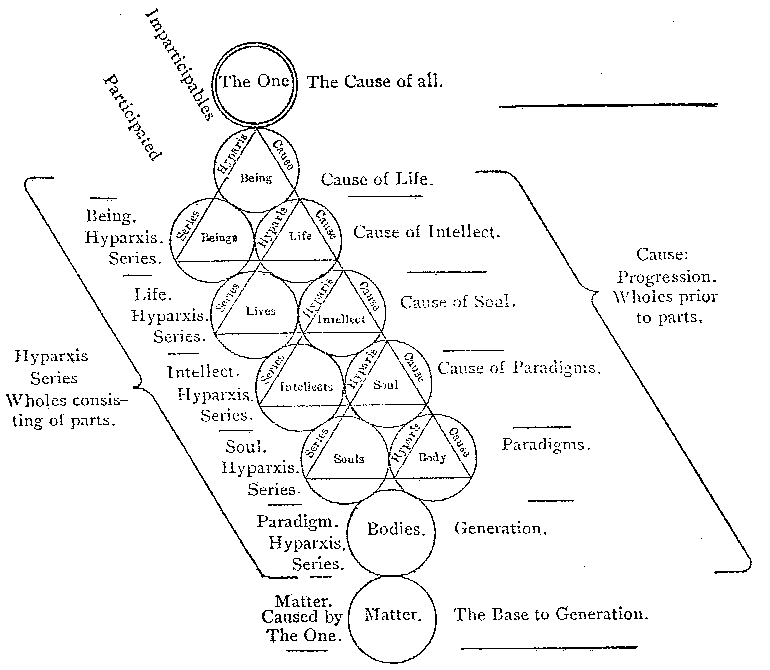
The diagram points to causes giving subsistence to natures in a two-fold manner, viz: the causes according to an order in the progression of causes, and the causes according to an order subsisting in each series or causal chain.
In the four interlacing triangles, each containing three circles, the circle at the apex of the triangle represents a leading cause; the circle at the base, to the right, representing a secondary cause in the order of progression; and the circle to the left represents a secondary order of natures subsisting according to the series. For instance, the upper circle in the upper triangle represents Being. Being is the cause of Life. In the circle to the [199] right, life is represented as in the order of progression. And to the left, the circle represents beings. The series of beings proceed from Being, for Being is the leader in the cause of beings; Life, of lives; Intellect, of intellects: Soul, of souls; Body, of bodies.
The circles at the apex of each triangle represent, (1) causes according to imparticipable natures — (2) causes according to self-subsistent natures — (3) causes according to hyparxis. Natures proceeding from imparticipable causes subsist according to wholes consisting of parts. Natures proceeding in the order of progression subsist according to self-subsistent causes. And natures proceeding according to hyparxis subsist in the series.
Prop. XCIX.
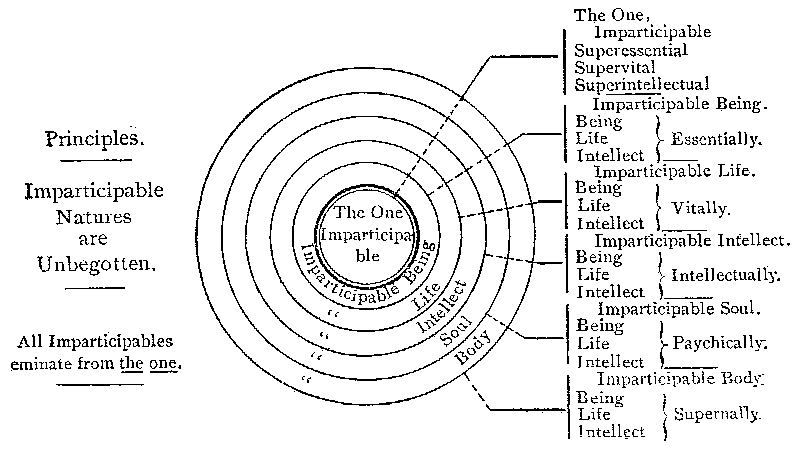
Primary causes subsist imparticipably. The One is the primary cause of all things, hence The One is the first imparticipable. The One is truly unbegotten, for there is no other prior, nor beyond. The One is truly the principle of all things, for the multitude subsists secondary to that which primarily subsists in The One.
Of the multitude, some things are first, and with [200] reference to the first of things; others subsist secondary; and, again, others, the last of things. Hence there subsists in the multitude an order of progression. But the principle of this progression subsists primarily in The One. For, as The One is to the multitude, or as the primary is to the secondary, so is that which is first in things, or primary in things, to that which is secondary in the multitude of things. The principle of ratio subsists in a cause which is the same in all ratios, that is, imparticipably. But if the first imparticipable, The One, is unbegotten, then, by reason of one principle, all imparticipables are unbegotten.