INTRODUCTION
TRANSLATION. CODEX A
| Twilit Grotto -- Esoteric Archives | Contents | Prev | protect | Next | timeline |
This digital edition by Joseph H. Peterson, Copyright © 2005. All rights reserved. Updated May 15, 2019.
You will need a Hebrew font installed to read some of this book.
|
THE BOOK OF PROTECTION BEING A COLLECTION OF CHARMS NOW EDITED FOR THE FIRST TIME FROM SYRIAC MSS. WITH TRANSLATION, INTRODUCTION, AND NOTES BY HERMANN GOLLANCZ, M.A., D.LIT. GOLDSMID PROFESSOR OF HEBREW UNIVERSITY COLLEGE, LONDON WITH 27 ILLUSTRATIONS LONDON HENRY FROWDE OXFORD UNIVERSITY PRESS, AMEN CORNER, E.C. 1912 |
INTRODUCTION |
|
|
In these introductory remarks I propose to limit myself to a description, with a few explanatory notes and details, of the two Syriac MSS. in my possession, published for the first time in this form. They were first brought to public notice at the International Congress of Orientalists held at Paris in 1897, on which occasion I read a paper entitled, 'A Selection of Charms from Syriac Manuscripts,' which was later on included in the Actes du onzième Congrès International des Orientalistes. The interest which this paper evoked at the time, and the repeated requests made to me since, have encouraged me to carry out at last both my own wish and the wish of others, that I should publish the text and translation of these MSS. in their entirety. I might add that as far as concerns the libraries I have been able to consult, these MSS. are extremely rare. The British Museum came into possession of one almost identical with the larger of the two but a few years ago, and the Cambridge University Library has one MS. similar to the smaller one, but smaller still, the writing being nothing near so clear and careful, nor the illustrations so good. It is described at fair length in William Wright's Catalogue of the Syriac Manuscripts preserved in the Library of the University of Cambridge, 1901. It was my intention at first simply to make this reference to Wright's Catalogue, and leave the reader to consult and compare the Cambridge MS. But upon consideration, observing the important discrepancies between this MS. and my smaller one, I have determined to include in this volume the full text of the Cambridge MS., together with a translation. [x] As regards my own two MSS., the one which I now call Codex A is larger in size and contains a much larger number of incantations, &c., whilst the smaller, which I call Codex B, is older, and what is most valuable, it has the vowel signs throughout; thus leaving little doubt as to the pronunciation especially of the proper names cited therein. Both contain illustrations more or less crude, but yet of undoubted interest; the headings in both are in red) the main portion in black: and they are written on paper. The Cambridge MS. I call Codex C, and in the Appendix I have added some interesting details with reference to the collation of the British Museum MS., which I cite as B.M. Codex A is dated '2114 of the blessed Greeks', which corresponds to the year 1802-3. It consists of seventy-two pages of text and two additional pages with illustrations at end, which I have divided into fifty-four sections (§), following more or less indications in the text. The writing approximates to Estrangelo; the place in which it was written is Shibani, among the mountains of Turkish Kurdistan, two days' ride from Urmiah.
On the two blank pages in front of the MS. there occur
the following inscriptions in pencil with the name of the
owner,
'This book belongs to Joseph of the village of Chamaki; it was given by Joseph son of Margul, of the village of Abajalu, 1889.'
[xi] Lo the Evangelist! 'Stretch forth, O my Lord and God, the right hand of Thy compassion from the High Sanctuary. Grant the food of those who worship Thee — an abundance of the heavenly grace of Thy sovereignty.' This is the ordinary Chaldaic prayer before meals. On the last page the following occurs (in ink) in a third hand:—
'This MS. (is the property) of Mirza Bon of the deceased martyr George from Abajalu [two hours' walk from Urmiah]. The man in whose hand it will fall and he will not return it to its owner, may he be under the ban of Mar Simeon.' Codex B is very small in size, consisting of 118 pages carefully written in Estrangelo proper, nine lines to a page; and, as I have remarked before, it has the vowel signs throughout. Particular attention should be called to the large number of Fathers and Saints occurring in § 5, some perhaps hitherto scarcely or not at all known, many more than the number mentioned in the corresponding incantation in Codex A, § 52. Codex C (in the words of Wright) is written in an inelegant Nestorian, probably of the eighteenth century, and I might add that, in proportion to its size, it contains a large number of scribe's errors. A striking instance is to be found in § 11, more especially when compared with B.M. § 55. As regards the texts of A and B, the MSS. are in the main correctly written: scribes' errors are pointed out in footnotes to the passages as they occur. Headings and other expressions [xii] in red in the originals are represented by the bold type in the Syriac portion of this volume. Codex B is printed line for line according to the original, and the number of pages (118) is also indicated. As far as the meaning of some few passages is concerned, they practically baffle all satisfactory interpretation; perhaps this was the intention of the author of the charm. Yet, in one or two instances, instead of leaving them untranslated, as was my original intention, a tentative translation is offered as the basis of a more complete rendering. The first instance is Cod. A, § 19. We have there, in the latter half especially, an admixture of Syriac, Arabic, and other expressions, which admits of no easy explanation. Similarly in the case of § 41, referring to the Ring of King Solomon, the names therein contained must I fear remain inexplicable, for they are evidently mystical names. But it may be of interest to note the recurrence of the syllable MTz (מץ) and PTz (פץ) in combination and permutation. And here we have some light thrown upon the subject from the fact that MTzPTz מץפץ occurs in other works of a similar nature as a transposition of letters for the Tetragrammaton (JHVH) יהוה according to the principle א״ת ב״ש i.e. the interchange of the first and last letter, the second and last but one letter, and so on of the Hebrew alphabet. Thus: M (מ) would stand for J, Tz (צ) for H, P (פ) for V and Tz (ץ) for H — hence JHVH (יהוה). It is further interesting to find the term PTzP''TzIH פצפ״ציה applied to the 'great Angel' appointed as the champion of Israel on the day on which the 'Cornet' is blown. Here we have פצ reduplicated, added to the terminal IH (יה, Jah), which is the shorter name for the 'Eternal'. So far for the names on the RING OR SEAL OF SOLOMON. But as regards the story itself and the power of Solomon over the spirits and the animal kingdom, we have ample references in Semitic literature. We read it e.g. in the Talmud. Treatise Gittin, 68 a-b: it occurs in somewhat [xiii] different form in the Midrash Tehillim on Psalm lxxviii. 45, again in the Yalkut Shimoni, 1 Kings vi. In the Koran (ch. xxxviii) we have a brief reference to it (see Note to Sale's edition). The part which King Solomon plays in the history of Magic generally may further be gleaned from the description which I published of the Hebrew MS. in my possession, dated 1700 (according to the title-page, which may he later than the copy itself) called Mafteah Shelomoh (מפתה שלמה, 'Clavicula Salomonis') (1903). The special reference to Ashmodai will be found on pp. 33, 34. Coming to more modern works, I would further refer the reader to the valuable articles in Hamburger's Real-Encyclopädie für Bibel und Talmud, vol. II, on 'Geister', 'Ashmedai', &c.; to the chapter on 'Solomon and the Queen of Saba' in Weil's The Bible, the Koran, and the Talmud: Biblical Legends, &c. (1846); to M. A. Levy's scholarly 'Epigraphische Beiträge' in the Jahrbuch für die Geschichte der Juden (1861), pp. 267-271 and 294-295; to the full articles in the Jewish Encyclopedia on 'Solomon' and the 'Seal of Solomon'. See also M. Grünbaum's Neue Beiträge zur Semitischen Sagenkunde (1893), pp. 201, 211 sqq.; Eliphas Levi's Transcendental Magic (ed. Waite, 1896). But perhaps, after all, the crucial version of this much involved story may be found in the early statement of Josephus in his Antiquities of the Jews, Bk. VIII, ch. ii, § 5; and I will therefore reproduce it here, both on account of its antiquity and its terseness:— 'Now the sagacity and wisdom which God had bestowed on Solomon was so great, that he exceeded the ancients in so much that he was no way inferior to the Egyptians, who are said to have been beyond all men in understanding; nay, indeed, it is evident that their sagacity was very inferior to that of the king's. He also excelled and distinguished himself in wisdom above those who were most eminent among the Hebrews at that time for shrewdness: those I mean were Ethan, and Heman, and Chalcol, and Darda, the sons of [xiv] Mahol. He also composed books of odes and songs, a thousand and five; of parables and similitudes, three thousand; for he spake a parable on every sort of tree, from the hyssop to the cedar; and in like manner also about beasts, about all sorts of living creatures, whether upon the earth, or in the seas, or in the air; for he was not unacquainted with any of their natures, nor omitted enquiries about them, but described them all like a philosopher, and demonstrated his exquisite knowledge of their several properties. God also enabled him to learn that skill which expels demons, which is a science useful and sanative to men. He composed such incantations also by which distempers are alleviated. And he left behind him the manner of using exorcisms, by which they drive away demons so that they never return, and this method of cure is of great force unto this day; for I have seen a certain man of my own country whose name was Eleazar, releasing people who were demoniacal in the presence of Vespasian and his sons, and his captains, and a whole multitude of his soldiers. The manner of the cure was this:— He put a ring that had a root of one of those sorts mentioned by Solomon to the nostrils of the demoniac, after which he drew out the demon through his nostrils; and when the man fell down immediately, he abjured him to return into him no more, making still mention of Solomon, and reciting the incantations which he composed. And when Eleazar would persuade and demonstrate to the spectators that he had such a power, he set a little way off a cup or basin full of water, and commanded the demon as he went out of the man to overturn it, and thereby to let the spectators know that he had left the man, and when this was done, the skill and wisdom of Solomon was shewn very manifestly: for which reason it is, that all men may know the vastness of Solomon's abilities, and how he was beloved of God, and that the extraordinary virtues of every kind with which this king was endowed may not be unknown to any people under the sun; for this reason, I say, it is that we have proceeded to speak so largely of these matters.' In connexion with this ancient version, the following extracts from a remarkable anonymous pamphlet, entitled The Talisman (printed by W. Whaley, 12 Holywell Street, Strand, no date) may be read with interest:— 'Tyrant! (p. 9) I have tarried, I have wielded a power of the thousand powers which may not resist the word of authority spoken by him who has looked unmoved and unrebuked upon [xv] the glories of the Shechinah, who has lifted the veil of the temple penetrated into the Holy of Holies, and learned the words of power engravened upon the signet of the master of all wisdom and of all demons — good or evil — the marvellous, the glorious Solomon.' 'And yet (pp. 11, 12) it is perfectly true that it is the quality of this root, as is averred by sundry writers of our despised and persecuted race to cast out evil demons from people possessed — and though it is never known to more than one person of our race, a preparation of this root (Baara) aided by the words of might en graven upon the signet of Solomon is potent exceedingly in tasking the hidden powers and in discovering the most hidden things.' 'The all-but-omnipotent signet of Solomon was deposited by that greatest of earthly princes in the Temple of Jerusalem; and in the Holy of Holies, entered only by the great High-Priest, reposed that gem of price and power unspeakable.'Nebuchadnezzar and Cyrus bore away the wealth of Jerusalem, but not this signet ring, 'which was from the beginning destined to work out the salvation of Judah, when her sins should be fully expiated and her people once more an acceptable people in the sight of the Lord.' It was successively preserved by each High Priest to the time of Titus: at the burning of the Temple the High Priest enjoins our magician with his dying breath to penetrate the Holy of Holies and snatch therefrom Solomon's signet ring, 'to snatch thence and from the very centre of the ark the Talisman of our people, even the signet of the wise Solomon, the Shem-amaphorah (sic!)' . . . . 'It (the ark, p. 16) was five spans long by three in height and breadth, and was strongly ornamented with plates of fine gold, and on the top were two cherubims of like precious metal. In that lay the palladium of our people — the seal of Solomon; and I, I! was to stretch forth my hand and seize it! The lid of the ark yielded to my mere touch and mine eyes fell upon the precious signet. It consisted of a single cincture of massive gold, set with a single gem: but such a gem! In the centre of the gem was engraven the ineffable name of God, and around it in mingled [xvi] radiance of diamond, of sapphire, of ruby and emerald, the seeming of 10,000 eyes gleamed with divine ardour, to which the lurid lightnings of the stormiest heaven are but as a meteor that dances upon the morass.' He seizes the ring just as he hears Titus approaching, but feels himself grasped by a giant hand and loses consciousness. When he recovers he finds himself under a palm, by the side of a fountain seated amidst wonderful surroundings, and listening to heavenly music. But Solomon's ring has gone. He is in the greatest grief at the discovery; but a voice from above soothes him and assures him that the ring is destined to play a great rôle in the history of his persecuted race. 'Words of might were engraven upon my soul, even the words of the signet of Solomon which all genii must obey, and I was sent forth to live the bodily life and die the bodily death in divers places — but with ever one task, one trust,' &c. Intimately bound up with the lore of the magician was the science of numbers. Now as regards the inherent numerical value of the letters of the Hebrew alphabet, we would quote the following from 'The York Medal, or the supposed Jewish Medal found in York', deciphered by Dr. L. Loewe, and extracted from the York Courant (1843):— 'Ibn Ezra in his work, Sefer Hashem, says with reference to the numerical importance of the letters Alef, Hé, Wav, and Yod (אהוי) which compose the great name, the Tetragrammaton and the Éhé (Exodus ch. iii, ver. 14), "These letters are peculiarly adapted for the purpose, as they surpass, in their capabilities, all the rest of the alphabet." . . . The numerical value of Hé and Yod is 15, which corresponds with the word composed of Yod and Hé, denoting God. The letter Hé alone, not followed by Yod, would, on having joined to it the four preceding numbers, produce the number 15, which is again the numerical value of the word composed of Yod and Hé, signifying God, thus 1 +2+3+4+5=15. ... The four numbers, 1, 5, 6, 10 (אהוי) are denominated to distinguish them from the others, "round numbers" (numeri rotundi). This was done, probably, because they always re-appear in [xvii] their products, whether multiplied in the square or cube, having, figuratively, the properties of a circle, and the letters expressing the name of the Most Holy, being such as correspond, in their numerical value, to those now referred to, are used to represent, emblematically, His perfection, immutability, and infinity. 'The number 9 was said to be perfect in itself, because it involves the products of all the preceding numbers when multiplied. . . . | |
'The numbers 9 and 15 were adopted, therefore, to represent the attributes of the Deity; "for", said the teachers, "the number 9, multiplied in every way, is immutable, and always produces a number to (sic!) exact proportion to its simple value". . . . In Hebrew the word "truth" is thus emblematically conveyed, the simple numerical value of its characters being 9, intimating that truth never changes. The word is Emét [Emeth or Aemeth] (אמת), and is composed of the letters Alef (א) 1, Mim (מ) 40, Tav (ת) 400; and by taking the tens and hundred as units 1, 4, 4, we produce, by adding them together, 9. In Hebrew, the word signifying man is also composed of letters that represent numbers, which, if added together on the same plan, amount to the value of 9; for Adam (אדמ), "man", is composed of Alef (א) 1, Dalet (ד) 4, and Mim (מ) 40; and by taking the figures, which stand for tens as units, 1 + 4 + 4, the product is 9 (vide Irira in his work Sháar Hashámáyîm). |
Irira: Abraham Cohen de Herrera, Sha'ar ha-Shamayim ("Gate of Heaven"), Amsterdam, 1655. -JHP |
'The number 15 has already been shown to correspond to the name of the Deity, composed of Yod and Hé. The tablet bearing an inscription of 9 and 15, a plan of which is here given;, is considered the most ancient of its sort, and is therefore denominated, "The seal of Solomon". 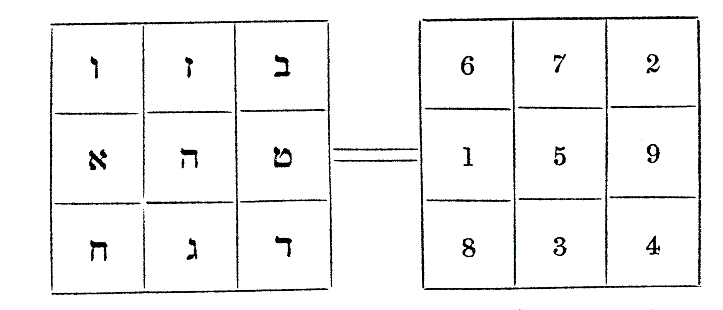
'The number 9 is represented by the nine compartments; and the figures are so ranged in every line of the three compartments, whether horizontal, vertical, or diagonal, that the [xviii] number 15 is produced by adding together the numbers contained in the three compartments. 'So far, it must be seen, that such tablets were designated for no other purpose than to keep the minds of their possessors constantly dwelling on the words "God of Truth"; that whoever believed in the "God of Truth" might discard the fear of every other object known to them, the influence or charms and of stars and planets included. It was natural to suppose that the possessor of such a tablet would continually meditate on the attributes of the Omniscient, and bear in mind the universe was the work of His hands, and in every respect perfectly subordinate to Him; that His actions were all based in truth, and that whatever emanated from Him bore the stamp of truth and harmony. 'But whilst tablets and scrolls thus inscribed had a beneficial effect on those to whom their use was correctly explained, they produced mischief to those who could not interpret their meaning, and such, instead of contemplating, through them, the true nature of the Divinity, and estimating as they ought to have done all inferior objects, their ideas became distorted, and they looked upon the senseless pieces of metal or parchment containing mystical inscriptions as though they were charms in themselves, invested with power to counterbalance the influence of adverse planets or other charms, and this conception, aided by degrees by the practices of necromante impostors, unknown and mystical inscriptions were multiplied on various substances to an immense extent, and largely distributed to the inferior portions of society. Square tablets, or signets, were fabricated, with inscriptions having allusion to each of the planets; and in process of time similar articles were produced, to suit an infinite variety of purposes, all widely different from the sacred one for which such things were first invented,' So far the value of numbers as represented by the letters of the Hebrew alphabet, and their relation to the Seal or Signet of Solomon. Speaking of Solomon, we pass on to an expression which occurs in the present volume, and which may at first sight seem difficult of explanation; I refer to the appellation in § 35, SOLOMON BAR JAKI. What is the meaning of bar Jaki?
On reference to Proverbs, ch.. xxx. 1, we find these words:
דברי אגור בן יקה
'The words of Agur the son of Jakeh.'
[xix]
This clause has given rise to a deal of discussion, and it has
been explained thus:— 'Agur' is another name for Solomon,
אגור שאגר דברי תורה
who had 'collected', 'stored up'
(rt. אגר)
knowledge and experience, and afterwards had 'given
them up' (lit. 'spewed them out'; rt. קוא
or קיא,
cf. Lev. xviii. 25, 28, xx. 22; Jonah ii. 11; Job x. 15; Prov. xxiii. 18),
for the benefit of mankind as maxims and rules of conduct
to guide them in life; in another sense, Solomon had 'given
them up', i.e. 'had renounced them' This latter explanation would be parallel to one of the interpretations given to the words in the next chapter of Proverbs, xxxi. 1, דברי למואל מלך 'the words of Lemuel king'. Why is Solomon called Lemuel (למואל)? Because there were occasions in life on which he threw off the yoke of Heaven and denied God, saying, למה לו אל 'Wherefore do I require God?' Of course others explain it again in the contrary sense, למו אל, Solomon was the one 'to whom God' was all in all — in fact, a correlative of the name Jedidiah, 'beloved of the Lord' (2 Sam. xii. 25). This is not the place to enter deeply into questions of etymology, or to discuss the question in its entire bearing. It has, for example, been objected that not the past participle אגור, but the present participle אוגר, (cf. Proverbs x. 5 אוגר בקיץ 'He who gathers in summer', &c.) should have been used, if it was to have applied to Solomon. But we dare not forget that we have such forms in an active sense, as e. g. יקוש 'the fowler' (Ps. xci. 3). Then again it has been asked: Why call David Jakeh? But the rejoinder is: Jakeh is applied not to David but to Solomon himself; and the word בן is not 'son of', but it is used in the same sense as בן שנה 'one a year old', בן שמן 'one oily', i.e. 'fertile' (Isaiah v.l); thus the phrase [xx] בן יקה would mean 'one who spewed out', 'gave out' or 'renounced'.
Suffice it to say, however, that the expression exists in
Scripture in the form 'Agur, the son of Jakeh', and this is
sufficient to account for its introduction into the wording of
our text.
| |
|
There occurs in A, § 20, the expression
This opens up a very wide subject of engrossing interest to the student of Oriental literature. As far as concerns Eastern popular custom, influenced by Chaldaic and Babylonian currents, all ailments were looked upon as caused by specific 'demons' or 'evil spirits', and among the Jews of many centuries these were called by such names as רוחות, שדים, מזיקים, &c. It is therefore not surprising to find in the Talmud, Treatise Gittin, 67 b, on the phrase מי שאחזו קרדייקוס, both the Talmud itself and the eminent commentator Rashi explaining the word קרדייקוס by שד or שם שידה 'demon' or 'the name of a female demon', though we recognize it as kardiakoz (=kardialghz, kardialgia) 'heart-ache' (also 'stomachic pains'). In the same manner 'leprosy' is identified with the demon 'Hamat' (Sanhedrin, 101 a), 'asthma' or 'melancholy' with the spirit 'Ben Nephalim' (Beehoroth, 44 b), 'throat affections' among children with 'Shibbeta' (Taanith, 20 b), &c. Coming from 'DEMONS' to 'THE SERPENT' to which somewhat frequent reference is made in these texts, I will quote the following from Grünbaum (p. 61): In the various passages of the Koran in which mention is made of the enticing of Adam and his wife (who, by the way, is not mentioned by name, Sur. 2, 34; 7, 19 sq., 20, 118 sq.) the [xxi] serpent is not spoken of; Satan is the seducer. As, however, the question arose as to how the latter could have entered Paradise, once having been expelled thence by God (Sur. 2,34; 7, 19; 38, 78), Zamahsari notes on Sur. 2, 34 that having concealed himself in the mouth of the Serpent, he entered Paradise; whilst Baidawi adduces further explanations. The Koran accordingly follows in this matter not the Jewish but the Syro-Christian tradition. Compare in this connexion Weil's Biblical Legends, ch. i, pp. 7-15. In the course of his remarks on the subject we read:— 'How can I bring thee into Paradise unobserved?' inquired the serpent. 'I will contract myself into so small a bulk that I shall find room in the cavity of thy teeth.' . . . The serpent then opened her mouth — Iblis ('the master of all evil spirits') flew into it, and seating himself in the hollow of her front teeth poisoned them to all eternity (p. 10). I might here state that, as far as references in the Talmud to magic and its practice is concerned, the chief sources of information are to be found in the Treatises Pesahim, 110-112; Sabbath, 66-67; Sanhedrin, 65 a-67, 111; Gittin, 67b, 70 a; and Hulin, 105 b, 109. But the history of magic in general, its origin and development, — the consideration of charms, incantations, amulets, and exorcisms, — this vast subject cannot be treated within the limits of a brief Introduction.
And as regards Syrian Magic, the specimens contained in
the present volume may now be allowed to speak for themselves;
and it must be left to the student to discover how far they
are original in thought, or to what extent they have been
affected by influences derived from adjacent peoples.
As to the illustrations in our MSS.:— In Codex A we have
on p. 1 of the text a horse-shoe border or vignette; on p. 3,
a square divided into thirty-six smaller spaces, containing
[xxii]
the words or St. John i; on p. 4, representations of 'Matthew',
'Mark', 'Luke', and 'John'; on p. 6, a picture of 'Mar Georgis'
on horseback and 'the great dragon'; on p. 11,
figures with the description, 'This is the ruler executing
judgment', with his 'pipe', 'sword', 'purse', 'goose', and
'fire'; on p. 15 we have representations of various implements,
such as 'bow and arrows', 'club', 'hatchet', 'gun', 'sword',
'daggers'; on p. 17, in the centre, a star or Catherine-wheel;
p. 20, equestrian figure of 'Mar Thomas' engaging with
'the Spirit of Lunacy'; p. 24, pictures of various animals,
'ram' or 'stag', 'goat', 'he-goat', 'hare', 'fox' 'sparrow',
and 'fowl'; on p. 27, various kinds of 'guns'; on p. 34, 'the
Angel Gabriel' on horseback in an encounter with the 'Evil Eye';
p. 39, 'an equestrian figure of 'Rabban Hurmizd' with
an animal to which is affixed the description, 'This is a lion
or a mad dog'; on p. 47, 'Daniel the prophet' on horse with
'the cunning wolf lying in ambush for the sheep';
p. 49, picture of 'two serpents', and on p. 50 of
'two scorpions'; p. 54 contains circle with inscription round
the border in illustration of the' Seal of Solomon', and on p. 55
'King Solomon' himself seated on a horse in an encounter with 'Ashmedai';
on p. 58 appears 'Mar Shalita' riding against the 'Evil Spirit'.
The whole of p. 64 is taken up with two figures
seated on thrones, one 'Elias', the other 'Enoch', on either
side of a tree with fruit (evidently guarding Paradise); pp. 73
and 74 contain fanciful illustrations of a star and a cross;
pp. 17, 35, 36, 55, and 56, have at the foot of the page the
letters
Codex B has also on first page a vignette border; on p. 23
a crude illustration of a hero on horse without description,
evidently fighting the Evil Spirit; on p. 57, woman on horse
described 'This is Mary, the mother of Christ', with figure,
having the words, 'This is the wicked Satan'; on p. 71,
'Mar `Abd-îshô`', (equestrian) and 'the accursed Satan'; p, 86, 'This
is Mar Georgis' (on horse), and on p. 95 an illustration of
[xxiii]
'the Evil Eye'. The pp. 17, 18, 37, 38, 58, 77, 78, 97, and
98 have at foot the letters
Codex C has on p. 4 b illustration of the 'wicked demon';
on p. 8 a, a cross within a circle; p. 11 a, 'Mar Georgis and the dragon';
p. 13 b, a circle; p. 19 b, an 'Emir with pipe,
sword, axe, &c.'; p. 23 b, 'Mar Milis and the ox'; p. 25 b,
'Mar Hananiah and tiger'; p. 26 a, 'circle'; p. 27 b, ornamentation;
p. 31 a, star within circle; p. 33 b, 'Mar Moushé
(on horse) and the devil'; p. 37 a, four doves' heads in a circle;
p. 39 a, 'Mar Joseph and the wicked person'; p. 41 a, cross
in circle; p. 43 a, 'This is an olive-tree'; p. 45 b, 'Mar Daniel,
bear, and dove'; p. 50 b, 'Mar Joseph and Lilith'; p. 52 b, a wheel;
p. 58 a, 'Mar Gabriel and the Evil Eye'; p. 61 a, circle;
p. 63 a, scorpions; p. 65 b, 'These are serpents'; p. 68 a,
'Lion, goat, fox and hare'; p. 70 a, 'Mar `Abd-îshô' and the
accursed devil'; p. 72 b, fanciful illustration; p. 76 a, 'Enoch and Elias'
on each side of a tree; p. 80 b, 'Mar Sabarisha' and the Satan';
p. 83 a, 'guns and flints'; p. 84 a, illustration of
'Shield of David'.
It remains for me to thank several friends for their kind suggestions and ready assistance while this book was passing through the press, more especially the veteran Orientalist, Professor Th. Nöldeke of Strassburg, Professor F. C. Burkitt of Cambridge, Rev. George Margoliouth of the British Museum, and Dr. M. Gaster. To my colleague, at University College, Professor W. P. Ker, my warm thanks are hereby rendered for his generous offer to defray the extra cost of the illustrations; and I am further pleased gratefully to acknowledge my indebtedness to two other kind friends, interested in literature generally, for the practical help which they have accorded me. |
[xxiv is blank]
[xxv]
TRANSLATION. CODEX A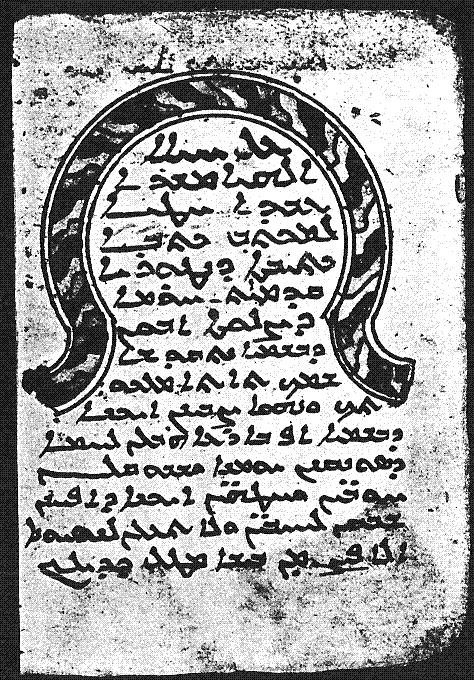
Cod. A, p. 1. Horse-shoe border or vignette.§ 1. By the Divine Power, the servant, the sinner, begins to write the 'Book of Protection'. |
|
|
First, the anathema by the prayer1: Our Father which
art in heaven, hallowed be thy name. Thy Kingdom come,
and thy will be done, as in heaven, so on earth. Give us
the bread which we need for the day. Forgive us our
trespasses and sins, as we also forgive those who sin against
us. And lead us not into temptation, but deliver us from
evil: for Thine is the Kingdom, the power, and the glory,
for ever and ever.
|
NOTES:
1. Matt. vi.9-13; Luke xi.2-4. |
§ 2. The Prayer of Adam.
We acknowledge thee, O Lord of All: and thee, O Jesus
Christ, we glorify, for thou art the reviver of our bodies,
and the redeemer of our souls.
§ 3. The Prayer of the Holy Angels. | |
|
O holy God, holy Mighty One, holy Immortal: O our
Lord, have pity upon us: O our Lord, receive thou our
petition: O our Lord, be gracious unto this thy servant who
bears these writs.2 Amen! Amen.
|
2. A magical scrap of writing or talisman is called  (only in
plural in this sense). Cf. Matt. v. 18, where sing. occurs with the meaning
'jot'; the word 'tittle' is rendered by (only in
plural in this sense). Cf. Matt. v. 18, where sing. occurs with the meaning
'jot'; the word 'tittle' is rendered by  (lit., 'scratch',
sc. of pen), an expression which frequently occurs at the end of a work (lit., 'scratch',
sc. of pen), an expression which frequently occurs at the end of a work
 this book has been 'scratched' and 'written'.
In modern language one still says: this book has been 'scratched' and 'written'.
In modern language one still says:  'Write me one or two lines or words'.
|
|
[xxvi]
§ 4. THE ANATHEMA OF THE GOSPEL, WHICH IS OF AVAIL FOR ALL PAINS AND ALL SICKNESSES.
In the beginning was the Word: that Word was
with God. And this Word was God, and the same
was in the beginning with God. And all was by
his hand, and without him there was not one
thing (made) of that which was. In
him was life, and the life was the light
of men. That light is in the darkness: it preventeth
it not. By the power of those Ten Words, proceeding
from the Lord God, and by the name I Am That I Am,
Almighty God, Adonai, Lord of Hosts,
may there be distanced and destroyed all the
evil and abominable actions of accursed demons,
and all their practices, and all opposition,
temptations, unclean spirits, and stumbling-blocks,
sounds, and creakings, fear and trembling that come
to oppose, devices, malice, and evil occurrences,
also the effects and bonds of witchcraft, the hot
and cold fever, the fever-horror, and the Jewish (fever), [may they be
driven] from the body and soul of the one who bears these
writs, by the prayer of my Lady, the blessed Mary, and of
Mar John the Baptist. Amen!
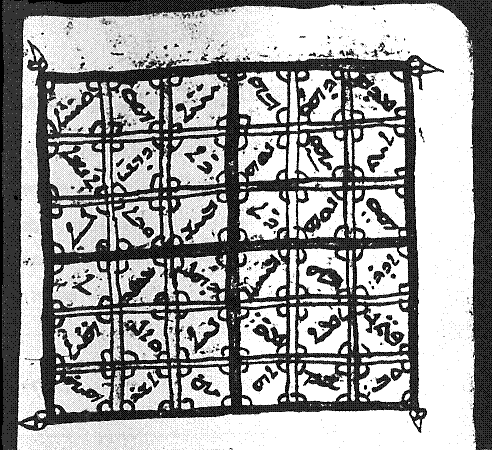
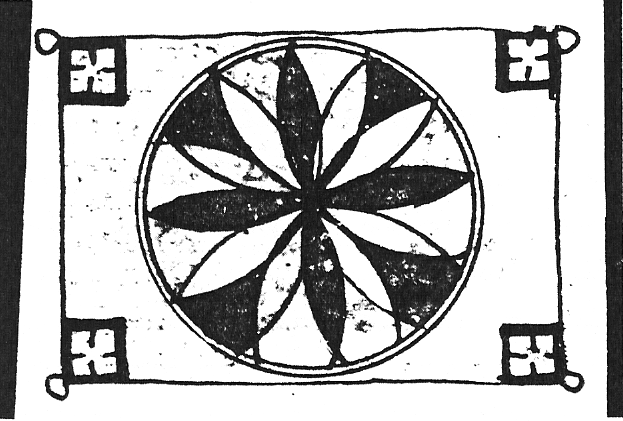
Cod. A, p. 3. Magic diagram containing the words of St. John.§5. THE ANATHEMA OF MAR GEORGE, WHICH IS OF AVAIL FOR FEVER AND TREMBLING. | |
|
In the name of the Father, the Son, and the Holy Ghost.
The prayer, request, petition, and supplication of Mar George,
the glorious martyr, which he prayed before God, saying:—
O Lord, God of Hosts, grant me this request:
May the twofold danger be annulled from off the flocks,
from the cattle, and from the house of him who beareth these
writs. Furthermore, may there be bound the inflammation,
the pestilence, and jaundice (?),3 the sickness of Mosul, by
[xxvii]
the prayers of Abba Mark and by the supplication of Abba Pahum:
may there be bound and expelled the twofold dangers
from the flocks and from the cattle of him who beareth
these writs, by the command of the Messiah, the Redeemer of
the world, and by that prayer which our Lord prayed when
they crucified him in Jerusalem, and by the name I Am That I Am,
Almighty God, Adonai, Lord of Hosts, by the prayers of
Abba Pahum, which he prayed, and the pestilence was stayed;
[so may these evils be chased] from off the flocks and the
cattle of the one who beareth these writs; the merit was
reckoned unto him for all generations and for evermore, by
the prayers of my Lady, the blessed Mary, and of Mar John the Baptist. Amen!
|
3. I have here rendered the word  'jaundice' as an abbreviation
of 'jaundice' as an abbreviation
of  . In A, § 26, it seems to be the name of a place known for
a certain sickness. The name occurs as that of a town in Egypt, and
a similarly sounding name is found on the frontier between Persia and
Afghanistan. Is it perhaps an abbreviated form (the first syllable) of
'Constantinople' . In A, § 26, it seems to be the name of a place known for
a certain sickness. The name occurs as that of a town in Egypt, and
a similarly sounding name is found on the frontier between Persia and
Afghanistan. Is it perhaps an abbreviated form (the first syllable) of
'Constantinople'  ? ?
|
§ 6. [PRAYER WHICH IS OF AVAIL] BEFORE THE AUTHORITIES.
In the name of the Father, the Son, and the Holy Ghost.
I take hold of the Father in secret, and openly I am wrapped
with the Son, and mysteriously doth the Holy Spirit dwell
within me; verily I fear no evil. As regards everyone who
dares to look at the bearer of these writs, I bind and curse
him by the Word which our Lord addressed unto his disciples:
'Whatsoever ye shall bind on earth, shall be bound in
heaven.' Thus, O Lord, God of Hosts, I bind the mouths
and tongues of all wicked persons, thieves, robbers, and
highwaymen, men of power, men in authority, and men of violence,
prefects, . . .4 and chiefs from off the one who beareth
these writs; [I bind them] by the power and the garment
with which Alexander, the son of Philip, was clothed, with
which he subdued the whole earth; thus, O Lord, God of
[xxviii]
Hosts, may the head of all wicked persons be humbled before
the one who beareth these writs by the sword of the Synod
and by the stones of Philon.5 O Lord, God of Hosts, as thou
didst cause Joseph to go forth from the prison-house, and
didst preserve Moses from the hands of King Pharaoh, and
didst deliver David from Saul, and didst save Elijah from
Ahab, and those of the house of Hananiah from the fiery furnace,
and Daniel from the Babylonians, so, I beseech thee, O Lord, God of Hosts,
that this thy servant who beareth these writs may have an
open and winning countenance before kings, men in authority,
men of violence.. chiefs and captains of the host, as had
Peter, Paul, and Gabriel. In like manner, O Lord, God of Hosts,
as thou didst rejoice thy disciples in the city Cana,6
so rejoice thou this thy servant who beareth these [writs] before
kings and the authorities, that the mouths and tongues of
evil persons be bound away from him. So be it, Amen!
|
4. The word  between 'prefects' and' chiefs' I have left
untranslated. It maybe an error for between 'prefects' and' chiefs' I have left
untranslated. It maybe an error for  'harsh', 'violent ones',
or 'harsh', 'violent ones',
or  'jealous ones'. 'jealous ones'.5. I shall be glad to have some light thrown upon the meaning of this latter clause. I was once informed by a native of Mesopotamia that the front of the dress of the priests of Chaldea is adorned with 'stones'. But is the robe itself called Pylon or Philon? Or, does 'the Synod' suggest the Greek 'Council' called Pylaea, Pulaia, for  ? ?6. John ii. 1-11. |
§ 7. [PRAYER WHICH IS OF AVAIL] BEFORE THE AUTHORITIES.
In the name of the Father, the Son, and the Holy Ghost.
I mount the lion and the young dragon. Save us, O Lord,
from the man of wickedness by the word and commandment
of our Lord, Jesus Christ, who overthrew kings (depriving
them) of their crowns, and chiefs, magistrates, rulers, and
governors (depriving them) of their thrones. By that power
which was with Joseph in the land of Egypt, may the beauty
of the one who beareth these writs shine before kings and
rulers, as the sun in the days of Nisan, and as the moon in
[xxix]
the nights or Ellul, and as the garden in the hands or the
gardener. By the prayers or the just and righteous ones do
I bind the tongues or evil men, men or power and violent,
judges, and chiefs, from off the one who beareth these formulae,
Gabriel (being) on his right and Michael on his left,
I Am That I Am, Almighty God, Adonai (being) above his
head, the Cherubim in front of him, and the Seraphim behind
him: nor will he fear the man of wickedness. In all the earth
may there light upon him compassion and mercy, and may they
favour him from near, and worship him from afar, may he hold
the sword in his right hand, and the bow in his
left, so that his head may be exalted before kings, rulers,
prefects, judges, and chiefs, and he will rule over him.7
As the beauty of Moses shone upon the children of Israel, so
may the beauty of him who carrieth (these) writs shine forth
before kings, rulers, commanders, and chiefs. As the crown
of Pharaoh before Joseph, so may there bow down to him the
rich and the poor, the base and the wicked ones, the men of
power and force, [departing] from him who beareth these
amulets, by the prayer of my Lady, the blessed Mary. Amen!
|
7. Rule over 'the man of wickedness'. |
§ 8. FOR A MAN GOING TO LAW.
In the name of the Father, the Son, and the Holy Ghost,
Patre et Filio et Spiritu Sancto, let him go forth — not by
himself alone — to judgment and victory.8 So may the angel
Gabriel be on my right, the Cherubim on my left, and hovering
over me and protecting me be the name I Am That I Am,
Almighty God, Adonai, Lord of Hosts: may the mighty
I AM, and He majestic in holiness be above my head, and
protect me from all the enemies of my name, and humble all
those who would lift themselves against me from above, from
below, from before me and from behind (lit. those who sit
before me and those round about me). May they (God's
[xxx]
names) be a helper, a redeemer, and protector unto me, that
they may receive me as a chalice, and place me on their heads
as a crown, in the name of Christ, the King, who judges all
mine enemies. From now unto thee, O Holy One, our Father in Heaven,
[I pray] be thou with me, come to my aid, and
redeem me: and may the four Evangelists come to my help,
Matthew, Mark, Luke, and John. By the prayers of these
holy ones [and by the prayer of] my Lady, the blessed Mary,
may they (God's names) be with him who beareth these writs.
So be it, Amen!
|
8. Cf. Matt. xii. 20. |
§ 9. BINDING THE ARROWS, DAGGERS, SWORDS, AND ALL IMPLEMENTS OF WAR.
In the name of the Father, the Son, and the Holy Ghost.
By the crucifixion on the Cross, when our Lord cried out upon
the Cross, and said: 'My God, my God, why hast thou forsaken me?'9
the earth trembled at his splendour, and
the heavens at his glory: by that great and terrible name,
and that exalted and mighty arm, I bind, anathematize, and
expel from off him who beareth these writs the arrows, bows,
swords, and knives, — all the implements of war belonging to
wicked men: [according to the words] 'He (God) maketh
wars to cease unto the end of the earth; he breaketh the
bows, and cutteth the spears in sunder; he burneth the
chariots in the fire'.10 'Their sword shall enter into their
own heart: as for his arrows, the Lord hath scattered them'.11
May they (these war instruments) be bound by me by means
of those seven priests who advance and retire, without beholding
the countenance of their Lord: may they be bound by
me through Elijah, the prophet, son of Eliezer the priest,
who bound the heavens for three years and six months, so that
no rain came down upon the earth. By all these names
[xxxi]
I bind their arrows, in fine, all the war-implements of
enemies. 'He ordaineth their arrows against the persecutors:
because be travaileth with iniquity and hath conceived falsehood,
and brought forth oppression'.12 May they be bound
by me beneath the throne of the Living God, and by means
of Him who sitteth upon it. (And thou shalt not be afraid
of the terror of the night: nor for the arrow that flieth by
day'.13 As far as the east is from the west, and the north
from the south, so may there be far removed and destroyed
from off the one who beareth these writs, the arrows, swords,
daggers, and guns of wicked men, thieves, and robbers, by
the prayer of my Lady, the blessed Mary. Amen!
|
9. Ps. xxii. 1; Matt. xxvii. 46; Mark xv. 34. 10. Ps. xxxvii. 15; only former half agrees. 11. PS. xlvi. 9. 12. Ps. vii. 13, 14; Scripture has 'his (God's) arrows', here 'their own'. 13. Ps. xci. 5. |
§ 10. THE ANATHEMA OF KING SOLOMON, WHICH IS OF AVAIL FOR AN INJURY (?) TO THE BACK.14
In the name of the Father, the Son, and the Holy Ghost:
and in the name of I Am That I Am, Almighty God, Adonai,
Lord of Hosts. King Solomon was building the House to the
name of the Lord, and the Holy Spirit was handing him
the stone: Solomon stooped to take hold of the stone: he
hurt (?) his back, his loin ruptured, and he gave forth a bitter
cry. Whereupon our Lord said unto his disciples: What
voice of crying is this? and they replied unto him: It is
that of Solomon, the son of David, who is building the
terrific, blessed House. Amen!
|
14. Perhaps 'lumbago'. |
§ 11. FOR EVERY SICKNESS.
In the name of the Father, the Son, and the Holy Ghost.
By thy great and fearful name, and by the power of thy
help, O Living King, full of compassion, rich in gifts, and
abounding in love, I stretch forth my hand and call unto
thee, O our Lord, Jesus Christ, and upon thy Holy Name,
[xxxii]
which thou hast put upon the dead and they came to life,
and the leprous became cleansed, and the blind had their
eyes opened, and those sick of the palsy thou didst heal
in thy grace: (concerning) the fever-horror, fear, and trembling,
the head-ache, eyes-ache, and every pain and grievous sickness,
which lay hold of mankind, as thy command chased
the fever-horror from the mother-in-law of Simon Peter, and
caused the light of righteousness to shine upon that man,
out of whom six devils went forth: and thou didst heal them
in thy grace, namely, her from whom the blood flowed, and
thou didst make whole the man sick of the palsy by the
living word proceeding from thy lips: and by thy living
and holy voice didst thou rebuke the sea, which was by the
lake Tiberias, and didst calm the billows and the tempests in the
sea, and there was a great calm and rest,15 so now, we beseech
thee, grant strength to the weak, and send thy help unto this thy servant
who beareth these writs. May he be healed from all pains and sicknesses
and grievous sufferings by the prayer of all the saints. Amen!
|
15. Cf. Matt. viii and ix. |
§ 12. THE ANATHEMA OF MAR THOMAS,16 WHICH IS OF AVAIL FOR THE SPIRIT OF LUNACY.
In the name of the Father, the Son, and the Holy Ghost.
The prayer, request, petition, and supplication of Mar George (sic),
the glorious martyr, who lived in the mountain for
forty years. He was torn as rags,17 and blood flowed from
them (i.e. the rents made in his flesh): and he prayed and
said, 'O Lord, God of Hosts, I beseech thee, and supplicate
thy grace, and ask the same request which Peter, Paul, and
Gabriel — chief of the angels, besought on account of the evil spirit
of lunacy. I bind you away from the three hundred
[xxxiii]
and sixty-six members of the one who carrieth these writs:
and you are bound by me, O evil Spirit of Lunacy, and you
have not the power to reside in the body and soul of the one
who carrieth these writs, but you will needs go forth from
the bones, from the sinews, from the flesh, from the skin,
and from the hair unto the ground, and from the ground
(passing on) to iron, and from iron to stone, and from
stone (you will pass on) to the mountain. This writing
must be sealed. Amen, Amen!
|
16. In the heading we have Mar Thomas, whilst in the body of the charm
Mar George is named. 17. Or 'into rags': cf. Isa. lxiv. 6. |
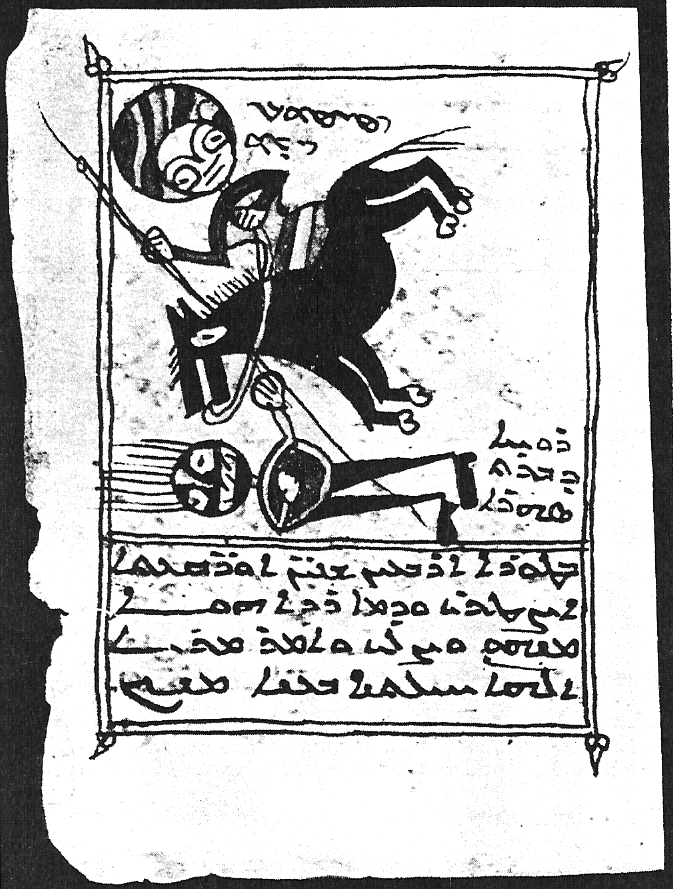
Cod. A, p. 20. Equestrian figure of 'Mar Thomas' engaging with 'the Spirit of Lunacy.'§ 13. FOR PAIN IN THE HEAD. |
|
|
In the name of the Father, the Son, and the Holy Ghost.
By thy name, O God, — the hope of all who are bound and oppressed,
we bind and anathematize, expel and destroy and drive
out, the pains and all the maladies which reside in the head,
in the eyes, and in the ears, which are in number seventy-two
aches: and these are the names by which they are called, evil spirits,
red maladies,18 black maladies, harsh and sweet sounds.
We bind, anathematize, and drive out, and thrust away these
evil spirits from the head, and from the eyes, and from the
temples, and from the cheeks, and from all the members of the
person who beareth these writs. By the name of the Word of the
Lord, in whose dominion are the heaven and the earth, and at whom
the rebellious demons tremble: by the name I Am That I Am, Almighty God,
Adonai, Lord of Hosts, and by the name
Gannus and Sloonus, men of fire, and by the name Gabriel and Michael,
by the prayers of Mar Simon Peter, we bind and anathematize all
evil aches from the head, and from the eyes, and from the eyebrows,
and from the temples, and from the cheeks, and from all the members
of the person who carries these formulae. Amen!
|
18. Lit. 'noises', 'creakings'. |
[xxxiv]
§ 14. FOR THE LOOSENING (OF OBJECTS) OF THE CHASE.
In the name of the Father, the Son, and the Holy Ghost.
As Simon Peter and Andrew threw the nets,19 (and had)
a goodly and abundant catch of large fish, so do I loosen
the (objects of) chase for the one who carries these writs, for
his dog, and for his company, and for the mountains in which
they go. I loosen them by the Living God, who loosens them in
heaven; as God loosened Joseph from the s1avery of Egypt, so
do I loosen the (objects of) chase on behalf of A., the son of B.20
|
19. Matt. iv. 18; Luke v. 20. Lit. So-and-so, the son of So-and-so. |
|
In the name of the Father, the Son, and the Holy Ghost.
The Lord looked from heaven upon the earth: and in order
to loosen the (objects of) chase from the rest, and mankind from
death, sent down to them flesh like the dust, and like the
sand of the seas the winged fowl of heaven, so that the
righteous ones might grow strong in glory. Thus may the
chase come from the East and from the West, and from the
four corners of the world: may it come and enter into his
(the huntsman's) hands, and in front of the gun of A.,
the son of B. Amen!
§ 15. FOR THE RICHES (OR SUSTENANCE) OF MAN. | |
|
In the name of the Father, the Son, and the Holy Ghost.
By thy name, Lord of the Universe and of Creatures, we pray
thee, O Lord, God of Hosts, (God) of every breathing thing
that exists in heaven and on earth, Creator of Adam and his
Hope, who breathed within him the spirit and he lived, and
gave him dominion over all things, who said unto Noah,
'Make unto thee an ark of wood, and gather within it every
creeping thing, bird, and fowl of heaven';21 thus, by the
command of the Living God, may (all things) be gathered and enter
into the house of him who beareth these writs, and
[xxxv]
may they benefit him (as) a good fortune, and may all the
advantages and good and fine provisions from heaven and
from earth come in great quantity from all men, bearing
the good things and coming to the house of him who carries
(these) writs, and to the places in which this writing will
be (hung), may they come. All those who behold him will come,
bearing and presenting gifts to him who carries these writings,
in the name of those angels who came to the house of Abraham,
and blessed him, and increased the riches of his house; so,
by the command of God, in their name, may everything be blessed
which is, and which will be unto him who beareth these writs. Amen!
|
21. Gen. vii. |
§ 16. BINDING THE GUNS AND THE ENGINE OF WAR.
In the name of the Father, the Son, and the Holy Ghost.
The voice of our Lord which cutteth the flame of the fire:22
the voice of the Lord against Gog and Magog, the governors and chiefs
of Meshech and Togarmah:23 the voice of the
Lord against the craft of wicked enemies, against evil-doers,
and against the stones which they fling with the machine and
with the gun. May these (stones) not be moved, nor heated, nor
come forth from their (machines' or guns') mouths against the
one who beareth these writs, but let them be as the dead in the
midst of the grave. Amen!
|
22. Ps. xxix. 7. 23. Ezek. xxxviii. 2, 3, 6; xxvii. 13, 14. |
|
'O thou, Capernaum, which art exalted unto heaven, shalt
be brought down to hell!'24
|
24. Matt. xi. 23; Luke x. 15. |
|
'And when Jesus was entered into the ship, and his disciples
followed him, and they awoke him, saying unto him, Save us,
Lord, for lo we perish! Then Jesus arose, and rebuked the
sea'.25 By that power I bind, expel, anathematize the
bullets (lit. stones) of the engines of war, and the balls of
the guns of the wicked enemies away from him who beareth these writs,
[xxxvi]
by the prayer of the Holy Virgin, the Mother of Fire.26 Amen!
|
25. Cf. Matt. viii. 23-26; Mark iv. 37-39; Luke viii. 22-24. 26. This expression occurs in the prayers and benedictions of the Chaldeans at the present day. |
§ 17. FOR CHATTERING TEETH.
GMIHID, GIHID, GHTR, GMHTR. Write (these
words) upon the wood of a twig,27 and hang (it) in the house.
|
27.  (Helapa), modern Syriac for (Helapa), modern Syriac for  'willow-tree'. 'willow-tree'.
|
|
Another (formula) for the teeth28 and for the molars.
|
28.  Neo-Syriac. Neo-Syriac.
|
|
As for me Jacob cut-in-pieces,29 when the time arrived for
me to be martyred by the persecutors, and the executioners
were surrounding me, clutching their sharpened swords, I
said: I beg of you, leave me alone until I have prayed.
And when they gave me permission, I moved aside somewhat,
and thus did I speak: O Lord, I beg of Thee, as regards all
who make mention of thy holy Name, Our Lord, Jesus Christ,
and of my name, thy servant Jacob, and will write and hang
(the formula) on their person, that the pain of the
teeth30 may no longer be unto him: but I anathematize
this malady, I, Jacob, in the name of the Father, the Son, and the Holy Ghost.
May no pain be unto him who beareth
these formulae, neither as regards his teeth, nor his molars, by
the prayers of my Lady, the blessed Mary. Amen!
|
29. Vide Castelli, Lexicon Syr., p. 717, citing Assemani A. m. O. 30. I have rendered the two terms by 'teeth'. |
§ 18, CONCERNING THE PEACE OF MEN, ONE WITH THE OTHER.
In the name (of the Father),31 the Son, and the Holy Ghost.
In the name of our Lord Jesus Christ, the Peace of the
world, grant peace unto thy servants one with the other
towards him who beareth these writs, by that Voice (Bath-Kol)32
[xxxvii]
which called unto Cain, the murderer, 'Where is thy
brother, Abel?' and he boldly replied to it, 'Am I my brother's keeper?33
He is thy friend'.34 In like manner may
there be cut off wily action, and may there too be annulled
from the house of him who beareth these writs, jealousy and
enmity, disputes, strifes, and divisions; by that Word which
spake to the water and it became wine,35 may (men) be at
peace with one another, may the gates of mercy and compassion
be opened, and the mouth of evil men be stopped from off him;
yea may his mouth be closed and stopped, that they shall not
again be able to dispute with one another, but that they shall
be at peace and harmony by the name of the glorified Trinity,
the Father, the Son, and the Holy Ghost. Amen!
|
31. Omitted in MS.; to be supplied. 32. On this curious expression see Dr. Edwin A. Abbott's From Letter to Spirit, which contains in Appendix IV an interesting and exhaustive explanation. 33. 2 Gen. iv. 9. 34. A strange interpolation. 35. John ii. 1-11. |
§ 19. CONCERNING
|
36. I had at first intended to dismiss this tantalizing passage, and leave
it untranslated, as Arabic gibberish, or rather an admixture of Syriac,
Arabic, and other forms. But after a deal of thought and investigation,
I have attempted, subject to future revision, some sort of translation
of almost the whole section. The rendering of the latter portion is conjectural.
The one-word heading is a great stumbling-block. From its form
one would take it to be Persian or Turkish, but I can find no satisfactory
explanation. The  is undoubtedly the preposition 'concerning'. Is
the word, perhaps, after all, a transposed plural form of the Syriac is undoubtedly the preposition 'concerning'. Is
the word, perhaps, after all, a transposed plural form of the Syriac
 'spider'? 'spider'?37. [Syriac] ham-shahri in Persian means 'townsman'. 38. The British Museum Codex (B. M.) has [Syriac], which is certainly better. 39. Note the Arabic forms in [Syriac] (for [Syriac]), [Syriac], [Syriac]. 40. Arabic [Syriac]; Arabic [Syriac], with the [Syriac] omitted before [Syriac]. 41. I cannot deal with the [Syriac] before [Syriac] (cf. Appendix, B. M.). 42. The [Syr.] or [Syr.] in [Syr.] (Arabic forms) is evidently a scribe's error. 43. [Syr.]. Is it [Syr.] 'uncia'? 44. I take it to be the Persian âsmân, 'heaven', the celestial orb'. 45. Undoubtedly the same as [Syr.]. 46. I will not venture upon a rendering of these five words. 47. I take [Syr.] to be [Syr]. 48. We have in Persian bîgâh, 'ill-timed'; bîgânah, 'alien', 'stranger'; and bîjân, 'lifeless'. 49. Jarjar in Persian is 'a camel braying'; jarjarat, 'the noise of a camel braying'. 50. Tartâr, Persian for 'a raging, swelling torrent'. 51. The MS. may read [Syr.]: is it, therefore, a compound of the Arabic 'Al' and the Aramaic מומ 'trumpet-blast'? 52. From [Syr.], an irregular form. |
§ 20. CONCERNING CRAMP53 AT THE HEART.
Say the benediction over butter, and give him to drink
(of it). In the name of the Father, the Son, and the Holy Ghost.
Our Lord and his disciples were walking on the way, and they
heard the sound of an exclamation, and our Lord said: What
sound is this? They replied unto him, It is that of one who
bears these writs, having been seized by a cramp
[xxxix]
(rheumatism) in his heart and in all his members. I said:54
(as a remedy) for teeth (which have fallen) from the mouth,
and for a child (which has fallen) from its mother, Go to the
garden of our Lord, and cut three branches, one in the name of
our Lord Jesus Christ, the second in the name of our
Lady, the blessed Mary, and the other in the name of Gabriel
chief of the angels, and smite the spirit in the heart of the
one who carries these writs, by the prayer of the blessed
Mar Augin (Eugenius).55 Amen!
|
53. See Introduction. 54. Perhaps: 'I have remarked in another work, &c.' Or, 'As I once remarked in the case of teeth, &c.', so I now say, 'Go to the garden of our Lord, &c.' [In that case, perhaps willow branches are intended here as in § 17. -JHP] 55. Occurs in Rabbinic literature as an attribute, 'noble born', not as a proper name. |
§ 21. BINDING THE MOUTH OF DOGS.
In the name of the Father, the Son, and the Holy Ghost.
'By the greatness of thine arm they shall sink as stones'.56
Make them still, O Lord God, make them still by that stone
which was put upon the mouth of the tomb of our Redeemer.
By it may these dogs be silenced through the prayers of my Lady,
the blessed Mary, and of Mar John the Baptist, and through the
prayer of all the martyrs and saints of our Lord. Amen!
|
56. Cf. Exod. xv. 16. |
|
Say the benediction over three morsels, and throw them in
front of the dogs.57
|
57. This ought, in all probability, to come at the beginning of § 21; cf. § 20. |
§ 22. BINDING THE EVIL APPARITION.
In the name of the Father, the Son, and the Holy Ghost.
My brother Moses — the servant of God — was tending the
sheep between seven mountains,58 and there met him three
evil forms: one was an evil man, (the other) an evil wolf,
and (the third) an evil lion.
|
58. The Bible makes no mention of seven mountains; the author is, perhaps, thinking of the seven hills of Rome, or using the round number seven. |
|
[xl]
In the name of the Father, may the evil man be bound
by me; in the name of the Son, may the evil wolf be bound
by me; in the name or the Holy Ghost, may the evil lion be
bound by me, so that they may not approach the person, nor
the house of him who beareth these writs, through the prayer
of the Virgin Mary. Amen!
§ 23. THE ANATHEMA OF THE ANGEL GABRIEL, WHICH IS OF AVAIL FOR THE EVIL EYE. | |
|
In the name or the Father, the Son, and the Holy Ghost.
The Evil Eye went forth from the stone of the rock, and
the angel Gabriel met her. He said unto her: Whither
goest thou, O daughter of destruction? She replied unto
him, I am going to destroy men and women, boys and girls,
the souls of cattle, and the fowl of heaven. The angel Gabriel
said unto her: Hast thou not been to Paradise, and
seen the Great God, the One who is surrounded by thousands
upon thousands and myriads upon myriads of angels, who
sanctify him? By His name thou art bound by me, and
I bind thee, O Evil and Envious Eye, and Eye of seven evil neighbours!
It is not within thy power to approach either the body or
the soul, or the spirit, or the connexions of the sinews,
or the 366 members59 which are in the frame of
the one who carries these formulae, through the prayer of
my Lady, the blessed Mary, and of Mar John the Baptist. Amen!
|
59. So also § 12. Cf. the Rabbinic conception (as in Targum Jer. on Gen. i. 27), that the human body consists of 248 members and 365 nerves, corresponding respectively to the number of affirmative and prohibitive precepts in the Torah, which together make up the total 613. |
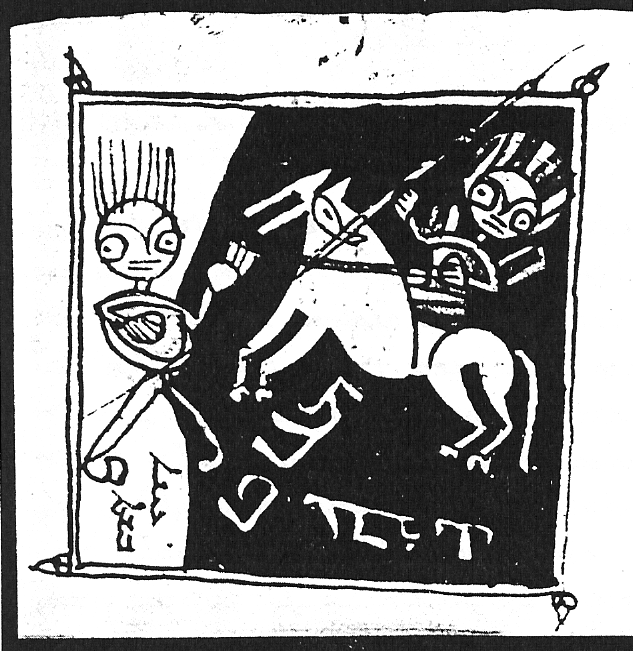
Cod. A, p. 34. The 'Angel Gabriel' on horseback in an encounter with the 'Evil Eye.' | |
§ 24. FOR THE COW WHICH DISLIKES, OR IS EXCITED TOWARDS, HER MISTRESS.60
In the name of the Father, the Son, and the Holy Ghost.
We beg of Thee, O Lord, God of Hosts, that by thy exalted
[xli]
and strong arm, this beast may be fond of and subject herself
to her mistress and her son. Guard her against the evil and
envious eye, by the power of thy beloved Son, our Lord Jesus Christ,
and by the power of the angels who minister
before Thee both night and day, who exclaim and repeat,
'Holy, Holy, Holy is the Lord God of Hosts, the heaven
and the earth are full of his glory!'61 Make this cow at
peace with her mistress A. the daughter of B., so that she
may milk her by thy living and holy command, by the sanctification
of those on high, and the action of those below, through the prayer
of my Lady, the blessed Mary, and Mar John the Baptist. Amen!
|
60. The position of [Syr.] and the endings [Syr.] are peculiar. 61. Cf. Isa. vi. 6. |
§ 25. BINDING THE COLIC AND THE COLD.
In the name of the Father, the Son, and the Holy Ghost.
(The effects) of cold are groaning and brooding, killing even
giants, to which our Lord, as a little boy, and his mother were
subject.62 In the name of our Lord, may the cold and the
colic be expelled and extirpated from one side and from two
sides, from the right side and from the left side of him who
bears these writs. Amen!
|
62. At the time of his birth, always represented in winter time. If this be the meaning, it is badly put in the original. |
§ 26. FOR TRE PESTILENCE AMONG SHEEP AND LARGER ANIMALS.
In the name of the Father, the Son, and the Holy Ghost.
Our Lord went to the Mountain of Sinai, and saw the sheep
of Abraham which Satan had killed, and he told one of the
angels to protect and help (whatever he saw) of all that
vision. May no hateful visitation approach either the cattle,
or the sheep, or whatever there is, or there will be belonging
unto the one who bears these writings, neither by night, nor
by day, nor at even-tide, nor in the morning, nor at noon-time,
[xlii]
nor sleeping nor rising. May the pestilence be annulled
from off the sheep and the cattle of the one who beareth
these writs. May no malady or sickness of Kûs,63
or sickness of Mosul, or evil and envious eye, or the wily eye of wicked
men (approach him):64 but may evil demons and (their) cursed
practices be removed from the sheep of the servant of Christ,
A., the son of B. Amen!
|
63. Cf. § 5, where I have translated
'jaundice — the sickness of Mosul'. 64. It seems necessary to supply this. |
§ 27. THE ANATHEMA OF RABBAN HURMIZD, WHICH IS OF A VAIL FOR MAD DOGS.
In the name of the Father, the Son, and the Holy Ghost.
The prayer, request, petition, and supplication of
Mar Rabban Hurmizd of Persia, son of Joseph the Chief, which he prayed
and asked of the Merciful and Compassionate God at the time
of his martyrdom. He said: O Lord, God of Hosts, I beg of Thee,
and supplicate thy Grace, that (as regards) everyone who will make
mention of thy Holy Name, and of my name — thy servant Hurmizd of the
Persians,65 may the mad dog neither bite nor put his
teeth in him: but let the destructive lion, the daring tiger,
the pig, and the lurking wolf, and an dangerous animals (be
kept aloof)66 from him and from his house, from his
sons and daughters, and from all that there is and will be unto
him who beareth these writings, through the prayer of my Lady,
the blessed Mary. Amen!
|
65. The original is Agami, old name for Persians. 66. Has to be supplied. |
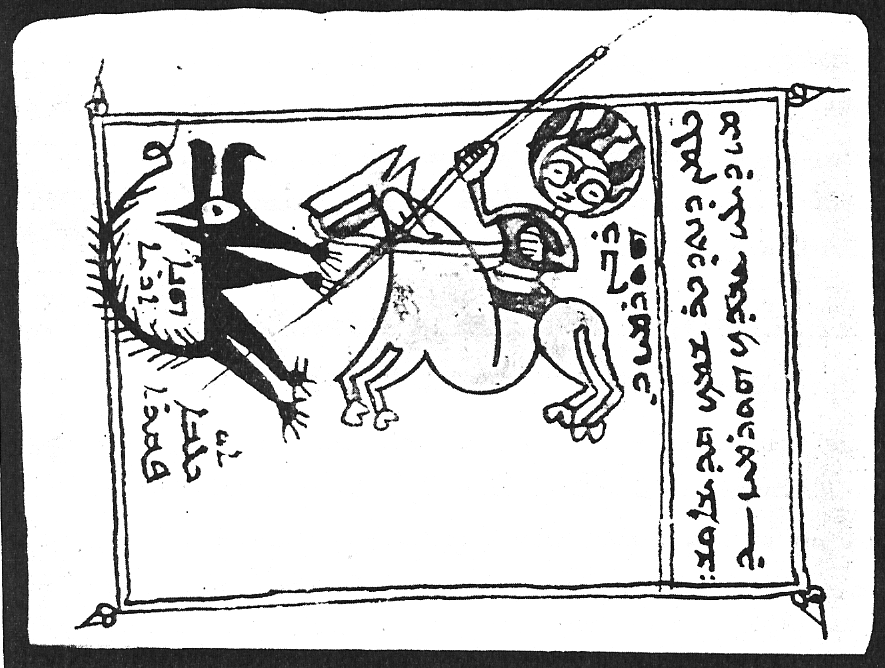
Cod. A, p. 38. Equestrian figure of 'Rabban Hurmizd' with an animal to which is affixed the description, 'This is a lion or a mad dog.' |
|
§ 28. BINDING THE FEVER.
In the name of the Father, the Son, and the Holy Ghost.
Christ suffered, Christ was crucified, Christ died, Christ rose.
May there be cut off and expelled from the body and sou1 of
A., the son of B., the hot and co1d fever, the fever-horror,
and the Jewish (fever),67 in fine, all sorts of fever. As far as the
[xliii]
East is from the West, and the North is from the South, may
there depart and be removed the hot and cold fever, the fever-horror,
and all sorts of fever from the body and soul of the one who carries
these formulae. So be it, Amen!
|
67. Cf. § 4. |
§ 29. BENEDICTION FOR VINEYARDS AND CORN-FIELDS.Pronounce the benediction over the seed:—
In the name of the Father, the Son, and the Holy Ghost.
Glory to Thee, O God! Glory to Thee, O Planter of all trees,
bearing fine fruit for the enjoyment of his servants. Bless,
O my Lord, the seed and all the crops of the one who beareth
these writs, also his vineyard, whatever he hath, and whatever
he will have, that they may be covered with joyous fruits. Remove
from them the evil and envious eye; and may drought and hard
growth, hail and locust, and the worm, and all plagues, be
annulled from off his seed, his vineyard, his crops, his
field, and from all that he hath, and will have, namely,
the one who beareth these writs. Amen!
§ 30. FOR RECONCILIATION IN THE HOUSEHOLD.
In the name of the Father, the Son, and the Holy Ghost.
Christ, the Peace of those above, and the great Rest of those
below! O my Lord, suffer thy peace to dwell among this household
of those who worship Thee: may they be in peace and harmony with
each other; as the line in the soil is to the husbandman, as the
servant is to the master, and as the maid is to the mistress, so
may the members of the household of the one who bears these writs
be rendered subservient, through the prayer of all the martyrs
and saints of our Lord. Amen!
§ 31. FOR THE JOURNEY AND FOR MERCHANDISE, THAT IS, ON BUSINESS.
In the name of the Father, the Son, and the Holy Ghost.
The Power which compelled into the Ark of Noah all
creeping things, birds, and fowl, et cetera, may He gather
[xliv]
large and fine and marvellous fortunes (lit. wedges) unto the
house of the one who beareth these writs. May the letter (of
business) proceed empty from his house, and may it return laden
(with orders): and may his business rise in the proportion
of thirty, sixty, or even one hundred to one. May his journey be
guarded against all evil enemies, and may the Lord help and
support him against all losses on his way; may the house of
the one who carries these writings be blessed in heaven and
on earth, through the prayer of Mar Isaiah of Haleb (Aleppo). Amen!
§ 32. FOR A MAN GOING BY NIGHT ON THE WAY, SO THAT HE NEED NOT BE AFRAID.
In the name of the Father, the Son, and the Holy Ghost.
O God of Abraham, Isaac, and Israel! O God of our Fathers,
just and righteous ones! O God, Father of our Lord Jesus Christ,
we beseech Thee, and supplicate thy Greatness for the hour on
which the one who bears these charms sets out on the way; may
thy care accompany him, thou preserving his body and soul from
all dangers, and delivering him from all obstacles. As thou
wast with Joseph in, the land of Egypt, and with Daniel in the lions' den,
and with those or the house of Hananiah in the fiery furnace, and with
Jeremiah in the pit of mire, so be thou with this thy
servant who bears these writs: lighten off from him the
tedium or the journey on which he sets out and is taking:
cause him to abound with a good result, being (his) support
and redeemer. Grant him a winning countenance in the sight
of all men: and as regards the land whither he goes, suffer
him, O my Lord, to return with his mouth full of thanksgiving,
and his tongue full of praise: so that he may return to his house
in joy and gladness, and send up to thee praise and glory, and to
thy glorious Name thanksgiving and adoration, (O thou, who art)
the Protector of thy servants, and the Helper of those who fear Him. Amen!
§ 33. FOR NOISES AND SOUNDS.
In the name of the Father, the Son, and the Holy Ghost.
By thy name, O God, the Hope of all those who are bound,
I bind the Satan and hindrance (lit. dispute) to the handiwork
of man; and further the sweet and harsh sounds which cling to
the temples corresponding to the eyes of him who beareth these
Charms. I bind them away from his head, from his eyes, from his
cheeks, and from the brain of his head: and it is not in your
power to beat or to revolve in the head or in any of the members
of the one who bears this charm, through the prayer of my Lady,
the blessed Mary, and of Mar John the Baptist, and of Mar Abraham Senior,
and of Mar Abraham Kidunaya, and of Mar Simon bar Sabai. Amen!
| |
§ 34. FOR THE ADVANTAGE OF THE HOUSE.
In the name of the Father, the Son, and the Holy Ghost.
May He who satisfied a thousand in the desert, when they
ate of a little bread,68 bless this table, that it may be full
and rich, so that the poor may eat and be satisfied, and the
orphans be fed from it.69 May all the crowds be seated
around it as (around) the table of Abraham, the Chosen;70
[and as he was blessed, and as were blessed] David, both
king and prophet, Solomon and Hezekiah, Daniel and Josiah,
and Constantine the Just,71 so, my Lord, may be blessed this
house, that is, that of thy servant, and may it abound in all
good things. O my Lord, bless those who keep it in good order:
bless, O our Lord, those who work in it: bless, O my Lord, his
house: bless, O our Lord, those who dwell therein. O our Lord,
shield his house, and cause to dwell therein the blessings
(wherewith) He blessed the righteous and the
[xlvi]
fathers,72 the workers of miracles and signs. May his table
be blessed, and his wealth be increased: may his dead ones rise,
may their sins and faults be atoned: [may he be blessed] now
and for all time, for ever and ever. Amen!
|
68. Cf. Matt. xiv and xv; Mark vi and viii; Luke ix; John vi. 69. This whole section is rhymed in the original; at all events it has a rhythmic ring about it. 70. Abraham, always regarded as the type of hospitality to strangers. 71. [Syr.] 'meritorious', 'victorious', 'holy', 'pure', often 'Christian'. 72. Should perhaps be 'the righteous fathers'. |
§ 35. BINDING THE MOUTH OF WOLVES FROM OFF THE SHEEP AND LARGER ANIMALS.In the name of the Father, the Son, and the Holy Ghost. The prayer, request, petition, and supplication73 of Mar Daniel the prophet, when he went down into the den of hungry lions, and they did him no harm.74 May there be bound, sealed, and bridled the mouths of wolves, bears, and lions, the mouth of every destructive animal, from off everything that there is and will be to the one who bears this charm, by the staff of Moses the prophet, and by the ring of Solomon Bar Jaki,75 — from off the cattle and the sheep of A., the son of B. Furthermore, may there be bound, sealed, and bridled their mouths and their tongues, so that if it be open it may not bend it to, and if it be bent it shall not open; by the prayers of Rabban Hurmizd, and by the request of Mar Elias, and by the supplication of Mar Daniel the prophet, may the mouth of wolves, bears, and all (destructive) animals be bound. Amen!
Pronounce the benediction over the Knife.76
|
73. [Syr.] is the general term for prayer expressed by the mouth;
[Syr.] prayer by word of mouth accompanied by signs with the
hand; [Syr.] worship by prostrating oneself, with hands and face
on the ground; [Syr.] the act of kneeling on the ground and
opening the arms in heartfelt prayer. 74. Dan. vi. 17 sqq. 75. Vide Introduction. 76. This may belong to the next section or to the present one, coming, of course, at the beginning: or, it may be the introduction of another incantation which the writer omits to give. |
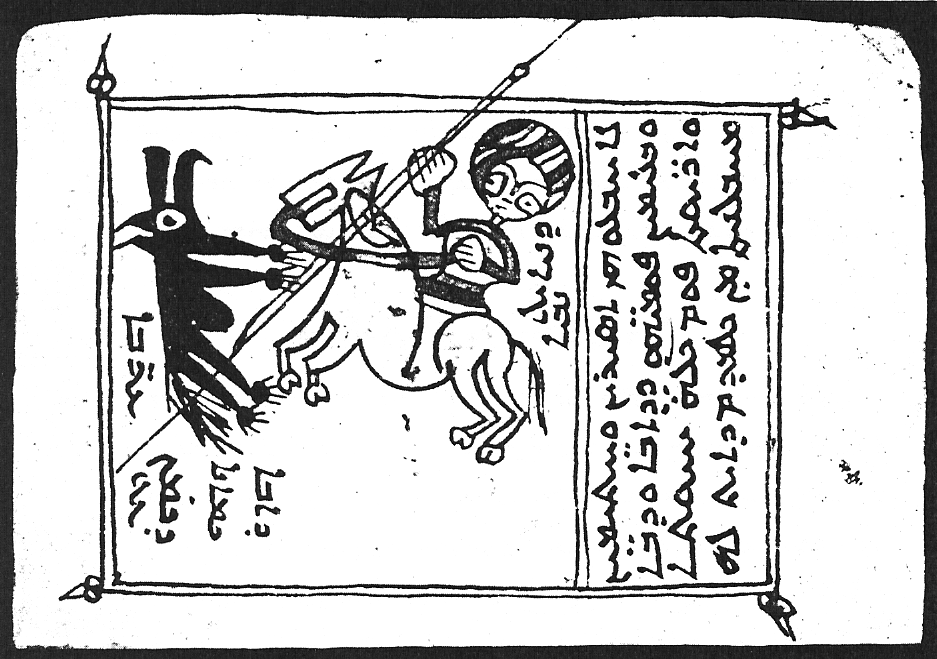
Cod. A, p. 47. 'Daniel the prophet' on horse with 'the cunning wolf lying in ambush for the sheep. | |
[xlvii]
§ 36. BINDING FALSE DREAMS.
In the name or the Father, the Son, and the Holy Ghost:
and by the name I Am That I Am, Almighty God, Adonai,
Lord of Hosts; and by the name or Christopher, and by the
name or Rabban Hurmizd, and or Mar Pityon, I bind,
anathematize, expel and extirpate those evil dreams and all
the phantasy or demons that comes at night and by day from
wicked demons and from false dreams, [I expel them] from
the chambers or the one who carries these writs. As thou
didst expel the Legion from the man that dwelt in the
tombs,77 so may there be distanced and expelled from the one
who bears this charm all78 evil dreams and startling visions,
excitements and anxieties, heaviness and discharge,79 weeping
and worrying, dreams evil and false. Amen!
|
77. Matt. viii; Mark v; Luke viii. 78. I read [Syr.] for [Syr.], which latter makes no sense. 79. I take [Syr.] = [Syr.] Lev. xii. 2, 5; xv. 19, 20. |
§ 37. BINDING THE SERPENTS.
In the name of the Father, the Son, and the Holy Ghost.
As for the crouching lion and the young dragon, I bind their
feet, and may they (lit. their soul) enter into the iron chains.
As for the poison of the accursed serpent, like that of the
deaf adder [that will not hear] the voice of the whisperer,
the charmer, and the enchanter,80 May God break their teeth
in their mouth,81 and the Lord uproot the serpents' teeth.
Thou didst break the heads of the dragons in the water, thou
didst crush the heads of the dragons of Leviathan,82 and of all
[xlviii]
serpents: of the speckled serpent, the red serpent, the black serpent,
and the white serpent, the offspring of deaf serpents.
|
80. Cf. Ps.lviii. 4-5. [Syr.] the man who calls the serpent out of the
ground; [Syr.] the one who gives the people power to touch the
serpent without risk of being bitten. 81. Ps. lviii. 6. 82. PS. lxxiv. 13-14. |
|
And the serpent went and adorned herself; she prevented
and joined the body of the peacock;83 she prevented by
cunning, which has exercised itself thenceforth and unto all
eternity. Amen!
|
83. Vide Introduction (Weil's Biblical Legends — 'The Peacock
and the Serpent'). It is interesting in this connexion to compare the Rabbinic
interpretation of Gen. vi. 7 in the Midrash, Bereshith Rabba, § 28 (towards
the end):— ìöà êìåä äéä áìëä ,ìåáîä øåãá ïäéùòî åì÷ì÷ ìëä /âå ,íååîä ìöà êìäî äéä ìåâðøúäå ,áàæä. |
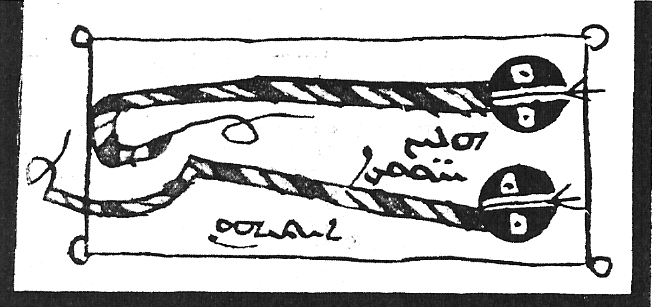
Cod. A, p. 49. 'Two serpents.' |
|
§ 38. BINDING THE SCORPIONS.
Put together the two scorpions: (then say):— Thou art
sealed, bridled, and stopped by the two angels Gabriel and Michael.
I bind the mouth of the scorpions by the staff of Moses the Prophet,
by the mantle of Elisha,84 by the ascent of Elijah, and by the ring of Solomon bar Jaki.85 Amen!
|
84. Cf. Codex B, § 5. For [Syr.] see Nöldeke's
Syriac Grammar (Eng. Edit., p. 58). 85. See Introduction. |
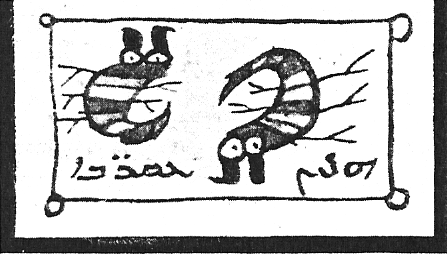
Cod. A, p. 50. 'Two scorpions.' | |
§ 39. As REGARDS CATTLE, THAT THE EVIL EYE SHALL NOT TOUCH IT.86
In the name of the Father, the Son, and the Holy Ghost.
[I said] to the seven accursed brothers, sons of the evil and accursed man:
'Whither are you creeping along on your knees, and moving upon your feet,
and crawling upon your hands?' The wicked sons of the wicked and accursed
man replied: 'We are creeping along on our knees, walking upon our hands,
and moving upon our feet, so that we may eat flesh, and drink [blood] in
our palms.' And when I saw them,
[xlix]
I cursed them in the name of the Father, the Son, and the Holy Ghost,
which is Eternal, and a third of God: (saying),
'You are accursed and bound in the name of Gabriel, Michael, and
Azrael, the three holy angels; in the name of that angel who
judged the woman that combed (the hair of) her head on the eve
of holy Sunday; and in the name of the Lord of the angels; so
that you may not proceed on your way, nor finish your journey.
May God break your teeth, and cut the veins of your head, and the
nerves87 of your teeth, (keeping
them off) from the cattle of the one who carries these writs.
As the smoke vanishes from before the wind, may they vanish,
in the name of the Father, the Son, and the Holy Ghost; in the
name of the Father, the Fatherhood, in the name of the Son, the
Lordship, and in the name of the Holy Ghost, the Emanation: in
the name of the glorious Trinity, now, and for all time, for
ever and ever. Amen!'
|
86. Cf. 87. [Syr.] is modern, [Syr.] old Syriac for 'nerves' or 'vein '. |
§ 40. FOR FAVOUR IN THE SIGHT OF ALL MEN.
In the name o£ the Father, the Son, and the Holy Ghost.
As God loved Solomon, and he subjected the rebellious devils
by his ring;88 and as God loved Moses, and divided the Red Sea
before him: and as God loved Joseph, and made him, in
place of a servant, lord over all Egypt, so, O Lord, God of Hosts,
cast the flame [fire] of benevolence towards the bearer of these
writs into the heart o£ rulers, judges, prefects, chiefs, officers,
and commanders. I bind and bridle their mouths and tongues by the
power of Elijah the Prophet, by which he bound the heavens three years
and six months,89 so that no rain came down upon the
earth; and by the name. I Am That I Am, Almighty God, Adonai, Lord of Hosts.
Amen!
|
88. Vide § 41. 89. Luke iv. 25; Jas. v. 17. Cf. 1 Kings xvii. 1, xviii. 1. |
[l]
§ 41. THE NAMES90 ON THE RING OF KING SOLOMON, WHICH ARE OF AVAIL BEFORE KINGS.In the name of the Father, the Son, and the Holy Ghost. HKUPS PTPNT LMPS DHST PSDMST SHHLT RHMT VHLIPT LMSTMPS SHCLLT TURSF KPIDT DMPST MRIPT PSJT HSPT SHPLT CTIBT PSJT DMPS BRULHT HKIKT TRCLT PPT PRISHT ALILT PPISHNT JSHRIET PLISHT91 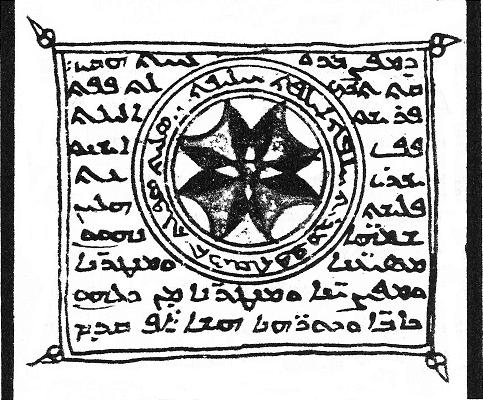
|
90. See Introduction. 91. In the circle occurring on p. 54 of the MS., around the border are these expressions:- SLJT SFILT TRIKT PPMRJT HLFT ILFT HLIFT |
|
May these names be a support and a precaution and a (means
of) redemption and protection against all pains and sicknesses:
also now (a precaution) before kings and judges so that there
may be a frank countenance to the one who carries this charm. Amen!
§ 42. BINDING THE SORCERERS.
Confound them, Harshael, Gabriel, and Azrael! Silence
(lit. 'make dumb') the hearts and thoughts of wicked men,
and evil rulers and oppressors, from off the one who bears
this charm. In the name of Tumael stop their lips with something
bad and horrid (when) with the one who bears this charm, through
the prayer of my Lady, the blessed Mary. Amen!
| |
[li]
§ 43. FOR A WOMAN IN TRAVAIL.
Write upon a leaf and give her to swallow: In the name
of the Father and the Son, Lazarus, come forth';92 or this
(expression), 'Mary bore Christ, and he silenced all natures.'
|
92. John xi. 43. |
§ 44. FOR MILK NOT TO SPOIL.In the name of the Father, the Son, and the Holy Ghost. By the name of Mar Artemus and Balnus, by these holy names, they who were in the cavern of the earth for forty years, and were praying to God on this account, that He might be the protector of this milk, that cream may be therein as the sand of the seas; by that angel which formeth the foetus in the womb of their mothers: so may there form and be healthy the milk of A. . . . B., and like Gihon93 may its curds and cream94 come, also as a fountain that flows in Eden,95 by the adored and glorious Name of the Living God. So be it. Amen!
Say the benediction96 over the salt, and give (of it)
to the cow to eat, and part of it (cast) into the fire, and part
of it into the milk.
|
93. Gen. ii. 13. 94. [Syr.] fresh butter (not boiled), and so would not keep; [Syr.] is butter boiled and put in jugs, able to keep for months. 95. Cf. Gen. ii. 10. 96. The proper place for this benediction is evidently immediately after the former heading, § 44. |
§ 45. BINDING THE NAVEL.Say the benediction over the egg, and give him to eat.
In the name of the Father, the Son, and the Holy Ghost.
I bind the navel of A., the son of B., like a bull in the yoke,
like a horse by the bridle, and like a dead person in the grave,
and like a bird in the snare and in the net. I bind his navel by
that power with which Elijah the Prophet bound the heavens for
three years and six months, so that no rain
[lii]
came down upon the earth.97 By that power shall come and
be bound the navel of A., the son of B. By that power with
which Mar Cyprian bound women who were with child, so
that they should not bring forth, and barren women that they
should not conceive, do I bind the navel of the one who carries
this charm. So be it. Amen!
|
97. Luke iv. 25; Jas. v.17. Of. 1 Kings xvii. 1, xviii. 1. |
§ 46. THE ANATHEMA OF MAR SHALITA, WHICH IS OF AVAIL FOR THE EVIL SPIRIT.
In the name of the Father, the Son, and the Holy Ghost.
The prayer, request, petition, and supplication of Mar Shalita,
which he prayed and asked of God at the hour of martyrdom.
He said: O my Lord, Jesus Christ, (as regards) everyone
who shall make mention of thy Holy Name, and of my name,
thy servant Shalita, may no red spirit nor evil spirit approach
him, (but may it be expelled) from98 the body and from the
soul of A., the son of B., by the prayer of blessed Mar Augin
(Eugenius). Amen!
|
98. If translated according to my foot-note in the text, it would be:— 'May no. . . . . evil spirit approach him, i.e. the body and soul of, &c.' |
§ 47. BINDING THE MOUTH OF THE SPARROW AND THE MOUSE.
In the name of the Father, the Son, and the Holy Ghost.
I bind the mouth of the eater, and of the mouse, and of the
sparrow, and of the winged creature, and of the cattle. I bind
them by the living Sign of the Cross of our Lord, and through
the prayers of my Lady, the blessed Mary, and by Him who bound
heaven, earth, the springs, and the rivulets, the cattle, the
winged creature of heaven, and the worm. I bind the mouth of
creeping things, of the eater, of the mouse, of the sparrow, and
of the bird from off the crops of him who bears
these writs. I bind them by Him who descended from heaven,
[liii]
presenting the sacred mysteries.99 I bind the mouth of the
eater, of the mouse, of the sparrow, of the winged creature, and
of the cattle; I bind them by the living Sign of the Cross of
our Lord, through the prayer of my Lady, the blessed Mary,
from the field of A., the son of B. Amen!
|
99. The Holy Sacrament, Mass, &c. |
§ 48. BINDING THE FIRE FROM OFF THE STALKS AND STANDING CORN.
By the Divine Power which extinguished the fiery furnace
from off those of the house of Hananiah, Azariah, and
Mishael,100 may He extinguish the fire and the flame, that
it burn not the heaps of corn and stalks, nor the house of A.,
the son of B.: by the Divine Power which extinguished the
fiery furnace of Mar George, may He extinguish the fire and
the flame, that it burn not, nor set light to the heaps of
corn, or the stalks, nor to the house of the one who carries
these writs. Furthermore, I bind, expel, and extinguish the iron,
and again I bind the flint-stone,101 that fire may not, proceed
from them: I bind the fire that it shall not burn.
|
100. Dan. iii. 101. Refers to the practice of rubbing steel against flint-stone, so as to produce sparks. The steel for this purpose is called in modern Syriac [Syr.] (Chakmak), not [Syr.]. The [Syr.] is a very hard yellow stone, sharp as a razor, often used to shave with; while [Syr.] (Kau) is the name for the cotton used in catching the spark. To make this [Syr.], grass is burnt to cinders, and water is poured on the cinders; the water is allowed to stand for two days, after which it becomes quite yellow; cotton is soaked in it for a few hours; it is then dried, and becomes easily ignited. |
|
The winds and the whirlpools are the work of his Word:
and Kedar shall be pastures.102 He causes the winds to blow,
and they cause the waters to descend.103 I bind their hands
and feet (i.e. of the incendiaries); their back shall always be bowed
down. I bind the iron and the flint-stone, that no fire may proceed
from them. By the Word which Elijah spake,
[liv]
who bound the heavens for three years and six months, so
that no rain came down upon the earth: by that selfsame
Word I bind the iron and the stone, that no fire shall come
out of them, that it may not kindle, nor burn the herbs or
the corn of A., the son of B. Amen!
|
102. Cf. Isa. xxi. 16, xlii. 11, &c. 103. Ps. cxlvii. 18. |
§ 49. FOR BLOOD COMING FROM THE NOSTRIL.Zechariah had his throat cut, and the fountain of waters104 was stopped. So may the blood of A., the son of B., be stopped. Amen!
Write105 with the blood of him (whose nose is bleeding) on
his forehead with a stalk of wheat.
|
104. Cf. Jer. ii. 13 ; Eccles. xii. 6; Zech. xiii. 1; Mark v. 29, &c. 105. Probably, 'write' the preceding formula: 'Zechariah, &c.' |
§ 50. FOR BOYS NOT TO CRY.In the name of the Father, the Son, and the Holy Ghost. In the name of Jamlicha, and Maxinos, and Martlos, and Serapion, and Johanis.
As those seven brothers who slept the sleep (of) 377 years,106
so may A., the son of B., be at rest and sleep; yea, may he
sleep the sleep of the man of valour, by the prayer of the
prophets and apostles. So be it. Amen!
|
106. Referring to seven noble youths of Ephesus who in the Decian persecution concealed themselves in a cavern, in which they slept for several centuries, then awoke for a short time only to expire. Cf. the Koran (Sale's edit.), ch. xviii, entitled 'The Cave': 300, 309, and 372 are the years of sleep according to the various versions, whilst the number seven is doubtful as regards the sleepers. Gibbon has the story in one form, giving the name of one of the sleepers as Jamblichus. Citing Gregory of Tours, De Gloria Martyrum, i. 9, the names of the seven are given as Constantine, Dionysius, John, Maximian, Malchus, Martinian, and Serapion. For the name Jamlicha or Jamblichus cf. 1 Chron. iv. 34. Other names are: Antoninus, Hexecostadianus, Martelius. |
[lv]
§ 51. FOR THE MAN UPON WHOM SORCERY HAD BEEN PRACTISED.
Jannes and Jambresl07 practised the magical arts; but they
were unable to stand against Moses the prophet. So may there be annulled
divination and the bonds of magic from off A., the son of B. So be it. Amen! Amen!
|
107. 2 Tim. iii. 8. These two names (Gk. 'Iannhz and 'Iambrhz) occur in the Hebrew garb of ñéðé (ñåðåé) and ñéøáîé (ñéøîé or ñåøáîåé); vide Midrash Tanhuma to Exodus xxxii. 1 on the words, 'And when the people saw that Moses delayed, &c.' They are supposed to be but another form of àøîîå éðäåé Johani (Johannes) and Mamre, the two chief magicians of Egypt at the time of Moses, to which a reference occurs in the Talmud, T. Menahoth, 85 a. This passage is interesting. |
§ 52. THE ANATHEMA OF THE FATHERS,108 i.e. OF PARADISE, WHICH AVAILS FOR ALL PAINS.
In the name or the Father, the Son, and the Holy Ghost.
By the prayer of the just and righteous Fathers, Paul, and
Antonis (Antonius), and Makris (Macarius), and Arsanis (Arsenius),
and Serapion, and Mar Paula of Shemishat, the
blessed Enoch and Elijah, Mar John the Baptist, Mar John T'yaya,
Mar John of Cashcar, Mar John Agubtaya, Mar John Kank'laya, Mar John Nach'laya,
Mar John the Pastor, Mar John of Mobadra (Modra?),109
Mar John the Golden,110 Mar John of Susina (sic),
Mar John bar Abgar, Mar John bar Martha, Mar John bar Edtha, Mar John Zoebi,
Mar John of Dassan, Mar John the Evangelist, Mar John Chemulaya,
Mar John of Azrak, Mar John of Jilu, Mar John of Urmiah,
Mar John of Anzal, Mar John of Zana,111 Mar John
[lvi]
the question-answerer, Mar Azad, Mar Buchtazad, Mar Gushtazad,
Mar Simeon of Shenna, Mar Abraham, Mar Georgis the Martyr,
and Mar Koriakas (Cyriacus) the Martyr, Mar Augin (Eugenius) and
all his order, and Mar Shalita and his order, and Mar Dubina, chief of
hermits, and the three hundred of the exalted monastery of Beth Sidra,
and Shamuni with her sons, and the poor woman and the two sons of Shushan,
Mar Pityon, and Rabban Pityon, by the prayers of Gaddi (Caddis), Makbi (Maccabeus),
Tarsi (Thassi), Hebron (Avaran), Hebson (Apphus),112 Bacchus and
Jonadab,113 Eleazar,114 and Shamuni the martyr,
Phebe,115 and Tabitha,116 and Ansimus, daughter of kings,
Martha,117 and Mary Magdalene,118 and
Mar Aha, and Mar `Abd-îshô`. With these their names,
and of those others that exist, I bind, anathematize, expel,
and extirpate all abominable actions, revenge, and evil spirits,
and all the wiles of cursed devils devoted to destruction,119
from the body and from the soul of A., the son of B. So be it. Amen!
|
108. For the fuller list of Father's, see the corresponding passage
in Cod. B, § 5. 109. City of Mesopotamia, not far from the river Tigris (Payne-Smith). 110. Golden-mouthed, adding [Syr.] before [Syr.] evidently Chrysostom, 'the golden-mouthed,' known as [Syr.]. 111. Jilu, Anzal, Zana are near Urmiah in Turkish Kurdistan. Urmiah [Syr.] or [Syr.] occurs as Urmia, Urumijeh, Urumijah, &c. 112. These five are the names of the five sons of Mattathias (see 1 Macc. ii. 1-5). 113. Bacchus and Jonadab are given in Wright's Cat. of Syriac MSS. in B.M. (p. 547), 'written in a later hand on the margin', as two of the seven sons of Shamuni, the other five being given as Makbi, Tarsi, Hebron, Hebson, Gaddi (Gedad) — the very names of the sons of Mattathias. 114. 2 Macc. vi. 18-31. 115. Rom. xvi. 1. 116. Acts ix. 36. 117. Luke x. 38 sqq.; John xi. 1 sqq. 118. Matt. xxvii. 56; Mark xv. 40. 119. According to one reading; or 'I excommunicate', according to the other. |
§ 53. CUTTING120 OUT THE ITCH (OR 'BOIL').121Say the benediction over ashes three times. In the name of the Father, the Son, and the Holy Ghost. O Itch, brazen serpent! Who is it that showed thee upon the [lvii] Mountain of Tarmaka122 and upon the dry log123 (trunk or root of tree)? Even so dry up the itch of A. B. Therefore may God root thee up, and destroy thee for ever from thy dwelling, and thy root from the land (i.e. surface) of the members of A. B. In the name of I Am That I Am, Almighty God, Adonai, Lord of Hosts, I cut it out on earth; God heals it in heaven. So be it. Amen!
The finish. By the right hand of thy dominion, O my
Lord, Our Father which art in heaven, bless, O Lord, the
bearer of these writs: protect, O Lord, the bearer of these
writs: support the bearer of these writs: shield, O Lord, the
bearer of these writs: help, O Lord, the bearer of these writs:
may thy mercies and the compassion of thy Godhead be continually
poured out in abundance upon the one who bears these writs, now,
and at all times, for ever and ever. Amen!
|
120. [Syr.] might mean either 'section' (of a book) or 'cutting out'. 121. In modern Syriac [Syr.] signifies a 'boil' or 'button', 'sore' or 'itch', and is practically identical with 'leprosy'; There may be a legend that the 'serpents' of Num. xxi were in reality the plague of 'leprosy', which was sent as a punishment for slander, as in the case of Miriam, the sister of Moses (Num. xii. 1,2, 10). In Deut. xxviii. 27 we have botch, scab, and itch ([Syr.]) in juxtaposition, whereas 'leprosy' is always rendered [Syr.] in the Syriac (Scriptures). According to Rabbi Hoshya, of Sichnin, in the name of R. Levi, the serpent was cursed with leprosy, seeing that it is spotted and speckled (Midrash Rabba to Genesis iii.15). 122. Cf. p. 50, B 44 'Mark of Tarmaka'. 123. Evidently referring to Moses putting the brazen serpent upon the dry pole: Num. xxi. 6-9; John iii. 14, 15. |
§ 54. DETAILS (METHOD OF RECKONING) CONCERNING SICK PERSONS, FROM WHAT SOURCE THE SICKNESS COMES UPON THEM.In the name of our Lord, I write the details (method of reckoning) concerning sick persons, from what source (the sickness) comes upon them. Take the numerical value of his name, and the name of his mother, and subtract124 (the number) 9 in each case.125 |
124. [Syr.] might equally well mean 'divide', for the Syrians did not
divide as we do, but by the process of 'subtraction'. 125. It has been suggested to me that this might mean: Divide by 9 so many times till one 9 or less than 9 remains. |
|
[lviii]
If 1 remains, (it implies that) on the first day of the week
(Sunday) the illness began; at sunset the Evil Eye took a hold
on him from the head, and from the shoulder, and from the neck.
Nine days it lasts.
| |
|
[In] the monastery of Mar John [you will find]l26 the prescription
(lit. 'writing') for the Evil Eye.
|
126. This is the only meaning we can assign to this and the following similar passages. |
|
If 2 remains, (it implies that) on the second day of the week (Monday), at the new-moon, the malady commences, (arising) from his stomach, and from his back, and from his heart, and from his entire body. His illness is from God. Three days it lasts.
[In] the monastery of Peter and Paul [you will find] the
prescription (lit. 'writing') for every kind (of illness).
If 3 remains, (it implies that) on the third day of the week
(Tuesday) the warm and dry sickness (took hold of him): the
pestilential atmosphere (lit. 'the air of devils') fell upon him.
Let him bathe in water and butter: make three coils of his clothes,
put one under his head, one on his right, and one on his left.
Sixteen days it lasts.
| |
|
[In] the monastery of Mar `Abd-îshô` [you will find] the
prescription (lit. 'writing '): I will lift up mine eyes unto the
mountains.127
|
127. Cf. Ps. cxxi. 1. |
|
And if you have 4 remaining (it implies that) on the fourth day of the week (Wednesday) was the atmosphere of the devils. He crossed the water, and did not call upon the name of the Living God: there is, further, the Evil Spirit (which caused the sickness). Let him give alms to the orphans. Seventeen days it lasts.
[In] the monastery of Mar Shalita [you will find] the prescription (lit. ' writing') for the Evil Spirit.
If 5 remains to you, (it implies that) on the fifth day of the week (Thursday) the illness began from over-feeding, and for not having called upon the name of our Lord. The atmosphere of demons fell upon him, and he has, further, the spirit of devils. Sixteen days it will last.
[In] the monastery of Mar Sergius [you will find] the
prescription (lit. 'writing') for one who has devils within him,
(sprung) from the blood of black hens.
If you have 6 remaining, the sickness began on Friday from being close to a smell. The malady originated from his head, from his heart, and from his chest. He requires a charm of two lengths. Twelve days it will last.
[In] the monastery of my Lady Mary [you will find] the
prescription for lunacy.
| |
|
If 7 remain to you, (it implies that) on the Sabbath Day
(Saturday) the creeping fear128 fell upon him; the sickness
(originating) from the lower part of his body,129 and from
his heart, and from his head, the trembling came upon him.
Fetch earth from seven ways, and from seven tombs,130 and
from seven springs of water, and water (from) under the mill, and read
over them (the portion):— 'In the beginning.'131
Then let him bathe in them. Twenty-one days the illness will last.
|
128. Or fear (called) [Syr.]; cf. Deut. xxxii. 24, and Micah vii. 17. 129. Perhaps the Latin cauda. 130. [Syr.] 'sepulchres', not burying-grounds: cf. Matt. xxiii. 29. 131. Most likely St. John, ch. i. |
|
[In] the monastery of Mar George [you will find] the
prescription for fear and trembling.
If 8 remains to you, (it means that) on Wednesday he had an evil vision of having been smitten by the Satan. His entire system is deranged. Twenty days it will last.
[In] the monastery of Mar Ezekiel [you will find} the
prescription for the evil spirit.
If you have 9 remaining, (it means that) on Friday he was sitting on a clod of mud or on a drain; he did not pronounce (lit. 'cause to come, take') the name of God. Under the threshold of the house the atmosphere of Zarduch fell upon him. Nineteen days it will last.
[In] the monastery of Mar Cyriacus [you will find] the prescription
as you wish (i.e. for whatever illness you like).
| |
|
This manuscript is finished in the blessed month Tammuz,
on the 30th day thereof, in the year 2114 of the blessed
Greeks.132 Amen!
|
132. Corresponding to 1802-3. |
|
This manuscript is finished under the roof (or 'bishopric')
of Mar George. Amen!
| |
|
This manuscript has been written in the name (by order)
of the blessed young man, the beautiful branch, Tarveran,
son of the deceased Zarunda (?);133 his mother is called
Elizabeth (?),134 of the blessed village Shibani. Anyone
into whose hands this manuscript shall fall, and he does not return
it to its owner, shall be under the ban of the 318 Fathers.
So be it. Amen!
|
133. MS. faulty. Payne-Smith has [Syr.], Zarvandades,
nom. duorum e duodecim Magis qui Dum nostrum adorabant. 134. MS. faulty; probably Elizabeth. |
|
This manuscript is finished at the hands of the feeble,
sinning, wicked, impure, and infirm one, that is, the priest
George, son of the deceased Zaia, of the blessed village
Shibani. Amen, Amen!
[lxi] CODEX B§ 1. By THE POWER OF OUR LORD, JESUS CHRIST, WE BEGIN TO WRITE (THE WORK ON) 'THE PROTECTION OF MANKIND'. | |
|
Foremost above all things, that prayer which our Lord
taught his disciples:1 Our Father which art in heaven,
hallowed be thy name. Thy Kingdom come, and thy will be done,
as in heaven, so on earth. Give us the bread which we need for
the day. Forgive us our trespasses and sins as we also forgive
those who sin against us. And lead us not into temptation, but
deliver us from evil; for Thine is the Kingdom, the power, and
the glory, for ever and ever. Amen.
|
1. Matt. vi. 9-13; Luke xi. 2-4. |
§ 2. THE PRAYER OF OUR FATHER ADAM.
We acknowledge Thee, O Lord of All: and thee, O Jesus Christ,
we glorify, for thou art the reviver of our bodies, and the
redeemer of our souls.
| |
§ 3. THE PRAYER OF THE HOLY ANGELS.
O holy God, holy Mighty One, holy Immortal: O our
Lord, have pity upon us: O our Lord, receive thou
our petition: O our Lord, be gracious unto thy servants
who bear these writs (amulets). Amen!
| |
§ 4. THE HOLY GOSPEL OF OUR LORD JESUS CHRIST, THE PREACHING OF JOHN.2
In the beginning was the Word, and that Word was with God. And this
Word was God, and the same was in the beginning with God. And everything
was by his hand, and without him there was not one thing (made) of that which
[lxii]
was. In him was life, and the life was the light of men.
And that light shineth in the darkness, and the darkness
preventeth it not.
|
2. John i, 1-5. |
|
By the power which is concealed in those Ten Holy Words
(Commandments) of the glorified Godhead, and by the name
I Am That I Am, Almighty God, Adonai, Lord of Hosts, may there
be expelled, extirpated, chased and dashed in pieces all those
accursed and rebellious demons, devils, and phantoms, and all
(evil) working: all temptations, unclean spirits, cruel dreams
and dark apparitions: fear and trembling, terror and surprise,
dread, anxiety, and weeping to excess: the fever-horror and the
three-days' one, aye, all kinds of fever, and febrile ills,
inflammations, burnings and piercings:
also (when) the child troubles its mother with the
pains of travail: and as for tumors and pestilences,
the designs of demons, the wiles of apparitions, and
the accidents of devils, sweet and harsh musical sounds,
and the sweet and harsh noises, all pains and all sicknesses,
all wounds and all oppositions, surprises, revenges and Zarduch,
and all (evil) working, the nine sicknesses, and Miduch,2b and the
demon and Lilith, [may they all be expelled] from the body and
members of him that beareth these writs. Amen!
|
2b. Miduch and Zarduch are alternate names for the demon called the 'the strangling mother of boys' in Codex B, § 6. -JHP |
|
By that Divine power which healed the mother-in-law of
Simon Peter of the fever-horror,3 and cast the devil out
of the governor, and by that Will and glorious command that commanded
the fish and it spewed out Jonah, and drove Adam out of Paradise: (by
that voice) that cried out on the Cross, by that Power that stopped
the sun, and caused the moon to stand still, and by those who cry out
night and day, 'Holy, Holy, Holy is the Lord, God All-powerful, heaven
and earth are full of his glory.' By the prayers, too, of Hezekiah,
and by the prayers of my Lady, the blessed Mary, and of Mar John,
the forerunner of Christ, may he who bears on his person these writs
be helped and healed. Amen!
|
3. Matt. viii. 14,15; Mark i. 30,31; Luke iv.38, 39. |
|
[lxiii]
And as ye go, preach, saying, The Kingdom of Heaven is
at hand. Heal the sick, cleanse the lepers, and cast out the
devils: freely ye have received, freely give,4 and preach my
gospel to all the world. He who will believe and be baptized will live,
but he who does not believe shall be condemned. Signs shall follow those
who believe these things.
|
4. Matt. x. 7, 8. |
|
By my name devils shall go forth, and they (the believers) shall
speak with new tongues: they shall take serpents in their hands,
and though they shall drink the deadly poison, it shall not hurt
them; and they shall place their hands upon the sick, and they
shall be cured.
He (Christ) said: There has been given unto me all dominion in
heaven and on earth: and as my Father has sent me, thus do I send
you. Go, then, teach all the peoples and baptize them in the name
of the Father, Son, and Holy Ghost: and instruct them to observe
all that I have commanded you. And lo, I am with you all the days,
even unto the end of the world. Amen!
| |
§ 5. THE ANATHEMA OF PARADISE,5 WHICH IS OF AVAIL FOR ALL SICKNESSES AND DISEASES.
In the name of the Father, Son, and Holy Ghost.
In like manner as the Lord, the All-powerful God,
planted the Garden in Eden, and placed therein a
large fountain, and distributed from it the four
rivers, Gihon, Pishon, Daklat (Hiddekel), and the great river Euphrates;6
and they sprang forth and watered the four corners of
the world: and just as none of humankind can withstand
and prevent them, so, O Lord, God of Might, let not evil
men, cursed and deceitful demons, hinderers and devils,
fear and trembling and dread, and all sicknesses and diseases
have power over [but let them be driven away from]7
the body of him who carries these writs. Amen!
|
5. Cf. Cod. A, § 52. 6. Gen. ii. 8-14. 7. Vide note on text. |
|
[lxiv]
By Him who looketh at the earth, and it trembles, and at
the fountains of water and they turn to blood: by that
Presence which dwelt upon Mount Sinai: by the praises of
the Cherubim, by the sanctification of the Seraphim, by the
powers and sovereignties, by the principality and dominion,8
by the nine regiments of angels who glorify that Chariot
upon which shineth the glorious majesty of the Living God.
By the creation of Adam and Eve, by the offering of Abel and
Jephthah, by the beauty of Seth,9 by the revelation
of Enosh,10 by the translation of Enoch,11
by the offerings of the just and righteous patriarchs, by the ark
of Noah, by the priests of Melchizedek, by the faith of Abraham,
by the sacrifice of Isaac, by the ladder which Jacob saw, by the
staff of Moses, by the priesthood of Aaron, by the chastity12
of Joshua, son of Nun, by the zeal of Phineas, by the strength
of Judah, by the prayer of Hannah, by the Nazaritism of Samuel,
by the mantle of Elijah, by the garment of Elisha,13
by the Vision which Isaiah saw in the Temple, by the Chariot which
Ezekiel saw, by the den of Daniel, by the furnace of the children,
by the mysteries which Jonah, the son of Mattai, typified in the
belly of the fish,14 by the annunciation (revelation)
of John, by the silence of Zechariah, by the coming of our Redeemer,
by the Power which descended and dwelt in the Virgin, by his birth
in the flesh, by his holy baptism, by his pure fasting, by the
Hosannas which the children cried out to him (on his way to
Jerusalem), by his great passion on the Cross which was on
Golgotha, by the nails and the spears which were fixed in
him, by the tomb in which
[lxv]
he was placed, by his resurrection 1I.fter three days, by his ascension to Heaven, by his seat on the right hand (sc. of God), by the Holy Ghost which he sent to his holy apostles, by the preaching of the apostles, by the massacre of martyrs, by the blood of the confessors, by the gospel of those who planted (the tidings), by the tears of hermits, by the goodly service of the monks and those who dwell in holes, by the prayer and petition of all who have been pleasing and are pleasing to thee, O Lord, God of Might, we bind, and anathematize, and expel, and prevent, and distance evil demons and accursed devils, rebellious Satans, wicked and envious people, the wiles of Emirs, fear, trembling, fright and surprise, anxiety and heaviness, the evil and envious eye, sweet and harsh sounds, evil spirits, all calamities and all opposition, [we expel these] from the body and members of the man who bears these writs. Amen!
|
8. Cf. Eph. vi. 12. 9. In the Liturgy, &c. Seth is spoken of as 'beautiful'. 10. Gen. iv. 26. 11. Gen. v. 22-24; Heb. xi. 5. 12. Celibacy; lit. 'virginity', used both of males and females; cf. Rev. xiv. 14. 13. Cf. Cod. A, § 38. 14. Jonah regarded as a type of Christ; three days in the belly of the fish to typify the three days of Christ in the tomb. |
|
By the prayers of my Lady, the blessed Mary, mother of
Christ, our Redeemer and Saviour, and of the ambassador
Mar John the Baptist, by the sufferings of Peter and Paul,
and the four Evangelists, Matthew, Mark, Luke, and John, and
by the right-hand of Mar Thomas, the Apostle, who touched the
side of our Redeemer, and Mar Stephen, the first of martyrs, by
Mar Deodorus and Mar Theodorus, and Mar Nestoris (Nestorius) and
(by the prayers) of the Syrian teachers, Mar Aprem, Mar Narsai,
Mar Abraham, Mar Job, Mar Sharbel, and all their companions. Amen!
| |
|
And by the prayers of our spiritual fathers, Abba Paulus,
and Abba Antonis, and Abba Makris (Macarius), and Abba Arsanis (Arsenius),
and Abba Evagris, and Abba Paladis, and Abba Ur, and
Abba Pasis, and Abba Isaiah, and Abba Paula, the Simple,
and Abba Moses of Cush, and Abba Piyur, Superior,
and Abba Serapion, and Abba Marcus of Tarmaka,
and Abba Aginus, and Abba Chronicus, and Abba Sarmita, and
(by the prayers) of all their companions. Amen!
And by the prayers of those of the Eastern and Western
[lxvi]
(peoples):— Mar Augin, and Mar Shalita, and Mar Sargis (Sergius),
and Mar Bacchus, and Mar Shahak, and Mar Cunyapa,
and Mar Uchama, and Mar `Abda, and Titus, and Mar Joseph of Yudablad,
and Mar Denha, and Mar Bahi of Semka, and Mar Sargis of Wada,
and Mar Cudau of Beth Hale, and Mar Jonah of Inbar, and Mar Simeon of Estuma,
and Mar Gabriel of Serapa, and Mar Gavruna, and Mar Jacob who was cut
in pieces, and Mar Shabur, and Mar Kurta, and the martyrs of the
monastery of Edre, and Shamuni and her sons, and the poor woman
and her two children, and Bar Sahade, and Mar Maruta and his uncle,
and Abdulla of Duchrana, and Mar Gushtazad, and Mar Simeon of Shenna,
and Mar Isaac, and Mar Georgis, and the martyrs of the mount of Nih,
and Mar Barchisu, and Mar Barkusri, and Mar Elia, and Mar Gabriel,
and Mar Michael, and Rabban Hurmizd, and Mar Jacob of Beth Abhe,
and Rabban Pityon of Dassan, and Rabban Joseph the seer, and
Mar Kardagh, and Mar Talya, and Mar `Abd-îshô` the monk,
and Mar Shalita of Rashina, and Mar Joseph, and Rahban Aaron, and
Mar Pappa, and Mar Saba the physician, and Mar Zeura,
and Mar Koma,15 and Mar Domestyane, and Mar Domat,
and Mar Aha, and Mar Gniva, and Mar Abraham of Cashcar, and
Mar Koriakos (Cyriacus), the boy and his mother, my Lady Julietta,
and Mar Zaia, and Mar Aziza, and Mar Shuha-l'ishô`,16
and Mar Tamsis, and Mar Cochva, and Mar Gaussa: by the prayers of
Mar John the Baptist, and Mar John the Evangelist, and Mar John of Ilumaya,
and Mar John the Seer, and Mar John the Pastor, and Mar John of Apma,
and Mar John of Liyaya, and Mar John of Shemishat, and
Mar (John)17 of Susana, and Mar John bar Malcha,
and Mar John bar Zoebi, and Mar John bar Evagra,
[lxvii]
and Mar John bar Narsai, and Mar John of Hirta, and Mar John Saba,
and Mar John of Ashnaz, and Mar John of Bluk, and Mar John of Anzal,
and Mar John of Hetre, and Mar Elia Abuhalim, and Mar Shamli the Just,
with all the just and righteous ones, and the companies of these
names of saints, they themselves and their disciples, those who have
died and those who are still living, as for the names of all of them,
you know them as they are inscribed in the books. By this ban shall
be bound, anathematized, expelled, prevented and despatched all
cursed and rebellious demons, Satans and devils.
|
15. Or 'Boma'; the first letter in MS. is indistinct. 16. Wright spells: Shûbha le-Yêshua. Cf. the name 'Praise-God' Barebone. 17. Supply 'John' after 'Mar'. |
§ 6. THE ANATHEMA OF MY LADY, THE BLESSED MARY, WHICH IS OF AVAIL FOR SICK PERSONS.
The prayer, request, petition, and supplication of her full
of grace, my Lady, the blessed Mary, mother of Christ, our
Redeemer and Preserver: at the time when she came down from
the Mount of Eden, and from near Paradise, and came to the
city Jerusalem, and when our Lord, having entered, there arose
the noise of babes and children who cried out and shouted, saying:18
'Hosanna in the highest: Hosanna to the son of David: blessed
be he that cometh in the name of the Lord!' and all the multitudes
(lit. assemblies) were carrying branches of trees, and were singing
unto our Lord while he was riding on the colt which was tamed, and
it was praised by the multitudes, who placed their garments before
our Lord: and (when) he saw Mary, his mother, and said unto her,
O mother, whence comest thou? and she replied and said: From the
country of Eden I come, in order to ask of thee one request. Our
Lord answered and said unto her, I will grant thee thy request,
and more than thy request. Thereupon my Lady Mary asked on behalf
of the sick, that they may be healed, and regarding the sorely
pressed, that they may be enlarged, yea exceedingly. [Thus did she speak]
[lxviii]
O my Lord, my Son, and my Salvation! [I pray] for the
barren among women that they may bear: that, by thy
power, O Lord, they who bear may bring forth sons who
will be a blessing, and daughters of righteousness:
that the barren may conceive, the sick be healed, and
those who are sore pressed receive enlargement; and
that the women who bear, those whose children are
strangled by this deceitful demon, who for a man
assumes the form of women, and for women the form
of men, [I pray, that they may be protected against
her] who assumes the form of a hateful woman, whose
appearance enslaves, and strikes the fruit of the womb,
and takes captive weak minds after its wickedness, as
though she would be unto them a help. People call her
by many names: some, by that of 'the strangling mother of boys':
some, Miduch: some Zarduch. And now, O my Lord, listen to
the prayer of the one who bore thee, and prevent and expel
this demon that she do not injure nor approach thy servants
who carry this invocation. [I pray] by thy great and terrible
Name, and by the power of thy Invisible Father who is concealed
in thee, and by the power of the Holy Ghost which dwelleth
within thee, and by the power of the Cherubim and the Seraphim
and the Heavenly Hosts, those who bear and glorify the Throne
of thy Divinity: and by the prayers of the prophets, apostles,
martyrs, confessors, fathers, and teachers. So be it. Amen!
|
18. Cf. Matt. xxi and Mark ix. |
§ 7: THE ANATHEMA OF MAR `ABD-ÎSHÔ`, THE MONK AND HERMIT.
The prayer, request, petition, and supplication of Mar `Abd-îshô`,
the monk and hermit of God, who was among the dumb beasts on
the Friday, which is the Passion (sc. day) of
our Lord and Redeemer, at the time when the evil spirit, in
the likeness of a hateful woman of dark appearance, was
coming down from the Mount of Eden, and she appeared unto
him, and called him by name, `Abd-îshô: and he said
[lxix]
unto her, Who art thou? She replied and said:— I am
a woman, and will be your partner. Thereupon the saintly
Mar `Abd-îshô`, as soon as he perceived that she was a wicked
and unclean spirit, bound her, and cursed and tied her up, saying:
You are not empowered to show your might and strength and craft
over the men-servants and women-servants of God who carry these
formulae. And furthermore, I conjure thee by Him at whom
angels and men tremble, that if thou hast any other names,
reveal it to me, and show me, and hide it not. She said unto
him: 'I will reveal it unto thee, though I desire it not. I
have twelve other names. Whosoever will write them and hang
them upon himself, or place them in his house, his house will
I not enter, nor [approach] his children.
First, Miduch: second, Edilta: third, Mouelta:
the fourth they call Lilita and Malvita and the Strangling Mother of boys.'
Thereupon the saintly Mar `Abd-îshô`, as soon as
he perceived that she was an evil and unclean spirit,
bound her, and cursed her, and tied her up, and said unto
her, You are not empowered to show your might and strength
and craft over the servant of the Living God who carries
these writs: and furthermore, I conjure you by the One, at whom
angels and men tremble, that if you have any other names, reveal
it to me, and show me, and hide nothing from me. She replied unto
him: I will reveal it unto thee, though I desire it not. I have
twelve other names. Whosoever will write them and hang them upon
himself, his house will I not enter, nor do harm unto his wife,
nor unto his children, nor unto anything which he hath or will
have. My first name (is) Geos : second, Edilta: third, Lambros:
fourth, Martlos : fifth, Yamnos: sixth, Samyos: seventh, Domos:
eighth, Dirba: ninth, Apiton: tenth, Pegogha: eleventh, Zarduch,
Lilita, Malvita, and the Strangling Mother of boys.
Then the saintly Mar `Abd-îshô` said unto her:
I bind you off him who carries these writs in the name of the
God of Gods and Lord of Lords, and in the name of the Being
who is from everlasting:
[lxx]
may there be bound, doomed, and expelled all accursed
and rebellious demons, and all evil and envious persons, and
all calamities from off him who carries these writs!
| |
§ 8. THE ANATHEMA OF MAR GEORGE, THE GLORIOUS MARTYR, WHICH IS OF AVAIL AGAINST FEAR.
The prayer, request, petition, and supplication of Mar George,
the glorious martyr, which he prayed, requested, and petitioned
before God at the time of his martyrdom. He put his knees in
(the attitude of) prayer, and said: O Lord, God of Hosts, I
request and petition thy grace, grant me this demand, that
everyone who shall make mention of thy Holy Name, Lord Jesus,
and my name, thy servant George, no harm shall happen unto him
carrying these writs, nor fear, nor trembling, nor surprise,
nor evil visions, nor the evil and envious eye. Remove from him
pains and sicknesses, fear and trembling, and those visions
which come by night and by day: and everyone who writes and
hangs upon himself thy Holy Name — Lord Jesus Christ,
and my name, thy servant George, may there be unto him neither
fear nor trembling, nor anxiety, nor surprise, nor visions of
hard dreams, nor dark phantasies, nor the evil and envious eye:
but let there be bound, doomed, and expelled all pains and
sicknesses, and calamities from off him who carries these
writs, and grant him his goodly requests from out of the
Treasure-house of thy Compassion, by the prayers of those on
high (angelic beings) and the supplication of those below, and
by the anathema of Mar George, the glorious martyr, and
Mar Simon Peter, and Mar Babi, and Mar Cyprian, and Mar Sassan,
and of all the martyrs and saints of our Lord, for ever and ever. Amen!
|
|
§ 9. CONCERNING THE EVIL AND ENVIOUS EYE.19
The Evil Eye went forth from the eye of the heart, and
the angel Gabriel met her, and said unto her, 'Whither goest
[lxxi]
thou, O daughter of destruction?' She replied unto him:
'I am going to destroy men and women, male and female
children, and the souls of beasts and fowls.' The angel
Gabriel addressed her: 'Have you not been to Paradise and
seen the great God — Him whom thousands upon thousands, and
myriads upon myriads of angels surround? By his Name may
there be bound by me, and I bind you, O Evil and Envious Eye,
the eye of strangers, the eye of those dwelling in our midst,
the eye of people far off, the eye of those who are near, the
green-coloured eye, and the blue- coloured eye, the dark-grey eye,
and the tearful eye, and the eye of the seven evil ones, from off
the body and members, from off the servants, from off the
sheep and oxen, from off the vineyards and fields of him who
carries these writs, through the prayers of my blessed Lady Mary,
and of Mar John the Baptist. So be it. Amen!'
|
19. Compare with Codex A, § 23. -JHP |
§ 10. [BAN FOR] THE FOLD OF CATTLE.20
Seven accursed brothers, accursed sons! destructive ones,
sons of men of destruction! Why do you creep along on
your knees and move upon your hands?' and they replied:
'We go on our hands, so that we may eat flesh, and we crawl
along upon our hands, so that we may drink blood.' As soon as
I saw it, I prevented them from devouring, and I cursed and
bound them in the name of the Father, Son, and Holy Ghost,
saying: 'May you not proceed on your way, nor finish your
journey, and may God break your teeth and cut the veins of
your neck and the sinews thereof, that you approach not the
sheep nor the oxen of the person who carries [sc. these writs]!
I bind you in the name of Gabriel and Michael. I bind you by that
angel who judged the woman that combed (the hair of) her head on
the eve of holy Sunday. May they vanish as smoke from before
the wind for ever and ever. Amen!'
|
20. Compare with Codex A, § 39. -JHP |
[lxxii]
§ 11. CONCERNING LUNACY.
In the name of the Father, Son, and Holy Ghost.
O Lord, God of Hosts, and Possessor of all! Thou hast
said in thy Gospel, that 'everyone who asketh receiveth,
and he that seeketh findeth, and it shall be given unto him'.21
So also now, O Lord, God of Hosts, I ask of thee on behalf of thy
servant who carries these writs (regarding) the bitter sickness
which is called' lunacy': mayest thou send the angel which bears
words of compassion and of healing, and may he who carries these
formulae be healed from the sickness of lunacy, through the
prayer of Mar Jacob,22 who was killed by the violent
Jews with a fuller's club at the time when he suffered martyrdom.
Thou, O Lord, aid him carrying these writs. Amen!
|
21. Matt. vii. 7, 8; Luke xi. 9, 10. 22. James, called the brother of Jesus. |
§ 12. [OF AVAIL] BEFORE KINGS, RULERS, PREFECTS, SATRAPS, AND CHIEFS.In the name of the Father, Son, and Holy Ghost. I clothed myself in secret with the Father, and openly I am wrapped with the Son, and mysteriously doth the Holy Spirit dwell within me: verily I fear no evil. [Mary] met Elizabeth, and the boy leapt in her womb23 over against the boy of Mary, through the mystery which was between them. As regards the one who beholds the bearer of these writs, I bind, and doom, and chase, and annihilate him by the word which our Lord said unto his disciples: 'Whatsoever ye shall bind on earth shall be bound in heaven.'24 Thus, O Lord, God of Hosts, I bind, curse, chase, annihilate kings, rulers, prefects, governors, centurions, magistrates, sub-officers, and officers, men and women, that they shall not speak evilly and hatefully with the one who carries these writs; by that power and by that garment with which [73] Alexander, the son of Philip, was clothed: he who subdued the whole earth: thus, O Lord, God of Hosts, may he who carries these writs be clothed in the garments of victory and salvation before kings, lords, rulers, prefects, and magistrates. So be it. Amen!
This book is finished by the hand of the feeble one,25
Daniel, son of the priest Cushaba of Alkoosh, and unto God be the glory.
|
23. Luke i. 41. 24. Matt. xviii. 18 and xvi. 19. 25. This last page is torn: vide note in text. |
CODEX C§1. By THE POWER OF OUR LORD WE WRITE THE BOOK OF PROTECTION, AMEN! IN THE NAME OF THE FATHER, THE SON, AND THE HOLY GHOST, THE HOLY GOSPEL OF OUR LORD, JESUS CHRIST, THE PREACHING OF JOHN:-1 |
1. i. 1-5. |
|
[Cf. A, §§ 4, 13, 33, and B, § 4.] In the beginning was the Word, and that Word was in the beginning with God, and God was [the Word]. In the beginning it was with God. And all was by his hand, and without him there was not one thing that existed. In him was life; and the life was the light of men. That light lighteth the darkness, which overcame it not.
By the power of those Ten Holy Words of the Lord God, by the name,
I am that I am, God Almighty, Adonai, Lord of Hosts, I bind,
excommunicate and destroy, I ward off, cause to vanish, all evil,
accursed, and maddening (lit. 'misleading') pains and sicknesses,
adversaries, demons, rebellious devils, also the spirits of lunacy,
the spirit of the stomach, the spirits of the heart, the spirits
of the head, the spirits of the eyes, the ills of the stomach,
the spirit of the teeth, also the evil and envious eye, the eye
that smiteth and pitieth
[lxxiv]
not, the green-coloured eye, the eye of every kind, the eye of all
spirits of pain in the head,2 pain on one side of
the head, sweet and soft (doleful) pulsations, seventy-two
such sweet and mournful noises, also the fever, cold and hot,
visions fearful and false dreams, as are by night and by day;
also Lilith, Malvita, and Zarduch, the dissembling (or 'compelling')
demon, and all evil pains, sicknesses, and devils, bound by spell,
from off the body and soul, the house, the sons and daughters of
him who beareth these writs, Amen, Amen!
|
2. For the spirit Slahta, cf. Talmud, T. Sabbath, 90 a; Gittin, 68 b, &c. |
§ 2. THE BAN OF MAR GEORGE, THE MARTYR.
In the name of the Father, the Son, and the Holy Ghost.
The prayer, petition, and supplication of Mar George, the
triumphant martyr, which he prayed and asked of God, the
Saviour, at the time of martyrdom, placing his knee in
(the attitude of) prayer, and said: O Lord God, All-powerful,
as for everyone who will make mention of thy Holy Name, O Lord,
Jesus Christ, and the name of Georgis, may there not come to him
either terror, trembling, anxiety, or anger, nor one of the evil
pains, sicknesses, accursed demons that lead astray; rebellious
Satan and envious evil ones; fearful visions and the faces of
evil devils, demons, and the evil spirit; the eye of all wicked
men and rebellious ones; nor fear, trembling, visions demoniacal,
fright, bonds of magic; nor Lilith and Zaduch, the demon Malvita,
mother of strangled children, boys and girls, the souls of the
birds of heaven, all pains, evil sicknesses, rebellious ones,
and visions fearful; nor the sweet sounds of the head,
seventy-two evil sounds, and accursed adversaries that
lead one astray, rebellious and envious, evil ones; may
all wounds, and all dire' sicknesses be kept away from
the house of him who carries these scraps, Amen!
| |
[lxxv]
§ 3. BINDING THE TONGUE OF THE RULER.[Cf.: A, §§ 6, 7; B, § 12.]
In the name of the Father, the Son, and the Holy Ghost.
By the name Gabriel, Michael, Ariel;3 by the name
Michael, Azriel,4 Shamshiel, Harshiel, Sarphiel, Nuriel; by
the name, I am that I am, God Almighty, Adonai, Lord of Hosts;
by the name Shamshiel, Susniel, Shamiel, Hiniel,
Zadikiel, Prukiel, Sahariel, Zakiel, Diniel, Eshiniel, Takifiel,
Gabriel, the mighty one, Shamshiel, Sahariel, Makiel,
Yomiel, Cukbiel, Shufiel, Mariel, Mehalalel, Zatriel, Umiel,
Hshahshiel, Tariel, Aziziel,5 Maniel, Samiel. By these holy
names, I bind, ban, stop the mouth and tongues of evil men, jealous
and wicked judges, emirs, satraps,6 governors, men in authority,
rulers and chiefs,7 executioners, prefects, the foreigner,
the genti1e, the infidel. I bind the mouths of all wicked judges, and
all the sons of Adam and Eve, evil ones, men, women, and children; I
bind their tongues and lips, their minds and thoughts, those of wicked ones,
rebels, judges, court-officials, and prefects; and the lips of the emir,
prefects, executioners, satraps, and rulers. I bind the tongues and mouths
of these wicked ones by that Word which our Lord spake to his disciples:
'Whatever you shall bind on earth, shall be bound in heaven.' I bind them
from off him who carries this charm!
|
3. Cf. Ezra viii. 16. 4. Cf. 1 Chron. v. 24. 5. Cf. 1 Chron. xv. 20; Ezra x. 27. 6. [Syr.] the same as [Syr.] 'satrap'; cf. B, § 12 (heading). 7. [Syr.], [Syr.], and [Syr.] seem to be different forms of one and the same word; even [Syr.] occurs (Castelli), all connected with root reg. (rex). In B, § 12 (heading), we have [Syr.] vice [Syr.]; the probability is, that either would be elided in pronunciation, and hence the form [Syr.] whilst the careless speaker would add [Syr.] after [Syr.] and pronounce [Syr.]. |
[lxxvi]
§ 4. BINDING THE TEETH.[Cf.: A, § 17, B.M. § 66.]
Pronounce the blessing upon bread, Amen! In the name
of the Father, the Son, and the Holy Ghost. In the name
of the Living God, the Saviour, and Mar Thomas, Mar Pachumos,8
Mar Dormesan, Mar Horkus,9 Mar Harkles; by these holy
names, we beseech thee, when the teeth chatter, or the evil spirit
of the sweet sound (knocks), bless the bread; let him
eat, and the teeth of A., the son of B., shall be healed. Amen, Amen!
|
8. The fuller form for 'Pachum' (cf. A, § 5,
where the name has [Syr.] not [Syr.]. 9. From the script it is difficult to determine positively whether the name is 'Horrus' or 'Horkus'. |
§ 5. BINDING THE OX ASLEEP IN THE YOKE.10[Cf. A, § 24.]
In the name of the Father, the Son, and the Holy Ghost.
By the prayer of Abba Jonah, Mar Shalita, Mar Milis, and
Malchizedek,11 the priest and minister; and by the
gentleness of all those at rest and laid low; by that Power which
subjected heaven and earth, angels and men; so may this ox, that of
A., the son of B., be subjected to its yoke; may the tread12
be obedient to its yoke, to its master, by the prayer of my Lady,
the blessed Mary, Mar John, Amen!
|
10. If we read [Syr.], the heading would run: 'Binding
the ox that injures the cattle.' 11. Gen. xiv. 18; Ps. cx. 4; Heb. v. 6. 12. According to the text; if according to my note, 'may the ox be obedient, &c.' |
§ 6. THE ANT THAT FALLS UPON THE WHEAT.[Cf. B.M. § 59.]
In the name of the Father, the Son, and the Holy Ghost.
Go forth, O ant, from within this wheat, that of A., the son
[lxxvii]
of B., just as the children of Israel went forth into the
wilderness, by the hand of Moses, the prophet; just as Adam
went forth from the Garden, Jonah,13 Daniel from the
dungeon, Hananiah from the fiery furnace, Noah from the ark;
so, O ant, go forth from within the wheat of A., the son of B.,
by the Loving God, the Saviour, Amen, Amen!
|
13. The words 'from the belly of the fish', which we should expect, are omitted (cf. B, § 5). |
§ 7. VERMIN14 THAT COME UPON MEN.
Pronounce the blessing over the dust of the mole; cast it upon
the vermin: (for) vermin that come upon possessions, bless the
dust in the name of our Lord, Jesus Christ, and of Gabriel,
chief of the holy Angels. . .15. He sowed sand and
reaped sand, and did not tread down the standing-corn. In like
manner, there shall not come any vermin upon A., the son of E.,
or the goats, or the oxen, in the name of the living Christ,
Amen! So be it!
|
14. Lit. 'worms'. 15. See note to Text. |
§ 8. BINDING THE FIRE FROM THE STONE JAR.[Cf. A, § 48.]
Pronounce the blessing over wood. In the name of the Father, the Son,
and the Holy Ghost. I bind this fire, this
jar; this fire, and this wheat-flour; that it burn not, nor inflame,16
neither to the right nor to the 1eft; may it be turned to its former and
original nature; may it be bound by me through the four holy angels
that bear the throne of the Living God, the Saviour! I bind this jar,
that it kindle not to the right, nor burn to the left. May it be bound
until I loosen it in the name of the Father, the Son, and the
Living Spirit, Amen, Amen!
|
16. The original [Syr.] can scarcely stand; we should have to read something like [Syr.], and I have translated accordingly. |
[lxxviii]
LOOSENING THE FIRE OF THE JAR.
Before you begin its formula, recite three times the three
words: 'Compassionate me, God!' Recite three times: 'I am loosened. . . as the
fire that burneth!
| |
§ 9. IN THE NAME OF THE FATHER AND THE SON. BINDING17 THE BOIL (OR 'SCAB').[Cf. A, § 53.]
In the name of the Father, the Son, and the Holy Ghost.
And Moses said unto his brethren, Go unto the land of Egypt
and make unto you a brazen serpent,18 and put it in
Midian; and one shall say, Let the children of Israel come,
and there shall dissolve (drop) this boil, this scab, by the
great Name of the Living God, by the name of the Glorified
Trinity, by the name of the nine regiments of the holy angels.
The Physician that heals all pains, the Healer of all sicknesses
and of all wounds, our Lord and God heals the scab from the body
of A., the son of B., Amen!
|
17. If [Syr.] be the corrected reading, it is a form derived from [Syr.]
'bind'. 18. Cf. Num. xxi. 8-9. |
§ 10. BEFORE THE EMIR AND THE JUDGE.[Cf. A, §§ 6, 7; B., § 12.]
In the name of the Father, the Son, and the Holy Ghost.
I bind and stop the mouths, the tongues, and lips, of wicked
and tyrannical people from off him who carries this order,
these writings; I bind them, excommunicate them, as the horse
(is bound) by the bridle, as the ox in the yoke, as the dead in
the grave, as the stars in the heavens, as the fish in the sea;
may they be bound by me by the ban19 falling from heaven upon the
mouths and the tongues of
[lxxix]
evil and violent men, emirs, kings, magistrates, rulers, tyrants,
satraps, prefects, avaricious ones; in the name of Gabriel, Michael,
in the name of Sarphiel, by the name, I am that I am, God Almighty,
Adonai, Lord of Hosts, I bind the mouths and tongues of evil men,
tyrants, military officials, and magistrates, all wicked and violent
men, from him who bears this charm, by the Living Sign of the Cross
of the Lord God, by the Name of the true Father,20 Amen!
|
19. The word [Syr.] in the text makes no sense whatsoever; I have,
therefore, proposed [Syr.]. 20. For this expression, see John xviii. 38 and Acts x. 34. |
§ 11. BINDING THE PREFECTS: BINDING THE TONGUE.[Cf. B.M. § 55.] In the name of the Father, the Son, and the Holy Ghost.
ARGI, DRGI, BRGI, ZRGI, MRGI, HRGI.21
* * * * *
And the Sun and Moon22 may be with him who bears this charm,
as God loved Moses, chief of the Hebrews, as God loved David, as God
loved the prophet Daniel.
|
21. A comparison between this passage and the parallel passage in B. M.
§ 55 will reveal, in a manner perhaps more striking than in any other
passage of this volume, how apparent errors in writing can baffle the
most ingenious attempts at explanation. The scribe undoubtedly wrote
down from memory or copied by rote, without in many cases even
understanding the meaning of the words he put down; hence the jumble
of unintelligible expressions. Whether here [Syr.] (as one word) is 'Aphrodite' (Venus), and [Syr.] (the [Syr.] of B.M.) is 'Kronos' (Saturn), and they are two of the seven names derived from the stars, taken as representing guardian spirits, I will not determine. Even the word [Syr.] in B.M. may be [Syr.] of C. Again, [Syr.] may be the 'Artemus' of A, § 44, and [Syr.] may be Simon Magus. In this section we have, indeed, the Mystery of Magic. 22. Though the MS. has [Syr.] 'Light', there is no doubt [Syr.] 'Moon' is the right word. |
[lxxx]
§ 12. HURT23 (?) TO THE BACK.[Cf. A, § 10.]
In the name of the Father, the Son, and the Holy Ghost;
in the name of the Living God, the powerful One; the Saviour,
compassionate and merciful, art thou; in thine abundant mercy,
in thy loving-kindness, who in thy compassion didst silence,
bidding the sea be still, and thou wast magnified; O Lord, by
thy great Power, O mighty One, and Master (?) of all, assuage,
I pray thee, this bitter stroke both from the back and side of
A., the son of B., by the prayer of my Lady Mary, the blessed,
Amen, Amen! So be it!
|
23. Wright renders the word 'lumbago'. |
§ 13. BINDING THE NAVEL.24[Cf. A, § 45.]
In the name of the Father, the Son, and the Holy Ghost.
I bind the navel of A., the son of B., in the spot where it will
never be moved, in its place, just as the ox in the yoke, the dead
in the grave, the fish in the sea, the horse by the bridle, the
camel by the cord, the star in the expanse of heaven, the tree
which is fixed in the ground, so do I bind the navel of A.,
the son of B., by the living Sign of the Cross, Amen!
|
24. If the word be [Syr.] (not [Syr.]), then read 'joint' here and in the other lines where 'navel' is mentioned. The same applies to the parallel passage in A, § 45. |
§ 14. BINDING THE WOLF FROM OFF THE CATTLE.[Cf.: A, § 35.]
In the name or the Father, the Son, and the Holy Ghost.
The prayer and petition or Mar Daniel, the great prophet,
at the time when they threw him into the den of lions, and
he prayed, placing his knee in (the attitude of) prayer, and
saying: O Lord God, the Powerful, we pray of Thee that as
regards everyone who shall make mention of Thy holy Name,
O our Lord, Jesus Christ, and of my name Daniel,
[lxxxi]
neither the wolf, nor the bear, nor the panther, nor the sow,
shall come to the lambs of him who carries these writs: the mouths,
tongues, and teeth of the wolf, the bear, and the panther shall be
closed against the goats, the sheep, the ox of him who bears this
charm, Amen!
| |
§ 15. BINDING THE DOG.[Cf. A, § 21.]
In the name of the Father, the Son, and the Holy Ghost.
Mary and our Lord were walking on the way, and Mary was speaking
unto our Lord, when 10 a dog came up, and our Lord said unto Mary:
See, I bind and stop them with chains of iron and stones of brass,
and the iron shall come into their soul and into the flesh of the
feet of these dogs of robbers, and they shall not bark at, nor have
power over him who bears this charm, nor rob.
| |
§ 16. ILLNESS25 (?) OF THE STOMACH.[Cf. A, § 25.]
In the name of the Father, the Son, and the Holy Ghost.
In the name of Puka, Mar Puka, Mar Nuka, Mar Puka,
O illness (?) of the stomach, Go forth from the stomach of A.,
the son of B., Go forth from. . . to the nerves, from (these)
to the hands, the bones, from the bones to the nerves, from (these)
to the hand, from (these) to the flesh, from (thence) to the skin,
from the skin to the waste and dry rock, in the name of
the Father, the Son, and the Holy Ghost, in the name of
Mar Mamas, Mar Avin, by the living Sign of the great Cross,
by the prayer of the blessed Mary, Amen!
|
25. If so, it is formed from 'malus'. |
§ 17. BINDING THE FEVER.[Cf. A, § 28.]
In the name of the Father, the Son, and the Holy Ghost.
THSIMA26 upon the fever of A., the son of B.; ASIMA
upon the fever of A., the son of B.; ZUSIMA upon the fever
[lxxxii]
of A., the son of B.; ABRHIMA upon the fever of A. (the
son of B.), by the prayer of blessed Mary, Mar Simon Peter,
John, Paul the blessed Apostle, Matthew, Mark, Luke, and John, Amen!
|
26. I must leave these four names without any explanation; they are probably but mystical combinations of letters. |
§ 18. LOOSENING27 THE FRUIT-CROPS FROM THE CATTLE.In the name of the Father, the Son, and the Holy Ghost. KIKI, KIKI, MIKI, MKI, KI. Cut off a piece of the sowing seed of the plots from the house, from the area, from the dwelling of A., the son of B., in the name of the Father, the Saviour, his Holy Son, the Holy Ghost, Amen!
And (by) the fragrance concealed in thy Name, Oh that
thou wouldst cause (the silence?) of the desolation to
cease, and again. . . Draw out this thorn of A., son of B., by
these names I bind this thorn; Jah does in no way prosper it: in
the name of [Syr.] (?), Simon, Markun (Marcian), and Mani (Manes), Amen!
|
27. I regard my rendering of this section but as an attempt at a difficult so1ution. Is the origina1 correct? |
§ 19. ON THE EVIL EYE.28
. . . . . . . . . .
boys and girls, the soul of cattle, the fowl of heaven; and Gabriel,
the angel, said unto her: Hast thou not been up
to Paradise, nor seen the Living God, Him to whom thousands upon
thousands, and myriads of myriads of holy angels minister, and who
sanctify his Name? You are bound by me, and I bind you, and
excommunicate you, and destroy you, O Evil and Envious Eye,
eye of the seven evil and envious neighbours, eye of all kinds,
the eye that woundeth and pitieth not, the eye of the father,
the eye of the mother,29
[83]
the eye of the foreigner, the eye of the gentile, (the eye of
the foreigner), the dark-grey eye, the jealous eye, the caerulean eye,
(the eye of those far off), the eye of all wicked men, the eye of
those far off and those near, the eye of all kinds, the eye of man
and woman, the eye of old men and old women, the eye of evil and
envious men, the eye of the infidel, from the house, from the
possessions, from the sons and daughters, from whatever else
there may be to him who bears this charm, Amen!
|
28. I add this heading; it is wanting in the origina1, as are a1so the
opening words of the Charm, to supp1y which see parallels in A and B. 29. I have a strong suspicion based upon B, § 9, 100, that [Syr.] of the MS. is a phonetic error for [Syr.] 'of tears', 'tearful', and this in spite of the word [Syr.] preceding, which seems to have crept in by an afterthought, suggested by [Syr.]. |
§ 20. CONCERNING BLOOD COMING FROM THE NOSTRIL.[Cf. A, § 49.] Zachariah came to Cana; the waters dried up, and the blood dried up. Thus may the blood of A., the son of B., dry up from the nostril, Amen, Amen!
Write upon the eyes, Amen!
| |
§ 21. BINDING THE DREAM.[Cf. A, § 36.] In the name of the Father, the Son, and the Holy Ghost. In the name of our Lord, Jesus Christ, and in the name of Mar Christopher and Mar Pityon, and the revered of yore, I bind the false dreams that are by night and day, all the phantasies of accursed evil demons that mislead, from off him who bears this charm, in the name of the Father, the Son, and Holy Ghost, Amen!
Before you begin the word of the passage ordained:
'The King hath sent,' begin, 'In the name of the Father,' Amen!
| |
§ 22. BINDING THE SCORPION.[Cf. A, § 38.]
[As the text here is most corrupt, it cannot be translated as it stands. I, therefore, refer the reader to the corresponding and more correct passages in A and B.M.]
| |
[lxxxiv]
§ 23. BINDING THE SERPENT (lit. 'SEA-MONSTER').[Cf. A, § 37.]
In the name of the Father, the Son, and the Holy Ghost.
The voice of the enchanter and men wise in magic lore;
the ear is stopped, that it will not hear; root out, O Lord,
the teeth of the lions (!) as water that is poured out; I bind
the black serpent, the red serpent, the dark-grey serpent, the
silent serpent, the sea-monster, son of the sea-monster,
Zargin, Zargin, Zerizin, Zargigin;30 I bind them by
Jeremiah the prophet, by Moses, and by Daniel; I bind all kinds
of serpents and reptile evil and low from off the body and soul,
from the children of him who carries this charm, Amen!
|
30. Cf. the similar expressions in A, § 19, and B.M. § 55 (Appendix). |
§ 24. LOOSENING THE CHASE.[Cf. A, § 14.]
In the name of the Father, the Son, and the Holy Ghost.
In the same manner as God commanded the just and
righteous Noah, (saying): 'Make unto thee an ark of wood,
and gather therein all creeping things, all the winged fowl
of heaven', so may there be gathered the birds and winged
creatures of the air in front of him who bears these writs;
may the spoil (of the chase) be sent from the east and from
the west, from the north and from the south, from the seas,
from islands, from the mountains, from the heights; from
every spot may the sport be sent in the case of him who
bears this charm, by the prayer of Mar Simon Peter, Andrew,31
Matthew, Mark, Luke, John, and Paul, Amen!
|
31. Matt. i. 18, &c.; Acts i. 13. |
§ 25. THE BAN OF MAR `ABD-ÎSHÔ`, THE SAINT.[Cf. B, § 7.]
In the name of the Father, the Son, and the Holy Ghost.
The prayer and petition of Mar `Abd-îshô`, the monk and
hermit of the Living God, he who dwelt forty years in the
[lxxxv]
mountain, smitten as regards his legs, torn on the eve of
the Sabbath, the day of the Passion of our Lord, the Redeemer;
and there appeared to him the soul of the Evil Spirit in the
guise of a hateful vulgar woman, a frightful vision, and she
called him by name32 . . . . Martlos, six; Salmios,33
seven; Apiton, eight; Dirba, nine; Pegoga, ten; Lilita, eleven;
Malvita, twelve; Zarduch, the dissembling (or 'compelling') demon,
the strangling mother of boys and girls. Then the holy Mar `Abd-îshô`,
with a zeal divine, equipped (lit. clad) with bond, anathema,
and bar, said to her: Thou art bound and I bind thee, I ban thee,
and I destroy thee, in the name of the God of gods,
the Lord of lords, the great and glorified King, in the
name of Emanuel,34 which symbolizes (signifies)
'With us is our God', in the name of Him who formed
Adam out of the dust, in the name of Gabriel, Michael, in
the name of Azriel, in the name of Sarphiel, in the name35 —.
|
32. Part of the text is clearly omitted here; cf.
B, § 7. 33. In B we have 'Samyos'. 34. Isa. vii. 14; viii. 35. Abrupt termination. |
§ 26. THE ANATHEMA OF PARADISE, OF AVAIL FOR ALL THINGS.
In the name of the Father, the Son, and the Holy Ghost.
By the prayers of our just and righteous Fathers, Abba Marcus,
Abba Serapion, Abba Dubina, Abba Paulus, Abba Moushe, Abba Thomis,
Abba Sargis, Mar John the Evangelist, Mar John the Baptist,
Mar John Avila, Mar John Saba, Mar John of Herta, Mar John Tyaya,
Mar John of Baka, Mar John of Tura, Mar John of Nehila,
Mar John the Seer, Mar John of Jilu, Mar John Nahlaya,
Mar John Taba, Mar John the Teacher, Mar John Baeya, Mar John of Hetra,
Mar John of Shenna, Mar John of Dassan, Mar John of Anzal,
Mar John of Ashnu, Mar John of Naza, Mar John of Rabana (or Cabana).
| |
[lxxxvi]
§ 27. THE GATE OF [OR 'SECTION ON'] GRAIN.36[Cf.: A, § 15.]
In the name of the Father, the Son, and the Holy Ghost.
O Lord, God Almighty, Lord of all souls and spirits that
are in heaven and earth, the Creator of our father Adam,
who breathed in him the breath of life, made him rule over
all things, He who spake unto the just and righteous Noah,
'Prepare unto thyself an ark of wood and gather therein all
things, of the creeping things, of winged creatures, of the
fowl, of the cattle'; thus at the command of the Lord God,
and in the name of that great Angel, chief of the holy angels,
helpers, may there be gathered all the good things to the house
of him who bears this charm, from every place, from every spot,
from all positions, from the east, from the west, from the south,
and from the north, fine provision and good fortune (lit. grain),
aye and beautiful, Amen, to the house of him who bears this charm,
in the name of the Living God, the Saviour, in the name of
Christopher,37 Hippocrates (?),38 and
holy Susannah;39 by that Power, great and mighty, that
moveth from the heaven and the earth, may there come the good
things to the house of him who bears this charm, by the
Living Sign of the Cross of our Lord God, Amen, Amen. So be it!
|
36. Perhaps also in a figurative sense: business, fortune, success. 37. Cf. § 21 of this MS. 38. [Syr.] (?). 39. Luke viii. 3. |
§ 28. BINDING THE GUN OF THE WARRIORS.
In the name of the Father, the Son, and the Holy Ghost.
The voice of the Lord cutting the flame of fire; the voice
of the Lord against Gog and Magog, the voice of the Lord
against the craft of philosophers, against the war-implements
of evil men, the profane, the foreigner, the infidel; by that
Word of our Lord, Jesus Christ, do I bind the mouths of
[lxxxvii]
their guns, the flints, the war-instrument, the spear. May their
eyes be darkened, so that they shall not see! By that Voice that
cried aloud on the Cross, saying: 'My God, my God, why hast Thou
forsaken me?' by that Power do I bind the guns of evil and
wicked men from off him who bears this charm, by the prayer
of Mar George, the triumphant martyr, Amen, Amen!
§ 29. THE GATE OF [OR 'SECTION ON'] THE WAY.In the name of the Father, the Son, and the Holy Ghost. The God of Abraham, the God of Isaac, the God of Jacob the God of the just and righteous Fathers! |
| Twilit Grotto -- Esoteric Archives | Contents | Prev | protect | Next | timeline |
 Georgis bar Lazar, while the
name (spelt thus)
Georgis bar Lazar, while the
name (spelt thus)  is also once in ink:-

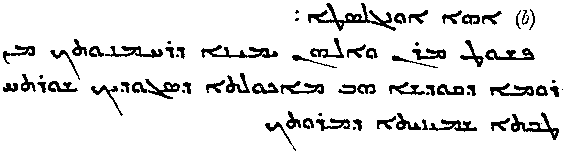
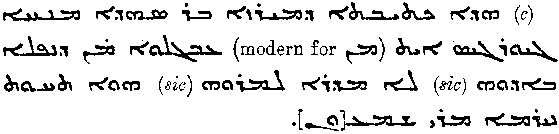
 which may be rendered either 'wind of the heart', i.e. cramp
or rheumatism, or more literally still, having in view the
purpose of this work, 'THE SPIRIT' or 'DEMON' of the heart.
which may be rendered either 'wind of the heart', i.e. cramp
or rheumatism, or more literally still, having in view the
purpose of this work, 'THE SPIRIT' or 'DEMON' of the heart.
 respectively.
 respectively.