CI CORNELII AGRIPPÆ
de Nobilitate & Præœcellentia Fœminei
sexus, ad Margaretam Augustam
Austriaco & Bur-
gundionum Principem
[1529]
Expostulatio cum Ioanne Catilineti super expo-
sitione libri Ioannis Capnionis de uerbo mirifico
De sacramento Matrimonii declamation ad
Margaretam Alenconiæ duœm.
De triplici ratione cognoscendi Deum liber vnus ad Guilielmum Paleologum Marcionem Mantisserrati.
Dehortatio Gentilis theologiæ ad Episcopum Vasatensem.
De Originali peccato desputabilis opinionis declamatio ad episcopum Cyrenensem. Regimem aduersus pestilentiam ad eundem episco.
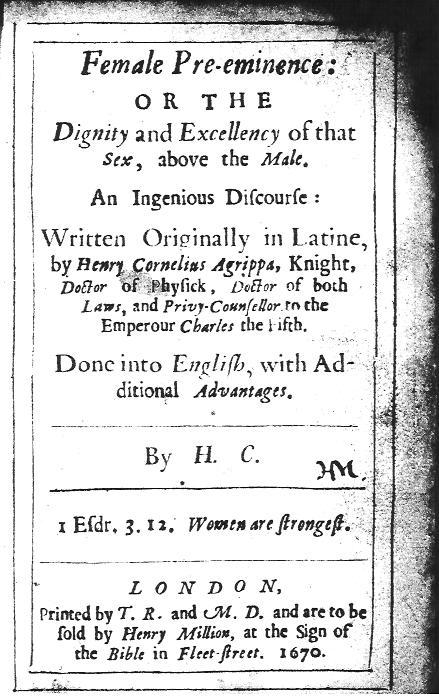
OR THE
Dignity and Excellency of that
Sex, above the Male.
An Ingenious Discourse:
Written Originally in Latine,
by Henry Cornelius Agrippa, Knight,
Doctor of Physick, Doctor of both
Laws, and Privy-Counsellor to the
Emperour Charles the Fifth.
Done into English, with Ad-
ditional Advantages.
BY H.C.
1 Esdr. 3.12. Women are strongest.
LONDON
Printed by T.R. and M.D, and are to be sold by Henry Million, at the Sign of the Bible in Fleet-street. 1670.
The Epistle Dedicatory.
TO HER
Most Excellent Majesty,
KATHERINE,
By the Grace of God,
QUEEN of Great Britain,
France, and Ireland, &c.
Madam,
 His little Champion,
who long hath Brav'd the World in Your
Noble Sexes Defence, being Arriv'd in Your
Majesties Dominions, and
taught to speak the English Dialect, is with all Humility
prostrated at Your Royal Feet. The Original Tratise was
Grac'd with the propitious Regards of a Great Princess,
The Illustrious Margaret of Austria, afterwards Empress;
whence this mean Translation derives, an ambition, not to
take shelter under any less than Soveraign Patronage.
Yet is not Your Majesties Greatness, so much as Goodness,
respected in this Humble Address; that serious primitive
Devotion, exemplary Virtue, and other excellent Endowments,
that render You more truely Glorious, than all
the magnificnet Advantages of
Your Most Illustrious Birth and Fortune. To Your Majesty
this Discourse is necessitated to Appeal; for 'tis
Your bright Name alone, that can, being stampt thereon,
(like Your Royal Consort's Effigies on Coyn) make
it pass Currant in the opinion of the World; who no
longer will be scandaliz'd at the Title, nor think the Author
too Lavish in Womens Praise, when they Reflect on
Your Majesty, that Great Example of Female Pre-eminence,
and Excellency, that have out-done the mosr daring
Hyperbolies, and not only Justified, but Surpass'd in
Life and Merit, whatever can
be said in the behalf of Your Most Glorious Sex.
His little Champion,
who long hath Brav'd the World in Your
Noble Sexes Defence, being Arriv'd in Your
Majesties Dominions, and
taught to speak the English Dialect, is with all Humility
prostrated at Your Royal Feet. The Original Tratise was
Grac'd with the propitious Regards of a Great Princess,
The Illustrious Margaret of Austria, afterwards Empress;
whence this mean Translation derives, an ambition, not to
take shelter under any less than Soveraign Patronage.
Yet is not Your Majesties Greatness, so much as Goodness,
respected in this Humble Address; that serious primitive
Devotion, exemplary Virtue, and other excellent Endowments,
that render You more truely Glorious, than all
the magnificnet Advantages of
Your Most Illustrious Birth and Fortune. To Your Majesty
this Discourse is necessitated to Appeal; for 'tis
Your bright Name alone, that can, being stampt thereon,
(like Your Royal Consort's Effigies on Coyn) make
it pass Currant in the opinion of the World; who no
longer will be scandaliz'd at the Title, nor think the Author
too Lavish in Womens Praise, when they Reflect on
Your Majesty, that Great Example of Female Pre-eminence,
and Excellency, that have out-done the mosr daring
Hyperbolies, and not only Justified, but Surpass'd in
Life and Merit, whatever can
be said in the behalf of Your Most Glorious Sex.
That Your Majesty, Encircled with all Happiness, may long remain a President of Piety to this Degenerous Age, and find as many to Imitate as Admire Your Royal Virtues, is the Prayer of
Your Majesties
Most Humble,
Loyal, and Obe-
dient Subject,
H. Care.
The Translators Preface.
In this giddy Age wherein each extravagant
opinion finds a welcome, and Conceits more wilde than any
Bedlam-phrensie, have been entertain'd
with zeal, and promoted with passion, an innocent
Paradox may fairly hope for Pardon at least, if not Applause.
(2.) By Glauco.
(3.) By Paco**nus.
(4.) By Erasmus.
To say much of the noble Agrippa, were to put an Affront on the Reader, (if he pretend at all to traffick in the Commonwealth of Learning) by supposing him a stranger to that Man, who was justly admir'd as the Prodigy of his Age, for all kind of Science. That vast progress he made, Tam Marte quam Mercurio, in Arms no less than Arts; the Titles and Honours he acquir'd; the respect paid him by most of the Grandees, and famous Men, his Contemporaries; and those Monuments of Learning, wherewith he hath oblig'd Posterity; all speak him a Person above the ordinary level of Mankind; to be rankt only amongst those few noble Heroes;
Queis meliore Luto finxit præcordia Titan.
Whom Titan with a gentle Ray,
Hath moulded of a purer Clay.
How prudently this Design was undertaken, or how well perform'd, I shall not fore-stall the Readers opinion, so far as to determine; but must confess my self pleas'd with that Diversion I met with in reading the Original; and thereupon to have attempted the Translation, not without some Additions, and variation, to render it more smooth and gratefull to the present Age, thinking I could scarce better devote my vacant hours, than to the service of that sweet Sex, which every one deserving the Name of Man, cannot but love; and to whom, whoever hath not forgot he had a Mother, is oblig'd to pay a reverential esteem.
Yet is it no part of our Design to flatter Women, but to put some check to the rude, undeserv'd reproaches, cast on them by the Men: To acquaint the fair Sex with its natural Dignity, that they may scorn to act any thing unworthy of themselves: to treat them with variety of real (not Romantick) Examples of true Piety, exact Chastity, sincere, unalterable Affection, and other rare, sublime qualities; whence inspir'd with a generous emulation, they may strive ti out-vye these ancient Heroinaes, and transcend the excellent Patterns here recommended; finding, that it is Virtue alone that can embalm their Memories, and render them still fresh and amiable, even then when Age or Sickness have plow'd their Faces with wrinckled furrows, and swept away the sparkling Glories of their Eyes.
To conclude: If the captious World shall a while lay aside its usual severities, and vouchsafe any Acceptance of these our inconsiderable pains, (now confusedly huddled up in hast,) we shall use our utmost endeavours in the second Edition to deserve that favour, by some further Additions and Embellishments.
H.C.
To His Ingenious Friend
Mr. H. Care:
On his Pains in Translating, and
Refining this quaint Discourse
of Female Pre-eminence.
'Tis bravely done, dear Friend! thus to Engage
For the Fair Sex, in this detracting Age,
When vip'rous Tongues so virulently throwe
Venome at thise to whom their Lives they owe,
And each base Fopp poor Womens Judge doth sit,
Who thinks Railing at them proves him a Wit,
And therefore Dams 'um, They'r all Whores, hee'l cry,
Though's Mother and his Sister both stand by:
Nor want there Squires o'th' Quill to wound their Name,
And with foul Ink Bespatter their bright Fame.
But as when Royal Phæbus shews his Face,
Those Sporads vanish which usurpt his place;
So all these black-mouth'd screeching Birds of Night,
And by your Book put to eternal Flight:
Your Book; For what you modestly do call
Translation, if with the Original
It be compar'd, 'twill easily be known,
That the far better part on it is your own.
You adde, correct, and so the Whole Refine,
That 'tis no more Agrippa's now, but thine;
He laid the Plot, but you the Language bring,
And giv't a Dress as glorious as the Spring:
Choice Words compos'd in Periods, that surprize
The Ear with most harmonious Cadencies,
Such charming stile, which France it self admir'd,
Was thought t'have vanisht when Love-Day expir'd;
Our English Prose seem'd sunk ever since then,
But now there's hopes you'l Buoy it up agen:
For such fair Blossomes in your Youth, presage
No common Fruit from your maturer Age.
But what dost aim at? (for I must profess,
In this Attempt, 'twill puzzle one to guess)
Weary of retail-Love, by this Design,
Dost thou intend to Court all Womankind?
T' ingross their Favour, and ambitiously,
Affect Loves universal Monarchy?
Or do thy flames which to some one Aspire,
Transport thee, the whole Sex thus to admire?
What e're it bem unto thy pains and wit,
All Ladies must confess themselves in Debt;
And to thee, whence such Ornament they find,
They'r most ungratefull if they prove not kind.
Their Snow-white Hands thy welcome Book shall hold,
And sometimes wrap't up in some silken Fold,
In their sweet Bosomes suffer it to Rest,
(Ah! who'l not envy it when 'tis so Blest?)
DE FOEMINEI SEXUS
praecellentia L. Beliaquetus
Desine vaniloquax sexum laudare virilemPlus aequo, laudum ne sit aceruus iners
Desine (si sapias) sexum damnare malignis
Fœmineum verbis, quae ratione carent.
Si bene lance tua sexum perpendis vtrumque
Fœmineo cedet quisquis virilis erit
Credere si dubites, & res tibi dura videtur
Haud alias visus nunc mihi testis adest
Quem nuper vigilans extruxit Agrippa libellum
Ante viros laudans fœmineumque genus.
[3]
CLARISSIMO VIRO DOMINO
Maximiliano Transsiluano Caroli quinti Caesaris
Imperatorisque A consiliis Hen. Cor. Agrippa S.D.
Anni ferme viginti retroacti sunt (splendide Maximiliane) quo tempore in Dola Burgundiæ Gymnasio pulpito donatus magna omnium admiratione librum Ioan. Capnionis, de Verbo Mirifico ad honorem diuae Margaretae Principis nostræ interpretabat, habita in prælectione insigni laudum suarum oratione. Instabant per id tempus apud me plerique eius ciuitatis non infimæ sortis viri, inter cæteros quem nosti Symon Vernerius Dolanæ ecclesiæ Decanus, & Gymnasii Procancellarilis vt prænominatæ Principi nonnihil operis scripto dedicarem: contendebant omnes improbis precibus, vrgebantque epistolis, & ingerebant me hoc ipso haud non insignem gratiam apud eandem principem initurum. Annui nefas arbitratus tantorum virorum preces rejicere, ac propositam mihi tantæ Principis gratiam contemnere. Et cepi argumentum operis de nobilitate & præcellentia Fœminei sexus, non indignum ratus quod illi Principi potissimum deuouerem dedicaremque quæ supra omnes nostri æui præclaras mulieres fœmineæ nobilitatis præcellentiæque vnicum exemplar visa est, vt se præside ac teste libellus ille non parum authoritatis caperet aduersus eos qui in fœmineo sexu vituperando, nihil faciunt reliqui. Quod autem ad id temporis cum ceptum hoc votum meum apud celsitudinem suam non liberarim, non loci distantia, non temporis effluxus, non animi facilitas, non propositi mutatio, non etiam argumenti angustia, ingeniiue paupertas, sed Catilineti cuiusdam calumnia in causa fuit (que cuiusmodi fuerit ex ipsa nostra ad eumdem expostulatione quam vna cum præsentibus ad te mitto videre, licebit) cuius hypocrisi victus, indignabundusque factus suppressi librum, usque adhuc nolui tamen hac fidelia aliam quamuis etiam pretiosum parietem dealbare, futurum aliquem [4] confidens quo liber ille non esset amissurus suam dominam. Nunc itaque reuersus in patriam hanc, equum putaui respondere fidei, nec diutius differendum librum illum principi nostræ offerre, qui illi ex stipulatione & voto æquissimo iure debetur. Atque vt cognoscat me interim temporis nec illius oblitum esse, nec deuotam fidem vnquam deseruisse, nec pluris valuisse apud me alienam nequitiam, quam proprii animi constantiam virtutibus ac laudibus eius impense fauentem. Quod si nunc tua prudentia hoc meum consilium non improbauerit, faciam vt libellus iste cum plerisque aliis meis progrediatur in publicum, etiam si videam res hæc quam sit exigua, & qua nulla elegantia dicendi reddita. Sed volo libellum hunc quondam in pueritia mea conscriptum, & nunc non nisi vt in hoc exemplari vides tumultuario, alicubi recognitum ipsi principi suæ (sicut apud Canonistas (quos vocant) dicendi mos est) ex nunc vt a tunc, vel cum æstimationis meæ iactura oblatum iri. Dum interim ætate iam grandior, grauiori ac pleniori argumento, sublimiora & digniora cælsitudini suæ parauero. Neque vero velim Principem ipsam, ab his pueritiæ meæ nugis, ingenium meum metiri: quod si experiri velit, possit sibi etiam in maximis rebus & pace & bello vsui fore. Proinde vero ne quis superbior, aut eruditionis iactantior, contemptu mediocritatis meæ, in ingenium nostrum ingratus hanc operam nostram despiciat, calumnietur, mordeat, laceret, tuæ Magnanimitati eandem, vna cum fœmineæ nobilitatis splendore, cum muliebris excellentiæ gloria insuper tuendam, defendendamque commendo, speroque futurum me huius causæ, quod viris fœminas prætulerim, facile veniam obtenturum quod tantæ Principi hæc scripserim, ac tua amplitudine hortante, tuenteque, ediderim. Vale. Ex Antuerpia, xvi Kalendas Maii An. M. D. XXIX.
Iuditium tuum expectabo
[5]
 DIVAE
DIVAEMARGARETAE AVGVSTAE
Austriacorum Burgundionumque principi
clementissimæ Henricus Cornelius
Agrippa, S. D.
 EM HACTENVS
inauditam, sed a vera haud absimiliem
pro viribus audacter quidem,
sed non sine pudore aggressus
sum fœminei sexus nobilitatem,
præcellentiamque
describere. Certauit fateor
intra me sæpius audacia cum pudore. Nam ut innumeras
mulierum laudes, virtutes, summamque præstantiam
oratione velle complecti, plenum ambitionis & audaciæ
putabam, sic fœminas maribus præferre, tanquam euirati
ingenii plenum pudoris videbatur. Hinc forte causans
cur quum pauci admodum de mulierum laudibus scribere
tentarunt. Nullus hactenus quod certo sciam earum
supra viros eminentiam adserere ausus est. Proinde
vero tam dignissimo sexui veras atque debitas sibi laudes
tacendo velut inuidere, & præripere eumque suppressa
agnita veritate suis meriti suaque fraudari gloria, plenum
ingratitudinis arbitrabar atque sacrilegii. Quum
itaque inter has varias dissonasque sententias anxius mecum
[6]
ipse hæsitarem, miro hoc ingratitudinis, codemque sacrilegii
metu, victo pudore audacior effectus sum in scribendo,
dum metuo videri audacior, si tacerem, bonum omen interpretatus,
quasi eius rei prouincia, quam hactenus eruditorum
cœtus penitus neglexisse videtur, mihi à superis relicta
atque decreta fuerit. Annunciabo itaque gloriam mulieris,
& honestatem eius non abscondam, tantumque abest quod me
assumpti argumenti pudeat, quandoque si fœminas viris præferam,
ob id me vituperandum putem esse, vt vix me excusatum iri
fidam, qui rem adeo sublimem humiliori quam par est dicendi
forma complexus sum, nisi me cum temporis angustia & rei
difficultas, tum causæ æquitas tuerentur, tum quia nullo adulandi
assentandiue studio hanc operam aggressus sum ideoque
non tam studium fuit rhetoricis figmentis officiosisque mendaciis
verba in laudes ornare, quam rem ipsam ratione authoritate,
exemplis, ipsisque sacrarum litterarum, & vtriusque
iuris testimoniis commonstrare. Tibi autem serenissima
Margareta, cuius inter huius aeui præclaras fœminas
per uniuersum orbem terrarum Apollo, Diana, dies
Aurora, Vulcanus, dii quinque non illustrarunt, cum generis
nobilitate, tum virtutum præstantia, & rerum gestarum
gloria, parem alteram hanc operam nostram,
ideo deuotam dedicatamque constituto, ut te (quæ ad id virtutum
fastigium ascendisti, quod, cuncta quæ de fœminei sexus
laudibus prædicantur, vita & moribus superasti)
præsentaneo exemplo, ac teste fidissima, eiusdem sexus
vestri decus, & gloria, quasi sole quodam splendidius
[7]
elucescat. Vale felicissime nobilissimarum mulierum simul
ac principum decus, & ornamentum, & gloria, modis
omnibus absoluta.
EM HACTENVS
inauditam, sed a vera haud absimiliem
pro viribus audacter quidem,
sed non sine pudore aggressus
sum fœminei sexus nobilitatem,
præcellentiamque
describere. Certauit fateor
intra me sæpius audacia cum pudore. Nam ut innumeras
mulierum laudes, virtutes, summamque præstantiam
oratione velle complecti, plenum ambitionis & audaciæ
putabam, sic fœminas maribus præferre, tanquam euirati
ingenii plenum pudoris videbatur. Hinc forte causans
cur quum pauci admodum de mulierum laudibus scribere
tentarunt. Nullus hactenus quod certo sciam earum
supra viros eminentiam adserere ausus est. Proinde
vero tam dignissimo sexui veras atque debitas sibi laudes
tacendo velut inuidere, & præripere eumque suppressa
agnita veritate suis meriti suaque fraudari gloria, plenum
ingratitudinis arbitrabar atque sacrilegii. Quum
itaque inter has varias dissonasque sententias anxius mecum
[6]
ipse hæsitarem, miro hoc ingratitudinis, codemque sacrilegii
metu, victo pudore audacior effectus sum in scribendo,
dum metuo videri audacior, si tacerem, bonum omen interpretatus,
quasi eius rei prouincia, quam hactenus eruditorum
cœtus penitus neglexisse videtur, mihi à superis relicta
atque decreta fuerit. Annunciabo itaque gloriam mulieris,
& honestatem eius non abscondam, tantumque abest quod me
assumpti argumenti pudeat, quandoque si fœminas viris præferam,
ob id me vituperandum putem esse, vt vix me excusatum iri
fidam, qui rem adeo sublimem humiliori quam par est dicendi
forma complexus sum, nisi me cum temporis angustia & rei
difficultas, tum causæ æquitas tuerentur, tum quia nullo adulandi
assentandiue studio hanc operam aggressus sum ideoque
non tam studium fuit rhetoricis figmentis officiosisque mendaciis
verba in laudes ornare, quam rem ipsam ratione authoritate,
exemplis, ipsisque sacrarum litterarum, & vtriusque
iuris testimoniis commonstrare. Tibi autem serenissima
Margareta, cuius inter huius aeui præclaras fœminas
per uniuersum orbem terrarum Apollo, Diana, dies
Aurora, Vulcanus, dii quinque non illustrarunt, cum generis
nobilitate, tum virtutum præstantia, & rerum gestarum
gloria, parem alteram hanc operam nostram,
ideo deuotam dedicatamque constituto, ut te (quæ ad id virtutum
fastigium ascendisti, quod, cuncta quæ de fœminei sexus
laudibus prædicantur, vita & moribus superasti)
præsentaneo exemplo, ac teste fidissima, eiusdem sexus
vestri decus, & gloria, quasi sole quodam splendidius
[7]
elucescat. Vale felicissime nobilissimarum mulierum simul
ac principum decus, & ornamentum, & gloria, modis
omnibus absoluta.
CORNELII AGRIPPAE DECLA-
matio de nobilitate & præcellentia Fœminei sexus.
 EVS optimus maximus cunctorum
genitor, pater ac bonorum utriusque secus
fecunditate plenissimus, hominem
sibi similem creauit, masculum
& fœminam creauit illos [Genes. prio.]. Quorum
quidem sexuum discretio non nisi situ
partium corporis differente constat, in quibus usus
generandi diuersitatem necessaria requirebat. Eandem vero
& masculo & fœminæ, ac omnino indifferentem animæ
formam tribuit. Inter quas nulla prorsus sexus est distantia.
Eandem ipsa mulier cum viro sortita est mentem, rationem
atque sermonem, ad eundum tendit beatitudinis finem, ubi sexus
nulla erit exceptio. Nam iuxta Euangelicam veritatem [Luc. 20. Mar. 12. Matth. 22.]
Resurgentes in proprio sexu, sexus non fungentur
officio, sed angelorum illis promittitur similitudo.
Nulla itaque est ab essentia animæ inter virum &
mulierem, alterius super alterum nobilitatis præeminentia.
Sed utrisque par dignitatis innata libertas.
Quæ autem præter animæ diuinam essentiam in homine
reliqua sunt, in iis muliebris inclyta stirps durum virorum
genus in infinitum pene excellit, quod tum
[8]
demum ratum firmumque erit, quum id ipsum (& quod
institutum nostrum est) non adulterinis fucatisve sermonibus
neque etiam logicis tendiculis quibus multi sophistæ
homines illaqueare solent, sed cum optimorum
authorum patrociniis, rerumque gestarum veridicis historiis
ac apertis ratioibus, tum sacrarum literarum testimoniis
& utriusque iuris sanctionibus ostensum est.
EVS optimus maximus cunctorum
genitor, pater ac bonorum utriusque secus
fecunditate plenissimus, hominem
sibi similem creauit, masculum
& fœminam creauit illos [Genes. prio.]. Quorum
quidem sexuum discretio non nisi situ
partium corporis differente constat, in quibus usus
generandi diuersitatem necessaria requirebat. Eandem vero
& masculo & fœminæ, ac omnino indifferentem animæ
formam tribuit. Inter quas nulla prorsus sexus est distantia.
Eandem ipsa mulier cum viro sortita est mentem, rationem
atque sermonem, ad eundum tendit beatitudinis finem, ubi sexus
nulla erit exceptio. Nam iuxta Euangelicam veritatem [Luc. 20. Mar. 12. Matth. 22.]
Resurgentes in proprio sexu, sexus non fungentur
officio, sed angelorum illis promittitur similitudo.
Nulla itaque est ab essentia animæ inter virum &
mulierem, alterius super alterum nobilitatis præeminentia.
Sed utrisque par dignitatis innata libertas.
Quæ autem præter animæ diuinam essentiam in homine
reliqua sunt, in iis muliebris inclyta stirps durum virorum
genus in infinitum pene excellit, quod tum
[8]
demum ratum firmumque erit, quum id ipsum (& quod
institutum nostrum est) non adulterinis fucatisve sermonibus
neque etiam logicis tendiculis quibus multi sophistæ
homines illaqueare solent, sed cum optimorum
authorum patrociniis, rerumque gestarum veridicis historiis
ac apertis ratioibus, tum sacrarum literarum testimoniis
& utriusque iuris sanctionibus ostensum est.
![[A]](../tritheim/a.gif) lmighty God, to
whose efficacious
Word all things owe
their original, abounding
in his own
glorious Essence with
infinite goodness and
fecundity, did in the beginning Create
Man after his own likeness, Male and
Female, created he them; the true distinction
of which Sexes, consists meerly
in the different site of those parts of the
body, wherein Generation necessarily
requires a Diversity: for both Male
and Female he impartially endued with
the same, and altogether indifferent
form of Soul, the Woman being possess'd
of no less excellent Faculties of
Mind, Reason, and Speech, than the
Man, and equally with him aspiring to
those Regions of Bliss and Glory,
where there shall be no exception of
Sex. For though at the last Trumpets
universal Alarm, when our recollected
bodies shall start up amazed, to find
themselves releas'd from their Prisons of
Darkness, we may perhaps appear in
our respective proper Sexes, yet shall
we not then either need or make use of
Sex, but are promised by him who is
Truth it self, a Conversation resembling
that of blessed Angels in Heaven.
Hence 'tis evident, that as to the essence
of the Soul between Man and Woman,
there can no Pre-eminence at all
be challenged on either side, but the
same innate worth and dignity of both,
the Image of their Creator being stampt
as fairly, and shining as brightly in one,
as t'other; whereas in all other respects
the noble and delicate Feminine Race,
doth almost to infinity excell that rough-hewn,
boisterous kind, the Male.
lmighty God, to
whose efficacious
Word all things owe
their original, abounding
in his own
glorious Essence with
infinite goodness and
fecundity, did in the beginning Create
Man after his own likeness, Male and
Female, created he them; the true distinction
of which Sexes, consists meerly
in the different site of those parts of the
body, wherein Generation necessarily
requires a Diversity: for both Male
and Female he impartially endued with
the same, and altogether indifferent
form of Soul, the Woman being possess'd
of no less excellent Faculties of
Mind, Reason, and Speech, than the
Man, and equally with him aspiring to
those Regions of Bliss and Glory,
where there shall be no exception of
Sex. For though at the last Trumpets
universal Alarm, when our recollected
bodies shall start up amazed, to find
themselves releas'd from their Prisons of
Darkness, we may perhaps appear in
our respective proper Sexes, yet shall
we not then either need or make use of
Sex, but are promised by him who is
Truth it self, a Conversation resembling
that of blessed Angels in Heaven.
Hence 'tis evident, that as to the essence
of the Soul between Man and Woman,
there can no Pre-eminence at all
be challenged on either side, but the
same innate worth and dignity of both,
the Image of their Creator being stampt
as fairly, and shining as brightly in one,
as t'other; whereas in all other respects
the noble and delicate Feminine Race,
doth almost to infinity excell that rough-hewn,
boisterous kind, the Male.
This may at first perhaps seem an odd
Assertion, and extravagantly Paradoxical,
but will appear a certain Truth, when
we have prov'd it (which is our present
undertaking) not with empty flourishes of
words, or gawdy Paint of Rhetorick, nor
with those vain Logical Devices, wherewith
Sophisters too frequently inveigle
unwary understandings, but by the Authority
of the most Approved Authors,
unquestioned Histories, and evident Reasons,
as likewise with Testimonies of holy
Writ, and Sanctions of both Civil and
Canon Laws.
 quod sonat oriens, occidens,
septentrio, meridies. Et in eodem libro interpretatur
idem nomen Adam, quia terra caro facta est, quam vis talis
expositio discrepat à traditione Mose, quum apud Hebræos
non quatuor literis sed tribus scribatur. Hæc tamen
expositio in tam sancto viro non est vituperanda,
qui linguam Hebraicam non didicit, quam plures sancti
& sacrarum literarum expositores sine multa culpa
ignorarunt. Quod si mecum non habeatur similis
licentiæ patientia, ut liceat mihi ad arbitrium in fœminei
sexus laudem nominis Euæ pariformem etymologiam
effingere, saltem hoc unum mihi dicere permittant
[10]
ex Cabalistarum mysticis symbolis, ipsum nomen mulieris
plus affinitatis habere cum nomine ineffabili diuinæ
omnipotentiæ
quod sonat oriens, occidens,
septentrio, meridies. Et in eodem libro interpretatur
idem nomen Adam, quia terra caro facta est, quam vis talis
expositio discrepat à traditione Mose, quum apud Hebræos
non quatuor literis sed tribus scribatur. Hæc tamen
expositio in tam sancto viro non est vituperanda,
qui linguam Hebraicam non didicit, quam plures sancti
& sacrarum literarum expositores sine multa culpa
ignorarunt. Quod si mecum non habeatur similis
licentiæ patientia, ut liceat mihi ad arbitrium in fœminei
sexus laudem nominis Euæ pariformem etymologiam
effingere, saltem hoc unum mihi dicere permittant
[10]
ex Cabalistarum mysticis symbolis, ipsum nomen mulieris
plus affinitatis habere cum nomine ineffabili diuinæ
omnipotentiæ  , quàm nomen viri
quod cum diuino nomine nec in characteribus, nec in figura,
nec in numero convenit.
, quàm nomen viri
quod cum diuino nomine nec in characteribus, nec in figura,
nec in numero convenit.
Some little wits at Woman rail and ban,
Swearing she's call'd so, quasi woe to Man;
Yet such vain derivations are to blame,
Since God himself did her Man's help-meet name.
Woman promote our joyes, partake our woes,
But we men work our own, and their o'rethrowes.
Tis too great a derogation from the known prudence and piety of our ancestors, to imagine them at once so injurious and impious, as to brand this noble Sex with a name, diametrically thwarting that character which Heaven it self had given of its Nature. We may with much more probability, (the only Compass to sail by in an Ocean of Etymologies) suppose the word, Woman, to be derived quasi Woe man, she being the loadstone of Man's desires, and the sole adequate object of his affections, whom he is to woe, court, and settle his love on; or else from With Man, abbreviated in the pronunciation, intimating the need Man hath of her presence and company, and his dull heartless condition without her. Society is the life of Life, and Women the life of Society, compar'd with whom all other pleasures and diversions are but flat and melancholy; whereof the Protoplast, even whilest he was in his state of innocency, and had a garden of pleasure for his habitation, was not insensible; of whom thus a minor poet,
Adam alone in Paradise did grieve,
and thought Eden a desert without Eve,
Untill God pittying his lonesome state,
Crown'd all his wishes with a loely mate.
No reason then hath Man to slight or flout her,
Who could not live in Paradise without her.
However if we shall not be allow'd the priviledge of contriving for the honour of the Female Sex, such advantageous etymologies, yet let us at least affirm from the mysterious learning of the Cabalists; that the Woman's Name in the original language, hath a much nearer affinity with the ineffable Tetragrammaton, or sacred name of the Divine Essence, than the Man's, which bears no resemblance thereto either in characters, figures, or number.
Sed in nunc supersedebimus:
sunt enim paucis lecta, paucis lecta, paucioribus intellecta,
& fusiorem narrationem requiunt quam ut hic adscribi
conveniat. Nos interim excellentiam mulieris
non à nomine modo, sed à rebus ipsis ac muniis meritisque
investigabimus. Scrutemur itaque scripturas (ut
aiunt) & ab ipso creationis initio sumentes exordium
quid dignitatis mulier ipsa in primo productionis ordine
supra virum sortita est disseramus. Scimus quæcunque
à Deo optimo maximo facta sunt, hoc potissimum
differre ut quædam eorum perpetuò maneant
incorruptibilia, quædam corruptioni, ac mutationi subiecta
sint, atque in his creandis, Deum hoc ordine
progressum ut à nobiliori unius incipiens, in nobilissimum
alterius desineret. Itaque creauit primum incorruptibiles
angelos, & animas: ita namque contendit
Augustinus animam primi nostri parentis ante corporum
productionem una cum angelis creatam fuisse [Augu. super Genes. Ii. 7.].
Porro creauit incorruptibilia corpora, ut cœlos ac stellas,
ac elementa incorruptibilia quidem, sed variis mutationibus
obnoxia, ex quibus cætera omnia quæ corruptioni
subiecta sunt, conflauit ex vilioribus per singulos
dignitatis gradus, rursus ascendendo ad universi
[11]
perfectionem procedens [Gene. 2.]. Hinc primum mineralia prodierunt
post vegetabilia, plantæ, & arbores, deinde
zoophita, demum animantia bruta per ordinem reptilia, natantia,
volantia, quadrupedia. Postremò verò creauit sibi
similes homines duos, marem inquem primum, & postremo fœminam, in qua perfecti sunt
cœli, & terra, & omnis ornatus
eorum, ad mulieris enim creationem, veniens creator, quieuit
in illa, ut nihil honoratius creandum præ manibus
habens, in ipsaque conclusa & consummata est omnis creatoris
sapientia, atque potestas, ultra quam non reperitur
creatura alia, nec excogitari potest. Cum itaque mulier sit
ultima creaturarum, ac finis, & complementum omnium operum
Dei perfectissimum, ipsiusque universi perfectio, quis eam
negabit super omnem creaturam præcellentia dignissimam
sine qua mundus ipse iam ad unguem perfectissimus, & numeris
omnibus absolutus fuisset imperfectus, qui non
aliter quam in creaturarum omnium longe perfectissima perfici potuit.
Dissentaneum enim est & absurdum opinari, Deum in
aliquo imperfecto tantum opus per fecisse. Nam cum mundus
ipse velut integerrimus aliquis perfectissimusque circulus
à Deo creatus sit, oportuit illum in ea particula absolui
quæ omnium primum cum omnium ultimo unitissimo quodam nexu in
sese copularet. Sic mulier dum creatur mundus inter omnia
creata tempore fuit ultima, eademque cum authoritate, tum
dignitate in ipso diuinæ mentis conceptu omnium fuit
prima, sicut de illa scriptum est per Prophetam: Antequam
cœli crearentur elegit eam Deus, & præelegit eam.
[12]
Ea siquidem est pervulgata philosophantium (ut illorum
verbis utar) sententia finem semper priorem esse in
intentione & in executione postremum. Mulier autem
fuit postremum Dei opus introducta à Deo in hunc
mundum velut eius regina in regiam sibi iam paratam ornatam,
& omnibus muneribus absolutam. Merito igitur
illam omnis creatura amat, veneratur, obseruat, meritoque
illi omnis creatura subiicitur, atque obedit, quæ omnium
creaturarum regina est atque finis, & perfectio, & gloria
modis omnibus absoluta. Quamobrem de illa Sapiens
inquit: Generositatem mulieris glorificat, contubernium
habens Dei, sed & omnium Dominus dilexsit
eam. Quantum etiam ratione loci in quo creata est mulier,
generis nobilitate virum excedit, sacra nobis eloquia
locupletissime testantur, quando mulier in paradiso
nobilissimo loco pariter & amœnissimo formata est
cum angelis, vir autem extra paradisum in agro rurali cum
brutis animalibus factus est. Postea creandam
mulierem traductus in paradisum. Ideoque mulier peculiari
quadam naturæ dote veluti assueta æditissimo creationis
suæ loco, quantumvis ab also despiciens non patitur
vertiginem, neque caligant oculi eius, ut viris accidere
solet. Prætereà si contingat mulierem cum viro pariter
in aquis periclitari omni externo adiutorio semoto mulier
diutius supernatat viro, citius subsidente fundumque
petente. Quod autem loci dignitas ad hominis nobilitatem
faciat, leges ciuiles sacrique canones haud obscure confirmant,
[13]
& omnium gentium consuetudo. Illud maxime obseruat
non solum in hominibus, sed quibusque animalibus,
etiam in inanimatis æstimandis, ut quanto quæque dignioræ
sunt orto loco tanto generosiora censeantur. Quocirca
Isaac præcepit filio suo Iacob ne uxorem acciperet
de terra Canaan, sed de Mesopotamia syriæ conditione
meliore. Est haud dissimile quod est apud Iohannem [Iohan. 1.] dum
Philippus diceret: Invenimus Iesum filium Ioseph, à Nazareth
dixit ei Nathanael, à Nazareth potest esse aliquid
boni.
But waving (at present) this abstruser mode of proof, as a matter read by few, understood by fewer, and requiring a more ample ample explication, than our leisure, no less than the reader's patience, can here allow of, we proceed from words to things, and come to investigate and display Female Excellency, not barely from the name, but in reality from its intrinsick worth and proper endowments; for long jangling about nominals, whilest substances fleet by unregarded, may argue some smattering in Grammar, or Sophistry, but no great stock of solid or usefull learning.
Let us then (as we are commanded)
search the Scriptures, and dating our
discourse with the World's original,
examine what dignity was alotted to
Woman above Man, by order of Creation.
We know that all things made
by the Almighty Architect, may not unfitly
be branched into these two ranks,
some remaining ever incorruptible,
others subject to corruption and mutation;
in the creation of both which,
Divine Wisdome proceeded in a method
of descension and ascension, beginning
with the more noble of the one,
and concluding with the most noble of
the other. Hence he first created those
purer essences, immaterial angels and
souls, (for so the great St. Augustine
contends, that the soul of our first parent
was created together with the angels,
before the poroduction of his body)
then the incorruptible bodies, as the Heavens,
and those vast numbers of glorious
stars, wherewith the same are embroidered;
as also the elements, incorruptible
too, but obnoxious to various
mutations, of which last he composed
all other things liable to corruption, beginning
with the meanest, and so proceeding
upwards again by several degrees of
dignity, to the perfection of the
Universe; so as first minerals were
brought forth, then sprouted up vegetables,
plants, herbs, and trees, afterwards
plant-animals, then living
creatures in order, creeping, swimming,
flying, and four-footed, and
last of all he formed our first parents
after his own similitude, first the man,
and then the woman, in whom was
compleated the Heavens and the Earth,
and all the glory of them, for after her
creation the great Creator rested, as
having nothing more honourable to
frame; and so well resented the pleasure
of having finisht this glorious work so
happily, that he instituted a day of each
seven to celebrate its Festival. Woman
then beingthe last of the creatures,
the end, complement, and consummation
of all the works of God, what ignorance
is there so stupid, or what impudence
can there be so effronted, as to deny
her a prerogative above all other
creatures, without whom the World
it self had been imperfect; it being impossible
the same should be compleated,
but in some creature most perfect,
and absurd to dream, that Infinite Wisdome
would conclude so noble a fabrick,
with a thing any way trivial or defective:
for the whole Universe being created
by God, as an entire and perfect circle,
it was requisite the same should be made
up, and finisht in such an exact and absolute
particle, as might with a most
strict tye unite and glew toghether the first
of all things with the last. Thus the
woman in relation to time indeed was
formed last, but in respect of dignity,
first of all conceived in the divine Idea,
(as 'tis written, Before the Heavens were
created I chose her;) the End, according
to the Catholick Creed of philosophers,
being ever first in intention, though last
in execution: but Woman was the
End, and last work of God, and introduced
into the World, not unlike a
queen into her royal palace, Paradise
her metropolitan residence, being fitted
and prepared before hand for her reception
and entertainment, where the
Man seem'd only her harbinger or attendant.
Deservedly therefore doth
every creature love, and pay respect
and homage to her, who is of all creatures
the queen, perfection, and glory;
for which cause the wise man saith, He
glorifies the generosity of the Woman, having
society with God, the Lord of all hath
loved her.
But further, in reference to the place
of her creation, how much Woman
doth surpass Man in dignity, sacred Oracles
liberally inform us, witnessing
her to be created in Paradise, a place
no less noble, than pleasant and delightfull;
but the Man out of Paradise, in a
rural field, with irrational brutes.
And therefore as great personages, of
noble extraction, though by the malice
of Fortune reduc'd to extremities,
retain still some marks of grandeur, and
a mean different from the vulgar, so
Woman carries yet an air of Paradise,
something that speaks her sublime descent,
her inclinations beign generally
more pious and devout, and her countenance
angelical, and (as accustomed
to that sublime place of her first birth)
she enjoys this peculiar priviledge,
that looking downwards, though from
never so high a precipice, she is not
seiz'd with that dizziness or dimness of
sight, which frequently in such accidents
happens to men. As also if a
man and woman together chance to be
exposed to danger by water, (deprived
of all external aid or assistance) you
may behold her a long time floating on
the chrystal superficies, the compassionate
element seeming unwilling to contract
the guilt of destroying so much
excellency; whilest the Man streight
sinks, and (like other gross bodies)
tends to the bottome, as his proper center.
Now that the dignity of the place
of nativity conduces not a little to the
enobling a person, both the civil laws,
and sacred canons plainly intimate, and
the custome of all nations confirms;
and that not only in men, but in all
other animals, yea inanimate creatures,
esteeming each so much more generous
and noble, as they come from a
more worth place. Thus Isaac commands
his Jacob not to take a wife of
the land of Canaan, but of the then
more renowned country, Mesopotamia
of Syria: not unlike which is that in
John, where Philip relating, that he
had found Jesus of Nazareth, Nathanael
(that true Isreaelite) nimbly queries,
If any thing good could come
thence?
Nunc ad alia pergamus: Præcellit mulier virum
materia creationis, propterea quod non ex inanimato
quopiam aut vili luto creata [Gen. 2.], quemadmodum vir, sed
ex materia purificata, viuificata, & animata, anima inquam
rationali mentem participante diuinam. Accedit ad hoc quod
vir ex terra quasi suapte natura omnis generis animantia
producente cooperante cœlesti influxu à Deo factus
est. Mulier autem supra omnem cœli influxum ac naturæ
promptitudinem absque ulla virtute cooperante à solo Deo
creata est, in omnibus sibi constans integra, & perfecta
viro interim unius costæ iacturam faciente, ex qua formata
est mulier, videlicet Eua de Adam dormiente, atque
tam profunde ut ne costam quidem evelli sentiret, quam
Deum abstulit à viro & dedit mulieri. Vir itaque naturæ
opus, mulier opificium dei. Ideoque mulier diuini splendoris
plerunque viro capacior, sæpeque plena existit, quod
etiamnum, ex munditia & pulchritudine ipsius mirifica
facile videre licet. Nam quum pulchritudo ipsa nihil est
[14]
aliud quam diuini vultus, atque luminis splendor rebus insitus,
per corpora formosa relucens. Is certe mulieres
præ viris habitare ac replere abundantissime elegit. Hinc
mulieris corpusculum omni aspectu tactuque delicatissimum,
Caro tenerrimam, color clarus, & candidus, cutis nitida,
caput decorum, casaries venustissima, capilli molles, lucidi
& protensi, vultus augustior, prospectusque hilarior,
facies omnium formosissima, ceruix lactea, frons expeditus,
spatiosus & splendidus, oculos habet vibrantiores,
micantioresque, amabili hilaritate, & gratia contemperatos,
supra hos supercilia in tenuem gyrum composita,
eademque cum decora planitie, decenti distantia
diuisa, è quorum medio descendit nasus, æqualis & intra
rectum modum cohibitus, sub quo os rutilum, &
tenellis labris conformi compositione venustum intra quæ
tenui risu, dentes emicant, minutili & æquo ordine locati,
eburneo candore nitentes, illorúmque quam viro
paucior numerus quod neque edax neque mordax. Circumsurgunt
maxillæ, genæque, tenera mollitie roseo fulgore
rubentes, verecundiæque plenæ, ac mentum orbiculare, decenti
concauitate iucundum. Sub hoc collum habet gracile, & longiusculum,
rotundis ex humeris erectum, gulam delicatam & albicantem,
mediocri crassitiæ fultam vocem, & orationem
suauiorem, pectus amplum, & eminens, æquali carne vestitum
cum mamillarum duritie, illarumque simul ac ventris orbiculari
rotunditate, latera mollia, dorsum planum & erectum
brachia extensa, manus teretes digitosque concinnis iuncturis,
[15]
protensos, ilia coxasque habitiores, suras carnosiores, extrema
manuum pedumque in orbicularem ductum desinentia, singulaque
membra succi plena. Ad hæc incessus gressusque
modestus, motus decentior, gestus digniores, totiusque præterea
corporis ordine atque symmetria, figura ac habitudine
longe lateque in omnibus speciosissima, nullumque in tota creaturarum
serie, neque spectaculum adeo mirandum, neque miraculum
perinde spectandum, ut nemo nisi cæcus omnino non videat
deum ipsum quicquid pulchritudinis capax est mundus
universus in mulierem simul congessisse, ut ob id illam
omnis creatura stupescat, & multis nominibus amet, ac veneretur,
usque adeo ut usu venire videamus quod incorporei
spiritus, dæmonesque mulieres sæpissime ardentissimis
amoribus depereant, quæ non fallax opinio est, sed multis
experimentis nota veritas. Atque ut omittam ea quæ poetæ
nobis de amoribus deorum, eorumdemque amasiis tradidere,
ut Apollinis, Daphne, Neptuni, Salmonea, Herculis,
Hebe, Iole, & omphale, cæterorumque deorum amasiis, &
ipsius Iovis admodum multis, Hoc tam divinum pulchritudinis
munus diis, hominibusque amabile sacra eloquia in mulieribus
præ cæteris gratiarum dotibus in multis locis celebriter
commendant [Gene. 6.]. Hinc legitur in Genesi quod videntes filii
Dei filias hominum quod essent pulchræ, delegerunt uxores
sibi ex illis quas voluerunt. Legimus etiam de Sara Abrahæ
quod fuit pulchra præ aliis terræ mulieribus, imo
pulcherrima. Sic servus Abrahæ cum vidisset Rebeccam
eximiæ pulchritudinis puellam, dixit tacitus secum: Hæc
est quam præparavit Dominus filio Abrahæ, Isaac, & Abigail
[16]
uxor Nabal viri pessimi erat prudens, & cordata,
perinde atque speciosa. Ideoque servavit vitam & facultatem
viri sui à furore David. Et malus vir per pulchram
mulierem servatus est. His namque verbis allocutus est
eam David: Vade pacifice in domum tuam, ecce audivi
vocem tuam, & honorificavi faciem tuam, nam cum omnis
pulchritudo sit, vel spiritualis, vel vocalis, vel corporea.
Abigail tota pulchra fuit, & prudentia spiritus,
& facundia sermonis, & venustate corporis, quo nomine
mortuo viro suo Nabal facta est una uxorum David.
Et Bathsaba fuit adeo insigni forma mulier, ut
eius amore captus David, illam post mortem viri desponsatam
reginali dignitate præ cæteris elevaret. Item Abisag
sunamitis quod esset puella pulcherrima, propterea
electa fuit ut accubando David senescœntis iam regis
calorem instauraret. Quapropter & summis honoribus
senex eam rex augere voluit, & post mortem regis
potentis reginæ loco habita est. Huc spectant ea quæ
de mira pulchritudine reginæ Vasti legimus, atque de
Hester quæ illi prælata, illaque præstantior fuit, nimis
quam pulchra & decora facie. De Iudith etiam legimus
cuius auxit Dominus pulchritudinem, in tantum ut eam
conspicati stupore sint admirando affecti. De Susanna
denique quæ fuit oppido quam delicata, & specie pulchra.
Quid quod legimus etiam post varia tentamenta Iob
& eius ærumnas exantlatas præter cætera quæ summa
patientia meruit, dedisse illi Dominum tres filias
[17]
pulcherrimas, tribus charitibus longe gratiores, quibus
mulieres in universa terra speciosiores neutiquam
inventæ sunt. Legamus porro licebit sanctarum virginum
historias, nimirum mirabimur quam miræ pulchritudinis
et speciosissimæ formæ præ cæteris filiis hominum
catholica ecclesia solemniter illas collaudando decantet.
Sed omnium longe lateque principem immaculatam Dei
genitricem virginem Mariam, cuius pulchritudinem sol
& luna mirantur, è cuius speciosissimo vultu tanta simul
effulsit pulchritudinis castimonia, atque sanctitudo, ut licet
omnium oculos pariter & mentes perstringeret, nemo
tamen unquam mortalium suis illecebris, vel minimo cogitatu
corruerit. Hæc etiam si fusius è sacris bibliis ubi
toties de pulchritudine facta mentio, idque ipsissimis pene
verbis ideo recensui, quo plane intelligamus mulierum pulchritudinem,
non apud homines solum, sed & apud Deum c
ohonestatam esse & honore cumulatam. [Numeri. 31] Proinde &
alibi legimus in sacris literis Deum præcepisse omnem
masculum sexum etiam pueros occidi, mulieres vero pulchras
servari. [Deut. 21.] Et in Deuteronomio permittitur filiis
Israel pulchram mulierem è captivis sibi deligere in coniugem.
But to proceed; as in order and place, so also in matter of her Creation, Woman far excells Man. things receive their value from the matter they are made of, and the excellent skill of their maker: Pots of common clay must not contend with China-dishes, nor pewter utensils vye dignity with those of silver. One line drawn by Appelles his exquisite pencill, is more to be esteemed, than whole portraitures perform'd by the slubbering hands of vulgar artists. Woman was not composed of any inanimate or vile dirt, but of a more refined and purified substance, enlivened and actuated by a Rational Soul, whose operations speak it a beam, or bright ray of Divinity. Man was taken out of the Earth, which of its own nature, with the co-operation of Celestial Influxes, is wont to bring forth living creatures: but Woman, above all influence of the Heavens, or aptitude of Nature, without any assisting virtue, or co-operating power, was formed miraculously, by god himself, out of that ribb taken from dormant Adam's side, whereby Man became maim'd and imperfect; and thence ever since, as a needle that hath suffered the magnetick touch, stands alwayes trembling till he looks full on its beloved North, so he can never rest, till by taking a woman, and incorporating her with himself, he retreive that loss, and render himself again intire and perfect, The rare art exercised in rearing this Female-Fabrick, is not obscurely intimated by the Divine Historian, in his Original Language, where God is said to make Man, but to have built Woman; that implying but common work, this much curiosity, and contrivance; insomuch that Man seems little more than the production of Nature, Woman, the more immediate handiwork of the God of Nature. And therefore for the most part Woman is more susceptable of, and replenisht with divine splendor and irradiations, than Man, of which her incomparable Neatness, and charming Beauty, may be a pregnant evidence; for Beauty is nothing but the brightness or radiancy of Divine Light, shining in created Essences, and casting on us its glorious reflections from fair bodies, as illustriously as out weak eyes are capable without dazleing to behold it. And this most frequently chooseth to reside in Woman, rather than Man; whence she becomes beyond all espression amiable and delightfull, her flesh tender and delicate, her colour bright and clear, her hair most becoming, her locks (Cupids Fetters, and the only threads wherewith he strings his bow) soft, long, and glittering, her countenance more august and majestical, her lokks more sprightly, vivid, and jocund, a snow-white neck, and large smooth high fore-head, sparkling eyes, armed with irresistable glances, and yet tempered with a lovely grace and chearfulness, arches over with stately eyebrows, (half Moons, that boast more conquests than the proud Turkish ensigns) which being divided with a beseeming, plain, and equal distance, her well proportioned nose leads to her pretty mouth, and that displaying with an amorous smile, the rosie portals of its soft ruddy lips, discovers a row of inestimable pearl, her fine small teeth, even, and out-vying ivory for whiteness, yet fewer in number than man's, as having less occasion to use them, being neither great eater, nor biter. Then her modest cheeks, whose colours are so purely mixt, that lillies and roses seem there to contend for superiority, and her pretty round chin, beautified with a love-dimple; a voice she hath most sweet and inchanting; breasts which seem two sphears of snow, or swelling mountaines of delight; long arms, little hands, interwoven with a curious laberynth of azure veins; long slender fingers, nimble joints, and all parts of her body plump, juicy, and attractive. Besides, her gate is so modest, her motions decent and natural, her gesture more free and noble, her air more taking and complacent, and the whole form, habit, and symmetry of her person, graced with such innumerable charms, as without injuring truth, we may affirm, That in the whole series of creatures there is nothing so much to be admir'd, or miracle so deserving to be seen, since in her alone all that have not their eyes blear'd with prejudice, or envy, may clearly see, the great Creator (who is the fountain of all that is good and amiable) hath epitomized the beauty of all his other works, for those perfections which sparkle here and there in them, are collected and constellated in her, whom we may call, a draught of the whole Creation in miniature, or a copy of that vast Volume done in exquisite short-hand. Hence all creatures admire, love, and almost adore her; for so (* Lib. 8. Nat. Hist.) Pliny (that great clark of Nature's Closet) relates, That the lion which spareth no other creature, trembleth at a woman, and hardly proffereth her that violence which usually he doth to Man; as if Nature had taught that savage animal the respects due to so fair a presence. Nor is it only the conceit of fond opinion, but a very credible Truth, That even spiritual Natures, incorporeal Essences, and Dæmons, have many times been enamoured on Women with wonderfull passion; for omitting those stories poets tell us, of the Amours of their fabulous Deities, as Apollo and Daphne, Neptune and Salmonea, or rampant Hercules with his three wenches, Hebe, Jole, and Omphale, &c. The Holy Scripture seems to intimate no less, as in Genesis we find, That the Sons of God seeing the Daughters of Men were fair, took of them for their wives: to which we might adde, (if it be not too Apochryphal) the ill spirit Asmodeus, who so jealously courted the Lady, that he destroy'd all his rivals, in the history of Tobit. Indeed these sacred rolls are frequent in recommending this divine ornament, Beauty, and furnish us with various examples of its power and excellency. Thereby it was Abigail preserved her churlish husband's life and fortune, from the fury of incensed David; for thus the royal captain accosts her, Return in peace, I have heard thy voice, and honoured thy face, (or as other versions render it, Accepted thy person.) All beauty is either intellectual, vocal, or corporeal; in each of which this Lady is recorded to have been eminently accomplisht, being both prudent in mind, eloquent of speech, and beautifull in person; for which excellency perfections, David after Nabal's decease accepted her for one of his wives. Hester's beauty was a means to deliver her people out of the jaws of destruction, to which proud Haman had devoted them. And fair Judith's charms infatuating the besotted general, preserved her nation from a ruine which seem'd inevitable. After those various temptations and tedious afflictions of holy Job, Heaven (as if it could not bestow a better earthly reward on such a stupendious and inimitable patience) blest him with three daughters so sweet, fair, and attractive, that they surpast those graces poets fable of, and the whole World (bankrupt of such other excellency) could not produce their parallels. Who reading the legends of the Sacred Virgins, can but admire in them that transcendent beauty, which the Church vouchsafes to celebrate with such solemn Eulogies of honour? especially that immaculate Virgin, the blessed Mary, whose beauty is said to be so exactly temper'd with chastity and holiness, trhat though it captivated all hearts, yet it never tempted any to folly, so much as in thought. Not is beauty only esteemed amongst men, but seems also to be particularly regarded even by God himself, (as indeed how can he but respect his own reflection.) Thus we sometimes read him commanding all the males (even children) should be slain, but the women that were fair to be saved alive. And in Deuteronomy, liberty is indulged to the Israelites, to take one of their captives to wife, if she were beautifull, which otherwise was unlawfull.
But besides this charming excellency, which not only invites, but commands our admiration, Woman is endowed with another natural ornament, not vouchsaft to men; her hair growing to that becoming length, as to veil those more reserved parts, whereof modesty commands concealment; and indeed of that slushing virtue this sweet Sex may justly challenge the far greatest share, it having been oft experienced, (*) that in desperate diseases, they have chosen to expose themselves to Death's imbraces, rather than to the view and handling of chyrurgions [surgeons] for cure. Nor can Death it self rifle them of this modest bashfulness, for when drowned, (as Pliny relates, and experience proves) they lye in the water with their faces downwards, Nature sparing their modesty, whereas a man in such a case swims on his back, exposing all his shame and nakedness to publick view. further, the most worthy part of us, whereby we chiefly differ from brutes, is the head, and of that, especially the face. Now in men, that noble member the head, is often by age or other infirmity plundered of hair, its native ornament, and grows deformed with a despicable baldness, from which misfortune women by an extraordinary priviledge of Nature are exempt. As likewise their faces remain alwayes smooth and comely; whereas men's are frequently so beset with over-grown beards, and sordid hair, that 'tis difficult to distinguish them from beasts; whence by the Law of the Twelve Tables, it was provided, women should not shave their cheeks, lest it might occasion the growth of beards, and destroy their native pudor [modesty] and comeliness. Now of the cleanness and purity of this sex, this oft-try'd experiment cannot but be a proof beyond exception; for when a woman hath once washt her self clean, let her wash again in fresh water, and it shall receive no spot or tincture of foulness; but a man never so well washt, as oft as he washes again, will still leave behind some filth and sordities. Nor may we omit, That Nature hath given Women the greatest share in the procreation of Mankind; for according to the opinion of those great pillars of the Art of healing, Galen and Avicenna, she contributes most to the matter and nutriment of the birth, which may be the reason that most children resemble their mothers many times in external features, but almost alwayes in genius and inclinations; for where mothers be simple, the children generally prove fools, and where they are wise, these are witty: but on the contrary, the wisest fathers have most times idiots to their sons, and foolish fathers frequently get wise children, provided the mother be but possest of a competent stock of discretion. And hence it should seem, mothers become more fond and indulgent to children, as being sensible of having a greater share and interest in them; in requital whereof for the same cause, we are naturally more affected towards our mothers than to our fathers, so as we seem but to respect our father, and to love only our mother. And this leads us to make some reflection on that which is our first commons in this World, our mother's milk, a thing of that catholick virtue, that it not only nourishes infants, cherishes the sick, and restores consumptive and languishing nature, but may in case of necessity suffice for the preservation of life to persons of any age, a notable instance whereof we read in Valerius, of a poor young woman, who therewith preserved her aged mother in prison, that otherwise had inevitable been swallowed up by the devouring jaws of famine, whereby
She sav'd her life who gave her life before,
And kindly did in kind her milk restore.
Which signal love and tenderness not
only procured the old woman's release,
and a competent maintenance for her
and her daughter, but for a monument
thereof the goal was converted into the
Temple of Piety, a virtue to which
women are almost ever more prone
than men; so that Aristotle recounts
piety, mercy, and compassion, as virtues
peculiar to this sex. Nor is it unusual
for physitians to relate, That the heat
of young women's paps, applyed to the
breasts of persons won out with age,
doth stir up, augment, and preserve the
vital heat, of which David not ignorant,
when age had snow'd her silver
hairs on his head, and robb'd him of
his youthfull vigour; procured the fair
young Shunamite for his bed-fellow,
that he might receive warmth from
her sweet caresses, and cherishing imbraces.
(*) This discourse in the original was dedicated by the author Agrippa, to the Princess Margaret, afterwards wife to Maximilian, Emperor, who was herself a fatal instance hereof, for breaking her thigh by a fall from a horse as she was hunting, she would not permit chyrurgions to set it, but chose rather to die thereof, than prostitute her modesty. See Speed's Chronicle.
Furthermore, to omit that women
are more early ready to accomplish that
great end of our being, generation, and
the propagation of posterity, than men,
and that stupendious miracle of Nature,
their longing, when many times without
danger they greedily feed on raw
flesh or fish, and not seldome on
coals, dirts, stones, and other trash,
which without damage they concoct,
and convert into healthfull nutriment:
We only at present adde, That according
to the traditions of philosophers
and physitians, ratified by experience,
women have obtained this excellent
book from the indulgence and bounty
of Nature, That in all diseases whatever,
they of themselves, from their
own proper stock, are furnisht with remedies,
and can cure themselves, without
praying in aid of any forreign help,
or far-fetcht medicament.
But that which transcends all wonder, is, that Woman alone, without Man, should be able to produce humane Nature, which Man alone never could pretend to; and yet this is commonly affirmed by the Turks and other Mahumetans, to be feazible; amongst whom many are believed to be conceiv'd without Fathers, whom in their own tongue they call Nefesogli. Stories likewise go of islands, where the women are conceived to conceive by the Wind; but this we dare not admit into our Creed, for thereby we should injuriously rob the blessed Mary of her honour, whose alone prerogative it was to conceive without the knowledge of Man, when she brought forth her natural Son, our Saviour, of her proper substance, being impregnated by the Holy spirit, and remaining still a pure and immaculate Virgin, such fruitfulness attending the precedent Benediction, that she needed not Man's help in reference to conception. But of brute animals it is more confidently affirmed, some females conceive without the company of the Male; as Origen against Faustus, delivers on the credit of history, concerning she-vultures; and Antiquity of certain mares, which went to foal by the fruitfull gales of Zephyrus, of which the Poet,
Ore omnes versæ in zephyrum stantrupibus altisIam quid de sermone dicam divino munere, quo uno beluis maxime præstamus, quem Trismegistus Mercurius eiusdem ac immortalitatem pretii existimat. Et Hesiodus optimum hominis thesaurum nominat. Nonne sermone mulier viro facundior, magisque diserta & abundans? Nonne quotquot sumus homines, non nisi aut à matribus, aut à nutricibus primum loqui didicimus? sane natura ipsa rerum architectrix in hoc humano genere sagaciter prospiciens, hoc muliebre genus donavit, ut vix uspiam mulier milia reperiatur. Pulchrum profecto & laudabile eos viros præcellere, quo cæteris animantibus homines potissimum præstant. Sed à prophanis ad sacras literas ceu postliminia redeamus, atque ab ipsis usque religionis fontibus rem auspicemur. Scimus in primis haud dubie propter mulierem viro Deum benedixisse, quam benedictionem vir utpote indignus habere non meruerat prius quam mulier esset creata. Cui consonat illud Salomonis proverbium, [Proverb. 18.] Qui invenerit mulierem bonam, invenitbonum, & haurit benedictionem à domino, Et illud Ecclesiastici: [Ecclesia. 26.] Mulieris bonæ beatus vir, numerus annorum illorum duplex. Et nullus homo potest in dignitate comparari illi, qui dignus fuerit habere mulierem bonam. Nam ut ait Ecclesiasticus: [Eccle. 26.] Mulier bona est gratia super omnem gratiam. Ideoque Salomon in proverbiis [Proverb. 12.] vocat illam coronam viri. Et Paulus [I. Corinth. 11.] gloriam viri: definitur autem gloria, consummatio & petfectio rei [24] quiescentis & delectantis in suo fine, quando videlicet rei nil amplius addi potest ut crescat eius perfectio. Mulier itaque consummatio, perfectio, fœlicitas, benedictio et gloria viri existit, atque ut ait Augustinus: Prima humani generis in hac mortalitate societas. Idcirco illam omnis homo amet necesse est, quam qui non amaverit, qui odio habuerit, ab omnibus virtutibus & gratiis alienus est, nedum humanitate, referenda forte istic essent cabalistica illa mysteria, quomodo Abraam benedictus à Deo per mulierem Sarah, decerpta à nomine mulieris litera H, & addita nomini viri, & vocatus est Abraham [Gene. 27. & 28.], quomodo etiam benedictio Iacob illi sit, per mulierem, matrem videlicet acquisita [Gene. 2.]. Sunt huius generis plura in sacris literis, sed hoc loco non explicanda. Benedictio itaque data est propter mulierem, lex autem propter virum, lex inquam iræ & maledictionis, viro namque interdictus erat fructus ligni, mulieri non item, quæ neque dum creata erat illam enim Deus ab initio liberam esse voluit, vir itaque comedendo peccavit, non mulier, vir mortem dedit, non mulier. Et nos omnes peccavimus in Adam, non in Eva, ipsumque originale peccatum non à matre fœmina, sed à patre masculo contrahimus. Ideoque vetus lex omne masculinum circumcidi iussit, fœminas autem incircumcisas manere, peccatum videlicet originis. In eo sexu qui peccasset solummodo puniendum statuens. Neque præterea increpavit Deus mulierem, quia comederat, sed quia mali occasionem dedisset viro, atque id quidem imprudens, [25] eo quod per diabolum tentaretur. Vir itaque excerta scientia peccavit, mulier erravit ignorans, & decepta. Nam & à diabolo primo tentata est, quippe quam cognovit creaturarum omnium excellentissimam. Et ut inquit Bernardus: Videns diabolus admirandam eius pulchritudinem, sciens eam talem qualem antea in divino lumine cognouerat, quæ super omnes angelos gauderet colloquia Dei, inuidiam iecit in solam mulierem, propter suam excellentiam. Quo circa Christus natus huic mundo humilimus, quo sua humilitate superbiam expiaret peccati, primi parentis, sexum assumpsit virilem, ut humiliorem, non sexum fœmineum, sublimiorem & nobiliorem. Præterea quia condemnati fuimus propter peccatum viri, non mulieris, voluit Deus vt in quo sexu fuerat peccatum in eo fieret & peccati expiatio, & qui sexus ignorans deceptus erat, per eundem etiam fieret vindicta. Ideoque ad serpentem dictum est, quia mulier, vel quod verius legitur quia semen mulieris caput eius conteret [Gene. 3.] non vir neque semen viri. Atque hinc est forte quare ordo sacerdootalis ab ecclesia commissus est viro potius quam mulieri, quia sacerdos omnis Christum representat. Christus autem primum hominem peccatorem ipsum videlicet Adamum. Ex hoc iam intelligitur Canon ille qui incipit [33 q. 5. hæc imago] hæc imago dicens mulierem non esse factam ad imaginem Dei, scilicet ad corpoream Christi similitudinem. Noluit tamen Deus ipse inquam Christus filius esse viri, sed mulieris, quam eo usque honorauit ut ex muliere sola carnem indueret. [26] Propter mulierem namque Christus dictus est filius hominis, non propter virum. Hoc est illud ingens miraculum, quod admodum Propheta stupescit, quia mulier circumdedit virum [Hiere. 31. (Jer21.20)] quando videlicet sexus devoratur à virgine, & Christum portat in corpore. Etiam resurgens Christus à morte, mulieribus primum apparuit, non viris [Io. 20. Marc. 16.]. Nec ignotum est post Christi obitum viros à fide discessisse, mulieres autem nusquam constat à fide & religione Christiana defecisse. Porro nulla unquam fidei persecutio, nulla hæresis, nullus in fide error à mulieribus unquam emersit, secus constat de viris. Christus traditus, venundatus, emptus, accusatus, damnatus, passus, crucifixus, tandem morti traditus, non nisi per viros. Imo etiam à Petro suo negatus, à cæteris discipulis relictus, à solis mulieribus ad crucem usque & sepulchrum comitatus [Luc. 24.]. Atque etiam ipsa Pilati uxor, Aethnica plus conabatur salvare Iesum, quam quisquam virorum etiam illorum qui crediderant [Matth. 27.]. Accedit huc quod tota ferme theologorum scola asserit, acclesiam tunc non nisi apud solam mulierem puta virginem Mariam mansisse, atque, ob id & merito religiosus ac sacer fæminei sexus appellatur.
Exceptantque leves auras, & sæpe sine ullis
Coniugiis vento gravidæ.
Ore omnes versæ in zephyrum stantrupibus altis
Exceptantque leves auras, & sæpe sine ullis
Coniugiis vento gravidæ.
Standing on top of rocks, the wanton Beast
Sucks in the gentle breises of the West;
Whence she grows pregnant, and such Coles you'd find
As fleet and nimble, at their Sire, the Wind.
What shall we say of speech, that divine Faculty differencing us from brutes, whereby the Soul puts conceptions into words, and makes her apprehensions audible, which the profound Trismegistus prizes at no lower rate than immortality; and the poet Hesiod deservedly stiles our best treasure. I appeal to each man's own exerience, (and some I know have had cause to observe it) whether women are not naturally more eloquent of speech, than men, and their tongues more apt and voluble to cloath their thoughts in language and express their sentiments on any occasion. How sweet and insinuating are their complements? how close and home their objurations? how sudden their answers? how ingenious their retorts? how ready their excuses? how neat their evasions? how irresistable their intreaties? Did not every one of us first learn to speak from no to tutors than our mothers or nurses? and in this behalf Nature (like a carefull governess) so wisely provides for Humanity, that scarce ever any of that sex are found dumb. Nor is this sure any mean or vulgar honour, but meriting the greatest regard, to surpass men in that, wherein Man himself chiefly excells other creatures.
But pretermitting these more vulgar and prophane instances of feminine superiority, let us return to sacred letters, deducing the rivulets of our discourse from the very fountains of Religion; where we may observe, That Man was first blest for the woman's sake, God vouchsafing no benediction on him till after her Creation, as if before he had been unworthy that celestial favour. consonant whereunto is that Proverb of Solomon, He that finds a good woman, finds a good thing, and shall receive a blessing from the Lord. And that in Ecclesiasticus, Blessed is the husband of a good woman, the number of his years shall be doubled. Nor indeed can any vye dignity with him whose good fortune 'tis to enjoy a good wife; for (as the same Siracides saith) she is a Grace above all Graces: and therefore the wisest of kings calls her, The Crown; and the great Apostle, The Glory of the Man: Now Glory is defined to be the consummation and perfection of a thing acquiescing and delighting in its end, viz. when nothing more can be thereto added to augment its perfection. Therefore Woman being the complement, feliciry, blessing, and glory of Man, 'tis but requisite every man should love and respect her accordingly; and he that doth not do so, or shall be to barbarous as to hate or dis-esteem her, is not only a stranger to all virtues and graces, but a very rebel against Humanity.
Hereto we might, perhaps not improperly, refer those Cabalistical mysteries, how that Abraham was blessed of God in some respect through means of his Wife Sarah; for by taking the letter H from her name, and adding it to his, he came to be called Abraham. As also that Jacob's blessing was acquired by a woman, his mother: of which sort there are in Scripture several other passages, not requisite here to be unfolded. This may suffice to let us see, that the blessing was bestow'd for the Woman's sake, but the Law given to the Man: to him was forbidden the fruit of that unhappy tree, which set all posterities teeth on edge; not to the Woman, who was not then so much as created. For although St. Gregory (*) [Greg l. 35. Moral c. 16.] read the Prohibition, you shall not eat, as though it were spoken to both Man and Woman, yet the original delivers it in the singular number. And St. Austin (*) (Gen. ad Lat. lib. 8. cap. 17) [St. Augustine] taketh away the doubt, and telleth us, That by tradition the Woman receiveth this Commandment from the Man, not by immediate delivery from God; which if so, we thence conclude, That by reason thereof the Woman might chance more easily to break this Law, than the Man; since the All-glorious Majesty of God that commanded, should take deeper impression in Man, than the equality of person that related, could in the Woman; the roaring of a lion being more trembled at, than the braying of an ass; the commands of a king more powerfull, than the words of one's companion. At most, when Woman sin'd, she did it, poor Soul, unwittingly, being deluded by the insinuating Serpent: so that, it appears the Man sinned against perfect knowledge, and the positive command of his Maker; the Woman out of ignorance, seduced by the crafty wiles of the Tempter, with whom for a considerable time she disputed the matter, and lost not the glory of the day without a fair combate (?), though at last she fell an unhappy trophy to his strategems: whereas no sooner was that too-pleasing apple proffered to the Man, but without scruple he greedily falls oon, and, rebel as he was, would needs tast its fancied sweetness, whose bitter rellish remains to this day, and hath left on us those original stains, which nothing but Divine Blood can fetch out.
That Woman was first set upon by the Adversary, may be an argument of her excellency; for we know, that the sharpest points are soonest blunted, and the perfectest white most easily soil'd.
Envy strikes at the best, who stand on high,
And fairest marks for foulest oblaquy.
The black Prince of the Air, that subtle degraded Seraphin, well knew Woman to be the most accomplisht of all creatures; and seeing (as St. Bernard observes) her amazing beauty to be such, as before his lapse he had beheld in the Divine Light, and which above the sublimest Hierarchies enjoys Communion with God, did thereupon meeryl out of envy, plot how he might dismount her from that Throne of Perfection, and endeavoured by his malitious darts first of all to wound her innocency, and sully her glory, whose transcendent lustre above others, his hellish nature could not but most of all repine at. Nor want we further intimation of the fair sexes dignity and pre-eminence, if we reflect, That when the promised seed of Woman, that bruised this cursed Serpent's head, I mean our blessed Savious, left the bosome of his Eternal Father, and the splendors of inaccessible Light, to become visible in these lower Regions, and veiling the Majesty of his glorious presence, cloath'd himself with humane flesh, coming into the World in the lowliest manner imaginable, that by his humility he might expiate the pride of our first Parents' sin; we may with all humble reverence conjecture, That he was therefore pleased to assume the Male, as the meanest and inferior Sex; contriving by his infinite wisdom, that since Man's offence had reduced us all into this forlorn condition, (for had the Woman only sin'd, we never had had such cause to cry out, Oh Adam! what hast thou done? nor the Apostle to say, In Adam we all dyed) satisfaction for sin should be made in that Sex, from whom that ocean of impiety which overwhelm'd the World, had its first source and origine. But although this blessed Immanuel took not on him the Female Sex, yet he so far honoured it, as to assume his Flesh only from the Woman; and is therefore entituled, Filius hominis, in respect of her, not of Man, (which our vulgar translations seem to have forgot.) This was that stupendious miracle, the contemplating whereof put the admiring Prophet into an extasie, That a Woman should encompass a Man; that is, Christ be conceiv'd in a pure Virgin's womb, Impregnated without the contact of two prolifick sexes; that Divinity should be embroidered in an earthly Tabernacle, and have its glories shut up in a cloud of flesh, like Sun-beams in curtains of chrystal [crystal]. Nor did our Lord afterwards when he had dissolv'd the powers of the Grave, and destroy'd death's Empire by his miraculous Resurrection, voiuchsafe his first appearance to men, but women, who are not known at any time to have quitted the faith, or turn'd their backs on true Religion; whereas men immediately after his ascension began to apostatize. Nor can it be proved, that ever any persecution, heresie, schism, or error in the church, had women for its first authors, but alwayes men. By that perfidious and cruell sex was our blessed Jesus the Lord of Life, and King of Glory, betrayed, sold, bought, accused, condemned, crucified, and slain: yea when he was denied by his own great confident, Peter, and abandoned by all the rest of his male disciples, even then the women left him not, but accompanied him still to the Cross and sepulchre; and Pilate's heathen wife endeavoured more his preservation, than any of the men which profess'd belief in him. Whereto we may adde, That almost all School-Divines concur in opinion, That the Church at that instant remained wholly and solely in a woman, viz., The Virgin Mary; and therefore this Sex is deservedly by them stiled sacred and religious.
Quod si etiam
quispiam cum Aristotele dicat [Arist. lib. de animali.] inter omnia animalia masculos
esse fortiores, prudentiores & nobiliores, huic respondet
excellentior doctor Paulus Apostolus dicens: Quæ
stulta sunt mundi elegit Deus ut confundat sapientes &
infirma mundi elegit Deus, ut confundat fortia, & ignobilia
mundi, & contemptibilia elegit Deus, & ea quæ non
[27]
sunt ut ea quæ sunt destrueret [I. Corynth. 1.]. Nam quis inter viros in cunctis
naturæ gratiarum dotibus Adamo sublimior extitit? [Gen. 2]
at mulier illum humiliavit. Quis Samsone fortior? mulier
eius fortitudinem superauit. Quis castior Loth [Iudich. 14. & 16.]? mulier
illum ad incestum prouocauit, Quis Dauid religiosior? mulier
eius sanctimoniam turbauit; quis sapientior Salomone, [Gen. 19.]
mulier eum decepit. Quis patientior Iob? [2. Reg. 11.] quem diabolus
fortunis omnibus exuit [3. Reg. 11.], familiam & filios occidit, ipsumque
ulceribus, sanie, dolore toto corpore oppleuit? tamen à pristina
animi simplicitate, patientiaque ad iracundiam prouocare
non potuit, prouocauit autem mulier, in hoc diabolo superior
confidentiorque, quem ad maledicendum irritauit. Quod
si modo fas est vel Christum ipsum [Matth. 15.] in hanc comparationem
vocare, quo nihil potentius, nihil sapientius, cum sit æterna
Dei sapientia, atque potestas, nonne à Chananea illa muliercula
sese superari passus est, dicente ipso: Non est bonum
tollere panem filiorum, & mittere canibus. Illa contra
respondente: utique Domine, nam & catelli edunt de micisquæ
cadunt de mensa Dominorum suorum, cum que iam vidisset Christus,
quia illam hoc argumento superare non posset, benedixiti
illi dicens, Fiat tibi sicut vis. Quis Petro Apostolorum
primo in fide ferventior? [Ioan. 18. Matth. 20. Marc. 14.
Luc. 22.] mulier illum non minimum
ecclesiæ pastorem ad negandum Christum seduxit,
dicant quicquid velint canonistæ, ecclesiam suam non
posse errare, Papa mulier illam egregia impostura delusit. [24. q. 1. à recta Plati. de Ioan. 3]
Cæterum dicet quis, hæc magis in opprobrium
mulierum vergere, quam ad laudem accedere.
[28]
Cui mulieres ad hunc modum respondebunt. Si alterum
nostrum necesse est aut boni alicuius, aut etiam vitæ iacturam
facere, malo ego te perdere quam me perditum
iri, Idque exemplo Innocentii tertii, qui in quadam sua
decretali epistola ad quendam Cardinalem à Romana se
de legatum scriptum reliquit. Si te vel me confundi oporteat,
potius te confundi eligam. Præterea ciuilibus legibus
etiam mulieribus indultum est, ut liceat sibi consule
re damno alieno. Atque in ipsis sacris literis nonne sæpe
benedicitur, et extollitur iniquitas mulieris, plus quam vir
benefaciens? Nonne laudatur Rachel, quæ patrem suum
idola quærentem [Genes. 31.], pulchra adinventione delusit?
Nonne etiam Rebecca quia per fraudem obtinuit Iacob
benedictionem patris [Genes. 27.], & postea cautius fecit declinare
fratris iram, Raab meretrix decepit eos qui quærebant
exploratores Iosue, & reputatur ei ad iustitiam
Egressa est Iahel in occursum Sisaræ, dixitque ad eum
intra ad me Domine mi, ac petenti aquam dedit illi bibere
de utre lactis, & operuit illum iacentem, dormiente
autem Sisara ingressa est abscondite, percussitque clauum
in caput eius, & interfecit illum, qui se fidei eius crediderat
servandum, atque pro hac in signi proditione benedicta,
inquit scriptura, inter mulieres Iahel benedicatur
in tabernaculo suo. Legite historiam Iudich [Iudich. 11], & notate
verba eius ad Olofernem. Sume inquit verba ancillæ
tuæ quoniam si ea secutus fueris perfectum te faciet
Dominus, veniens nunciabo tibi omnia, ita ut adducam
[29]
te per mediam Hierusalem, & habebis omnem populum
Israel, sicut oues quarum est pastor, & non latrabit
vel unus canis contra te, quoniam hæc mihi dicta sunt
per prouidentiam Dei, sopitumque blanditiis Olofernem percussit
in ceruicem, & abscidit caput eius. Quod quæso, iniquius
consilium, quæ crudeliores insidiæ, quæ captiosior
proditio ex cogitari posset, & hanc idcirco benedicit, laudat
& extollit scriptura, & longe melior reputata est iniquitas
mulieris, quam vir benefaciens.
But if any object with Aristotle, That the male is generally much the strongest, and therefore to be more valued; wedesire such to consider, how contemptible a glory tis to boast of big bones, or brawny arms, and what mean trophies they can hope to raise to themselves by excelling women, by those advantages wherein they must confess themselves inferior to hundreds of beasts. If strength alone must give the pre-eminence, let Men give place to their horses, confess their oxen their masters, and pay homage to elephants. But in truth they have little reason to vaunt of the strength or prudence, the valour or subtilty of their Sex, having been alwayes shamefully baffled by those whom they vainly call the weaker vessels. What Man was ever able to vye strength with Sampson, whose single arm no better weapon'd than with an asses jaw-bone, could at once sacrifice a thousand and lives to his fury? yet did this prodigious hero (like Hercules) truckle to a distaff, and was ridiculously captivated by a woman. Who could boast a more severe chastity than just Lot, whose righteous soul did daily suffer pangs of grief and indignation, seeing the Sodomite's debaucheries? yet women easily inticed him to ebriety and incest. Who more religious than David? yet a bathing Beersheba caused him at once to sully the pure robes of his sanctity, with the black stains both of adultery and murder. Who so wise as Solomon, who seems to have been Nature's Privy-Counsellor, and to have had the honour to behold her undrest? yet was not all his wisdom amulet sufficient to guard him against women's charms, but that he still placed more felicity in their enjoyment, than in all the curious contemplations and researches of Philosophy; and even abandon'd the worship of that God, who had bestowed those stupendious parts on him, to wantonnize in their imbraces. Who more fervent and resolv'd in the faith, than Peters, the chief of the Apostles? yet a silly damsel caused that great pastor of the Church thrice to deny his Master.
But methinks I hear some whispering, That all this makes more against than for Women, and tends rather to their infamy, than praise. To whom we answer, That the evil of the before recounted actions redounds chiefly to Men the actors, rather than to the Women, who were only accidently the occasion of them. And if the Sun's lustre by dazling our weaker eyes, bring on us any inconvenience, shall we accuse his glorious brightness: or rather ought we not to bewail the imbecillity of our own Opticks, unable to cope with so much splendor? Besides, admitting Women to be in some of these cases criminal, we could (if we delighted to be paradoxical) alledge, That even the holy Scripture seems to put a more favourable construction on their lapses and failings, than on Mens. Is not Rachel commended, who with a neat invention deluded her Father, in his search for her Idols? And Rebecca, who by fraud procured Jacob his father's blessing? Rahab with a lye deceived those who sought for Joshuah's spies, and 'tis accounted to her for righteousness. Jahel most perfidiously destroy'd Sisera, as he lay innocently sleeping in her tent, whither with an entire confidence he had committed himself for preservation; which signal treachery notwithstanding, 'tos said, Blessed amongst women shall Jahel be, &c. Read the story of Judith; observe well her dissembling insinuations to Holofernes, and those flatteries wherewith she having lull'd him to sleep, cut off his head, for which she is applauded and extolled to the sjies. Lot's daughters pass uncondemn'd for their incest; and yet their father is not excused, but hath his succession excluded from the Church of God. Lascivious Thamur is defended, and said to be more just than the Patriarch Judah; and by that fraudulent incest obtains the honour to be named in our saviour's geneology. But 'tis time we dis-entangle our self from this odd digression and return to the prosecution of our subject.
[Nonne bonum operatus est Cain offerens in sacrificium optimarum frugum primitias & eo ipso reprobatus esta Deo? Esau nonne benefecit dum pia obedientia venatur decrepito parenti cibum, & interea defraudatur benedictione, & odio habitus est Deo? Oza, dum, zelo religionis inclinatam, & iam prope labantem arcam sustinet, morte subita percussus est; rex Saul dum Amalechitarum pinguiores hostias in sacrificium parat Domino, deiectus regno etiam spiritui nequam traditus est. Excusantur ob incestus patris filiæ Loth, & non excusatur temulentus pater, & successio eius eiicitur ab Ecclesia Dei. Excusatur incestuosus Thamar, & dicitur iustior patriarcha Iuda, & fraudulento incestu meretur propagare lineam Salvatoris. Ite nunc viti fortes & robusti, & vos prægnantia Pallade, ligata tot fasciis scolastica capita, & totidem exemplis contrariam illam probate sententiam, quod melior sit iniquitas viri quam mulier benefaciens. Certe non poteritis illam tueri, ni recurratis ad allegorias, ubi tunc æqualis cum viro mulieris erit authoritas.]
There needs not any more evident argument of this happy sexes pre-eminence, than to reflect, That the most worthy of all creatures that ever was or will be, was a Woman, viz. the blessed Virgin. Nor is this any other than one of Aristotle's own Arguments. That kind of which the best is more noble than the best of another kind, is it felt more noble than that other kind: now of the Female kind the Virgin Mary is the best. In the Male there arose not a greater than John Baptist; and how much that sacred Virgin, who is exalted above all the Quires of angels, doth surpass him, there is no Catholick so ignorant but understands. In like sort we may argue, That kind whose worst is worse than the worst of another kind? but we know, that the worst and vilest of all creatures is Man; whether we understand it of that wretched Judas, who committed high treason against the King of Kings, and of whom 'tis said, It had been good for him not to have been born; or whether there shall hereafter arise an Antichrist worse than he, in whom shall dwell all the power of Satan. And here by the way give us leave to remark, that the Scriptures mention divers Men banisht to eternal torments; whereas we nowhere read of any woman damn'd. But to proceed;
Nature herself gives a suffrage to our assertion; for in all her productions, when any thing is to be framed more excellent than ordinary, she makes it a Female. Thus the Eagle, the noblest of birds, and Queen of all the winged troops, is never found a Male. And the wondrous Phoenix (to which the World is too poor to yield a mate) is related by the Egyptians to be ever of the female sex. But on the contrary, The King of Serpents, whom they call the Basilisk, the most mortal of all poisons, is alwayes, and cannot but be a male, as the more proper receptacle of venome and destructive qualities. Whereas the excellency and innocency of this other sweet-natur'd sex, which we here recommend, is hence abundantly manifest, in that all those black crimes and crying enormities which incense Heaven, and infest Earth, derive their pedigree from men. Adam the first man, first lockt up the Gates of Paradise, and by presuming to transgress the Law of his Maker, rendred all us his unhappy posterity obnoxious to sin, and consequently entituled to the wages thereof, death. And his first-born son unlockt the Gates of Hell; first of all introducing that infernal train, Envy, Murder, Paracide, and Despair into the World. The first that ventured on polygamy was Lamech; the first drunkard, Noah; the first setter up both of tyranny and idolatry, Nimrod, that mighty hunter, who thereby at once exercised his cruelty both on body and soul. Men they were that first establisht a commerce with the Regions of darkness, by treating and making compacts with infernal spirits, and inventing prophane arts. Men they were whose raging lusts first transported them to offer violence to Nature, whereof the ruines of Sodom and Gomorrah (once famous cities) calcin'd by that unnatural heat, remain to this day a dreadfull monument. To read of men that have abandon'd themselves to all kind of brutish sensualities; had two or more wives, or been adulterers, or whore-mongers, is not at all rare or unfrequent. How many wives had Abraham, Jacob, Esau, Joseph, Moses, Sampson, Saul, David, Solomon, Roboam, Abashuerus (?), and a numberless number more, who besides their wives, had concubines; and yet not satisfied, could not refrain tampering with their servants and handmaids. But we find not one woman (except Beetsheba) mentioned, but was content with one man; nor any that made a second choice, if she had issue by the first: for women are naturally far more chast and continent than men; insomuch that perceiving themselves unfruitfull, they have oft abstained from their husband's bed, and brought in others to supply their places, as Sarah, Rachel, Leah; and others voluntarily offered their maids to their husband's embraces, to raise them up posterity.
Nor are examples wanting of divers illustrious ladies, surpassing the best of men, not only in an exact and rigid chastity, but also for entire conjugal affection. Some out of a passionate tenderness, not enduring to survive their husbands, have violently cast themselves into the graves or funeral piles, together with the beloved corps. Others have thought no tomb but their own bodies, worthy to inshrine the ashes of their dearest mates. How religiously have they preserved their love's flames, as pure and undecaying as vestal fires? What means have they left unattempted? What hazards have they not embraced, to serve those to whom Hymen's sacred Band hath united them? Witness Cornelia, who so dearly affected her Pompey, that she would not suffer him to go into the wars, (though he were the World's Terror) unless her self in person might wait on him. Witness Demotia, who having lost her Leosthenes, could not find her self, and therefore through solitariness made a speedy voyage to death after hijm. Witness Sulpitia, who being adjudged to stay, and watched that she should stay at rome, when her husband Lentulus was banisht thence, did yet (notwithstanding the Senate's command, her princely father's charge, the love of her city and country, the loss of friends and family) alone expose her self unto the danger of the night, beguiled the watchfull eyes of her strict guard, brake forth of the city, and lacquted after him along the fields, until she became the joyfull companion of his wofull banishment, so little she esteem'd all the World's felicity in regard of her dear Lentulus; and for her Lentulus so willingly she incurr'd whatsoever misery. Witness Panthæa, Rhodogune, Laodemia, Martia, Valeria, Portia, Lucretia, Penelope, Alcinoe, and millions more, whose singular fame herein as it hath caused Antiquity to invest them in eternal shrines of honour, so may their rehearsal enforce Posterity to receive them as the fruitfull patterns of imitation, and so dar proselyte the bitterest Woman-hater, as to convert his aversion into an admiration of this sexes heroick vertues; especially if in his thoughts to these miracles of affection, he adde those mirrours of chastity, who have bravely slighted all both temptations and torments to preserve their honour, which they not only scorn'd to prostitute for sordid gain, or aiery titles, fror a flattering complement, or prodigal treat, but also withstood the importunities of Grandees, and defi'd the menaces of tyrants, valuing their virgin purity more than crowns, or kingdomes, or Life it self; as the Calidonian Atlanta, the Volcian Camilla, the Grecian Iphigenia, Cassandra, and Crase, and divers Lacedemonian, Spartan, Theban, and other virgins, whos enames are embalm'd in History, for the wonder and imitation of Posterity,
But here perhaps some barking Zoilus may interrupt us, by objecting the datal matches of Sampson, Jason, Deiphobus, Agamemnon, &c. and those tragedies thence ensuing: in most, if not all which, if we narrowly inspect all circumstances, we may easily find the women to be wrongfully accused; for scarce ever do ill wives happen to any but bad husbands, and such as by their own vitious examples debauch them, and teach them to be wicked by a president. We are more easily sway'd by patterns, than by precepts: every example is a most pleasing invitation, where the eye is guided unto present action, not the ear fed with fained speculation. A lascivious husband will make a wanton wife; a spend thrift husband an extravagant wife; and a modest, honest, careful husband, a modest, honest, carefull wife. We should therefore take St. Austin's [St. Augustine's] counsel, and such as we would have our wives appear unto us, the same should we first approve our selves to them. 'Tis an impudent and impious fellow (saith Seneca *) [(*) Ad. I** Epist. 94.] that requires of his wife an undefiled bed, yet he himself defiles it. For this reason (as Diogenes struck the father, when the boy swore, because he had taught him no better) so in some places the husbands are punisht only for the faults of their wives; as in Catalonia, whoever is cuckolded, payeth a summe of money; and in Paris, he rides in disgrace through the city, the cryer proclaiming these words before him, So do, so have; from which our English custome of ridings is not much different. Nor do these deplorable consequences alwayes arise from any extream ill habit or disposition of wither of the parties, but from their indiscreet conjuncture; their tempers disagreeing cause their discord, and their humours being contrary, are unfit for so close an union; such jarring notes can produce no harmony, but rather dismal effects: as a fiery vapour inveloped in the arms of a cold cloud, breaks forth with amazing flashes, and terrible thunderclaps. A mature deliberation is requisite before such an eternal bond be entred into: The mutual affection of each party; the consent of parents; the approbation of friends; the tryal of acquaintance; the special observation of disposition, genius, kindred, education, and behaviour, ought seriously to be weigh'd, before one conclude for the better, for worse, and tye that Gordian knot, which cannot be loosed till death cuts it. Now then if a man make his choice with these due respects, his marriage cannot but prove a merry age, and be crown'd with joy and felicity, because he is guided by Prudence, which never faileth her followers. But if not, he may well be stiled a fool, since he is hurried on with passion, and a giddy fancy, which easily impoison the best designs. He therefore that is truely wise, cannot but choose a vertuous wife, and by consequence live happily with her; and if any take one that proves vitious, it argues his own folly, and so by good reason he ought patiently and without repining to endure her, as the effect of his own inconsiderateness, and not to aggrandize his misfortune, by quarrelling with his own Choice.
Besides, as the Lion in the fable reply'd to the fellow upbraiding him with a picture, wherein was drawn a man killing a lion; Were we lions' painters, you should see one lion tearing a thousand men. So had women but the power of making laws, and writing histories, what tragedies might they not justly have published of men's unparalleld villany? Amongst whom are daily found so many murderers, theeves, ravishers, forgers, fierers of cities, and trayters, who in the time of Joshua and King David, robb'd in such vast multitudes, that they march'd in a posture of war, and made them captains of their padding bands, (a trick they have scarce forgot at this very day) whence so many prisons become crowded, and so many gibbets loaded with their carkasses. Whereas on the contrary, to women we owe the invention of all things usefull or beneficial to Mankind, which may either adorn and enlighten our dark minds, or relieve and accommodate the necessities of our frail bodies. Hence both the Muses and the Graces are said to be Shees; and the names of all arts, sciences, and vertues, are feminine, and drawn by painters in the habit of women. Nor was there amongst all kinds of idolaters, and so much celebrated for learning and prudence, as those who paid their adorations at the altars of female Deities; such being the veneration and esteem of this Sex of old, that those three principal parts (which Antiquity conceited to be all the World) were christned after the names of women; one taking its denomination from Asia the Nymph; the other from Europa, the daughter of Agenor; and the third from Lybia, the daughter of Epaphus, which is also called Africa.
If we particularly take an impartial survey of all kinds of virtues and excellencies, we shall find that women may in each without usurpation challenge the principal place. If we look of Chastity, 'twas a Woman first vow'd virginity to God. If the gift of prophesie [prophecy] be required, Lactantius, Eusebius, and St. Austin [St. Augustine], can tell us with what a divine spirit the Sybils were inspired: and holy Writ records Miriam the sister of Moses, and Olda, Jeremiah's unkle's wife; and no less than four sisters, daughters of Philip, all eminent prophetesses. If constancy and perseverence in virtue be regarded, you will find Judith, Ruth, and Hester, so gloriously celebrated by the holy Spirit, Inditer of those sacred Volumes, that the books themselves retain their Names. If a lively, vigorous, and stable faith be expected, we shall see Men generally come short of Women. The poor widdow of Sarepta believed the Prophet Elias, though the things he told her could not but to carnal reason appear in the shape of impossibilities. Zacharias was reprehended for his infidelity by the Angel, and struck dumb; but his wife Elizabeth prophesies both with her womb and her voice, and loudly celebrates the praises of the blessed Virgin Mother, saying, Blessed art thou who hast believed the things which are said unto thee by the Lord. To omit the Samaritan Woman, with whom Christ entertain'd discourse at the well, and being satisfied with the more acceptable dainties of her stedfast faith, refused the Apostles provsion. And that irresistable belief of the Woman of Cananaa; her who had the issue of blood, who seemed to storm Heaven, and offer a welcome violence to their Saviour, not to be put off with any denial. Was not the faith and confession of Martha equal to that of Peter? What a noble constancy of faith and resolution do we find in Mary Magdalen, verifying that saying, She to whom much was forgiven, loved much. For when the priests and Jews, blinded with rage and ignorance, crucified that Messias, whom they had so long passionately expected, she stands weeping by the Cross, a floud of tears flowing from her fair eyes, to see those streams of blood and water trickle from his precious side. Afterwards she brings spices and precious oyntments to embalm his body; but missing it in the tomb, enquires of the supposed gardiner, and soon acknowledgeth him to be God; goes with as much speed as joy (?) to the Apostles, and tells them her Lord is risen: They all doubt the miracle, or rather deride her narration, as if 'twere only some dream of her melancholly fancy; but still her confidence continues, and her faith remains unshaken, even when all those pillars of the Church seem'd weak and tottering. What shall we say of holy Priscilla, who instructed Apollo, a person learned in Law, and (as Ecclesiastical histories inform us) Bishop of Corinth, which great Apostolical Man was so much a stranger to the pride and conceited humour of our giddly Age, that he thought it no shame to learn of a woman what he might teach in the Church.
If we consult primitive histories, and turn over martyrologies, we shall find, those women who have testified their faith in the flames of martyrdome, and embraced death and torments, rather than renounce true Religion, not to have been out-numbred by the men, all which particularly to enumerate we should be infinite: only give us leave not to forget that wonderfull matron, deserving a place in all good men's memories, who not only with a divine and incredible patience, beheld her seven sons perishing in her sight by cruel martyrdome, but also couragiously exhorted them to death; and putting her entire confidence in God, was afterwards her self destroyed for the laws of her countrey.
To this good natur'd Sex, (as instruments of providence) whole nations stand indebted for their faith, and owe their conversion. Did not Theodilina, the daughter of the King of Bavaria, convert the Lombards? Greisil the sister of the Emperour Henry the First, the Hungarian? Clotidis, the daughter of the King of Burgundy, the Francks? and a poor she-Apostle of very mean extraction, the Hiberti? each of them illuminating with the bright beams of the Christian Faith, many thousand souls, which before lay groping in the hellish darkness of Pagan superstition and idolatry. By this method of beneficence, doing good to the better part of those we converse with, and promoting the eternam Concerns of Mankind, is trur Honour only acquir'd. This alone is the Royal Road to that immense Glory, which will still remain fresh and sparkling, when Pyramids shall lye buried in rubbish, and the noise of victories be forgot; for so Divinity assures us, They that turn many to righteousness, shall shine as the Stars in the Firmament for ever and ever.
But lest any scrupulous heads should doubt of Women's abilities, to dispatch all those affairs which are usually transacted by Men, let us joyn issue, and try the matter by examples, and we shall find, That never any difficult office was manag'd, hazardous undertaking attempted, or brave, generous exploit achieved by Men, but the same hath been perform's as famously, and with as much dexterity and success ub every respect by Women. That of old they were priests, is evident; for Melissa amongst Gentiles was so eminent in the Priesthood of the Goddess Cybele, that all that succeeded her were called Melissa. and to pass by Hyperaustria, the Priestess of Minerva; Mera of Venus; Iphigenia of Diana, &c. it may be nothing unpleasant to repeat those various names, wherewith Bacchuse's she-priests were honoured, as Thyades, Bacchæ, Menades, Eliades, Mimallonides, Ædonides, Eubyades, Basarides, Triaterides, &c. Amongst God's own people too, the Jewes, Mary, Moses's sister, used to accompany Aaron into the Sanctuary, and was by all reverenced as a priest. Nor are there wanting at this day many holy Recluses, whom Antiquity scrupled not to call (Sacerdotes) Priests.
Famous for prophesie hath this Sex been amongst all Nations; witness Cassandra, all the Sybils, Moses his sister, mentioned but now, Deborah, Hulda, Anna, and others of old, besides divers more modern, as Bridget, Hildegard, &c.
Præterea in magica siue
bonorum, siue malorum dæmonum inexpugnabili disciplina
præ cæteris Circes, atque Medea longe mirabiliora
[37]
effecerunt, quam vel ipse Zoroastes, licet huius
artis inuentor à pluribus credatur. Insuper in philosophia
præclaræ extiterunt Theano vxor Pythagoræ,
eius denique filia Dama in exponendis paternis sententiarum
inuolucris clara. Item Aspasia & Diotima Socratis
discipulæ & Mantinea ac Philesia Axiochia,
Ambæ discipulæ Platonis. Extollit denique Plotinus Geminam,
atque Amphicleam, laudat Lactantius Themisten.
Exultat Christiana ecclesia in diua Caterina, quæ
sola puella omnem illius æui sapientum doctrinam longe
superauit. Nec nobis hoc loci Zenobia regina Longini
philosophi discipula, memoria excidat, quæ ob effusam
& candidam literarum peritiam Ephinissæ accepit
appellationem, cuius opera sacrosancta Nicomachus
Græca reddidit. Ad Oratoriam & Poesim vadamus.
En se nobis offerunt Armesia, cognomenta Androginea,
Hortensia, Lucera [Lucretia], Valeria, Copiola, Sapho [Sappho], Corinna,
Cornificia Romana, & Erimna Telia seu Tesbia,
quæ epigrammatista cognominata fuit. Et apud Salustium
Sempronia, apud iurisconsultos Calphurnia,
& nisi vetitum esset hodie mulieribus literas discere,
iamiam adhuc haberentur clarissimæ doctrigæ excellentores
ingenio mulieres quam viri. Quid de hoc dicendum
est, quod sola natura ipsa, mulieres facile omnium
disciplinarum artifices superare videntur. Nonne grammatici
se benedicendi magistros iactant, atque id nos longe
melius discimus à nutricibus & matribus, quam à
[38]
grammaticis? Nonne Grachorum eloquentissimam linguam,
mater Cornelia formauit, et Sylem Aripithi Scythiæ
regis filium Istrinei mater Græcam linguam docuit? nonne
semper in introductis apud exteras gentes coloniis
nati, pueri matrum sermonem tenuerunt? Non aliam ob causam
Plato & Quintilianus de deligenda pueris nutrice
idonea, tam sollicite statuerunt, vt pueri lingua atque
sermo recte discreteque formaretur.
In Magick, or the inexpugnable discipline of good or ill spirits, (which many talk of, most condemn, and few understand,) Circe and Medæa wrought more wonders than Zoroaster himself, though most believe him the first inventer of these black Arts.
For profound knowledge in the abstrusest parts of Philosophy, were eminent, Thaana, Pythagoras his wife, and his daughter Dama, excellent at explaining her father's mysterious Sentences; Aspasia and Diotima, scholars of Socrates; Philesia and Axiochia, both disciples of Plato; Plotinus extols Gemina and Amphiclea; Lactantius applauds Themiste; the Christian Church glories in St. Katherine, a Lady that alone for learning surpast all the wisest Men of that Age. Nor may our memory here without an unpardonable crime, let slip the mention of Longinus; the Philosopher's excellent pupil Queen Zenobia, for her vast knowledge in Letters, and clear understanding, called Ephinissa, whose devout works Nichomachus rendred into Greek. If we proceed to those soul-charming faculties, Oratory and Poesie, behold a whole troop crowd about us; as Armesia, surnamed Androgenia, Hortensia, Lucretia, Valeria, Copiola, Sappho, Corinna, Erimna, Telia, or Tesbia, surnam'd the Epigrammatist; Sempronia in Salust; and amongst the lawyers, Calphurnia.
'Tis a proud self-flattering conceit of the Bearded-Tribe, to arrogate all learning to themselves, or think the noble Female Sex incapable of making as generous flights towards the top of Parnassus, as they. Women's Phantasies are much more quick and searching; their memories as tenacious and faithfull; their judgements as solid; all their faculties as ready, and their thirst after knowledge and fame no less intentive, than Men's. Why then should they not with the same advantages, make at least an equal progress in Literature? 'Tis true, our male Dictators strive to monopolize Learning, and having by a brutish custome barr'd the Doors of the Muses' Temple against Women, do now pretend they are unable and unfit to enter: yet vain are these their envious designs, to depress or cloud the Glories of this Sex: for indeed Women by nature alone do excell the Professors of Arts, even in those particular Arts which they pretend to; those Sciences and accomplishments which Men acquire not without a vast expence of time, waste of spirits, and other inconveniencies, being all in Women as it were innate and con-natural. That this may not seem a naked affirmative, or inconsiderate rant, be pleas'd to consider, That although Grammarians proudly boast themselves masters of the Art of well-speaking, as if all must be dumb, or at least barbarous, that have not submitted to the tyranny of their Perula; yet we learn far better to speak from our mothers and nurses, who are continually engaging us to prattle, and correcting the errors of our lisping Tongues, than from the crabbed instructions of those supercilious pedagogues. 'Twas Cornelia's industry that form'd her sons' the Gracchi's tongues, to such an admired height of eloquence; nor had the king of Scythia's son Siles any other tutor to teach him the Greek Tongue, but his mother Istrinea. When colonies are planted, and several nations mingled, do not the children alwayes retain their Mothers' languages? For which reason, both Plato and Quintilian have been so exact in giving precepts for the choice of a fit nurse, that children's speech may rightly be ordered, and discreetly moulded from their infancy.
Iam uero nonne
& Poetæ in suis nugis & fabulis, ac Dialectia in sua
contentiosa garrulitate à mulieribus uincuntur? Orator
nuspiam adeo tam bonus aut tam felix, ut suadela
uel meretricula superior sit. quis Arithmeticus, falsum
supputando, mulierem soluendo debito, decipere potest?
Quisue Musicus hanc cantu, & uocis amœnitate
æquat? Philosophi, Mathematici, Astrologi, nonne in
suis diuinationibus, & præcognitionibus non raro
rusticis mulieribus inferiores sunt, & sæpissime anicula
medicum uincit? Ipse Socrates uir omnium sapientissimus,
si Pythio testimonio fides habenda est, iam natu grandior
à muliere Aspasia adhuc quiddam discere non dedignatus
est, sicut nec Apollo Theologus à Priscilla erudiri
ueritus est. Quod si etiam prudentia requiratur,
exemplo sunt Opis inter deas relata, Plotina Traiani
uxor, Amalasuntha Ostrogothorum regina, Emilia
Scipionis uxor, quibus accedit Delbora mulier prudentissima
uxor Labidoth, quæ ipsa ut legitur in libris
Iudicum, aliquamdiu super populum Israë [Israel] iudicauit,
[39]
ascendebantque ad eam filii Israël [Israel] in omne iudicium.
Quæ etiam recusante Barach, hostilem pugnam
ipsa dux Israëlitici exercitus electa, hostibus cæsis fugatisque
uictoriam reportauit. Legitur præterea in regum
historia Attaliam reginam regnasse, & iudicasse per
septem annos in Hierusalem. Atque Semir amis post
mortem Nini regis iudicabat populos quadraginta annis.
Et omnes reginæ Candaces Aethiopiæ prudentissimæ
potentissimæque regnarunt, de quibus mentio
est in Actibus Apostolorum. Mira autem de illis narrat
fidus ille antiquitatis scriptor Iosephus. Huc etiam
accedit Nicaula regina Saba, quæ veniens à finibus
terræ audire sapientiam Salomonis, & testimonio domini
condemnatura est omnes uiros Hierusalem. Fuit
& Thecnites quædam sapientissima mulier, quæ Dauid
regem interrogatione concludit, enigmate docet,
exemplo Dei mitigat. Nec hic prætere unda sunt Abigail
& Bethsaba, quarum illa uirum suum liberauit
ab ira Dauid, & post mortem uiri sui, facta est regina
& uxor Dauid. Altera autem Salomonis mater
filio suo regnum prudenter impetrauit. Porro in rerum
inuentionibus exemplo stint Isis, Minerua, Nycostrata.
In condendo imperio & urbibus, Semiramis
uniuersi orbis monarchiam tenens, Dido, Amazones.
In bellorum certaminibus, Thomiris Massagetarum
regina, quæ Cyrum Persarum monarcham
deuicit. Item Camilla de gente Volscorum, Valisca
[40]
Bohemiæ ambæ potentes reginæ. Item Indorum Pande
Amazones, Candæes, Lemnenses, Phocensium, Chiarum,
Persidæque mulieres. Legimus de aliis multis illustrissimis
mulieribus, quæ mira uirtute uniuersæ nationi
suæ, in summa rerum desperatione salutem restituerunt.
Inter quas est Iudith, quam beatus Hieronymus
his uerbis extollit, inquiens: Accipite Iudith uiduam
castitatis exemplum, triumphali laude, perpetuis eam
præconiis declarate. Hanc enim non solum fœminis,
sed & uiris imitabilem dedit, qui castitatis eius remunerator,
uirtutem talem tribuit, ut inuictum omnibus,
uinceret, et insuperabilem superaret. Legimus adhuc
quia mulier quædam sapiens, uocauit Ioab, & dedit
in manus suas caput Sibæ inimici Dauid, ut conseruaret
Abelam ciuitatem, quæ erat mater ciuitatum in Israë.
Et mulier quædam iaciens fragmentum molæ, allisit caput
Abimelech, & confregit cerebrum eius, executurum
vindictæ Dei super Abimelech, quia fecerat malum
coram domino, contra patrem suum, interfectis per
eum septuaginta fratribus super uno lapide. Sic Hester
Assueri regis uxor, non solum liberauit populum suum
à morte turpissima, sed insuper summa honore decorauit.
Obsessaque à Volscis urbe Roma, Cn. Martio Coriolano
duce, quam armis uiri urbem defendere non
poterant. Veturia magno natu mulier, ac Coriolani
mater filii obiurgatione seruauit. Arthemisia irruentes
sibi Rhodios & classe exuit, & insulam domuit,
[41]
erecta in urbe Rhodia statua, quæ perpetuum stigma
illi inureret. Iam quis satis laudare poterit puellam
nobilissimam (licet humili generæ ortam) quæ anno
Christianorum M.CCCC.XXVIII. occupato,
per Anglos Franciæ regno Amazonis more, sumptis
armis primamque aciem ducens, tam strennue feliciterque
pugnauit, ut pluribus præliis superatis Anglis, Francorum
regi iam amissum regnum restitueret. In cuius
rei perpetuam memoriam apud Genabum oppidum
quod Aurelianum uocant, in ponte qui est super Ligurim
fluuium sacra statua puellæ erecta est. Possem innumeras
adhuc ex Græcorum, Latinorum, Barbarorumque,
tam ueteribus quam recentioribus historiis præstantissimas
mulieres recensere, quod, ne in grande nimium
opus turgesceret, breuitati studere uolui.
Are not the Poets in their trifling fables surpast by hundreds of old Women? and Logitians in their contentious brawlings out-done by each Billingsgate-Fish-wife?
Your smooth-tongu'd Orators seem almost almighty in words, and able at pleasure to raise or calm the passions, by the Magick of their rhetorick; yet where was there ever any of them so happy, but that a pretty obliging Wench would out-go him in the art of persuasion? What subtle Arithmetician is able to mis-reckon a Woman when he goes to pay her a debt, or cheat her of a penny by all his rules of practice or falshood? What musitian [musician] can equal her for singing; or dare compare the squeaking of his Crowd to the melody of her ravishing voice?
A silly Grammar's predictions have often been answered with suitable events; whilest the prognosticians of great mathematicians, and famous star-readers, (that boast themselves of Heaven's cabinet-Councel) serve only to prove their authors either lying fools, or flattering knaves. How frequently is the art of the most eminent physitians [physicians] forc'd to veil to the skill of a countrey-matron? who with an ordinary receipt chases away those sullen distempers, which bid defiance to all the slops and hard words levied against them by Master Doctor.
Nor need any of these artists resent this ill, since Socrates, the wisest of Men (if you'l credit an Oracle) thought if no shame in his wisest Age to learn of Aspasia: nor did Apollo the Divine blush to receive instruction from good Priscilla.
Having thus briefly vindicated the fair Sexes reputation in the schools, we next proceed to the Court and Camp, and find them there not at all deficient in policy of State, or that civil prudence requisite for the conduct of humane affairs: not so ignorant as many imagine, in State-craft; that refined skill which dis-imbroils the intrigues of the Court; which teacheth the Science of War, and the dexterity of treating for peace; Women's wits having generally been esteemed more quick and ready in sudden exigents, and most fertile and dexterous for the plotting and carrying on any politick design, or subtle contrivance.
No stratagem did warriour e're devise,
Which first he learnt not from their catching eyes.
Of these she-Machiavils and feminine Hectors, history copiously affords us examples; as Opis, reverenced by the Ægyptians [Egyptians] as a Deity; Plotina, the wife of Trajan; Amalasmutha, the Queen of the Ostrogoths; Deborah, to whom in all cases of difference the Israelites repair'd for judgement, and rescu'd themselves from slavery, by a memorable victory under her conduct. Semiramis, who for forty years with much honour and renown governed the Assyrians; and Candaces, Queen of Ethiopia, no less eminent for prudence, than power and magnificence, of whom some mention is made in the Acts: but wonders are related by that worthy Register of Antiquity, Josephus, for laying the foundations of Empires, and building cities; Semiramis, Dido, and the Amazons, for both skill and success in war; Thomiras, Queen of the Massagetæ, who conquer'd Cyrus, that great monarch of the Persians; as also Camilla, of the Nation of the Volci; and Valisca, of Bohemia, both potent Queens. To whom might be added the Indian Pande, and the women of Phocia, Chios, and Persia; with many other illustrious Viragoes, who in the greatest exigencies, and most desperate shocks of Fortune, have preserv'd their gasping countreys; of whom the noble Judith and fair Hester deserve to lead the van, as the glory of their own, and shame of the other Sex. Whilst Rome stands, the name of that grave matron Vetruria, will be famous; who by checking the inordinate rage of her son Coriolanus, preserv'd that emperial city, the young captain at his Mother's perswasions desisting from his unnatural hostility against his Mother-Countrey. Nor can the brave Arthemisia want her due applauses, who destroy'd the Rhodian Navy that invaded her, and to return the civility of their intended visir, subdued their island, erecting an ignominious statue in the midst of their chief city, to remain there as a perpetual brand of infamy and reproach.
The English Nation were most ungratefull,
should they ever forget their
obligations to this Sex, to whose contagious
resolution alone, they owe their
deliverance from the insufferable tyranny
of the Danes. Nor is the most Christian King
less engaged, whose tottering
crown was once refixt on his ancestor's
head by a Female hand. That
strange ridling prodigy of valour, Joan of Arc,
(celebrated by some as a saint,
and branded by others for a Witch,)
when the English had almost spred their
victorious Ensigns over the whole Kingdome
of France, and wanted little to
compleat its total conquest, taking
arms like an Amazon, arrested their
fortune, put a stop to the torrent of their
victories, and by degrees restor'd the
withering de Laces to their former lustre;
in honour of which gallant Enterprise,
a statue sacred to her memory stands erected
on the bridge at Orleans.
Nam scripserunt de illis Plutarchus, Valerius, Bocacius &
plures alii. Hinc est quare non tam multa de mulierum laudibus
dixerim, quam plurima reticuerim, quippe qui
non sum tam ambitiosæ ceruicis, ut mulierum infinitas
præstantias atque uirtutes tam pauculo sermone me posse
complecti præsumam. Quis enim ad percensendas
infinitas mulierum laudes sufficiat, à quibus omne nostrum
esse, omnisque humani generis conseruatio, quod
alias in breui petriturum esset, omnisque familia & respublica
dependet. Quod nec Romanæ urbis conditorem
latuit, qui dum mulieribus careret, cum Sabinis
raptis eorum filiabus, bellum asperrimum inire non
[42]
dubitauit, cogllouit namque eiusmodi imperium, si mulieres
non adessent breui periturum. Tandem capto à
Sabinis capitolio, cum media foro collatis signis cruentissime
pugnaretur, intercursu mulierum inter ambas
acies prælium cessauit, factaque tandem pace, & percusso
fœdere perpetuam amicitiam inierunt. Quamobrem
earum nomina Curiis imposuit Romulus, uolentibusque
Romanis, in publicis tabulis exceptum est,
mulierem nec molere, nec coquinariam facere, uxorem à
uiro, uirum ab uxore aliquid dono accipere uetitum,
quo bona omnia communia esse scirent. Hinc tandem
consuetudo emersit, ut sponsam introducentes, dicere
iuberent, ubi tu ego, denotantes ubi tu dominus, ego domina.
Ubi tu herus, ego hera, deinde cum regibus exactis
Cariolano Martio duce Volscorum legiones ad
quintum lapidem castrametatæ essent, per mulieres auersæ
sunt, pro quo beneficia insigne templum fortunæ
muliebri dedicatum est. Magni insuper honores dignitatisque
insignia, senatusconsulto illis collata. Cuiusmodi
sunt, quod in uia superiori loco incedant, uiris insuper
quibusque illis in pedes assurgentibus, locumque cedentibus.
Præterea uestes purpureæ cum fimbriis inauratis,
gemmarum etiam ornatus, et inaures anulique
& torques illis concessa, posterumque imperatorum
lege cautum, ut quoties alicubi statutum fiat, prohibens
deferri certas uestes aut ornamenta, mulieres sub illo
non comprehendi. Hæreditatum quoque & bonorum
[43]
successionibus donatæ sunt, legibus etiam permissum
est, mulierum funera, quemadmodum illustrium uirorum
publicis laudibus celebrari. Siquidem cum mittendum ad
Delphicum Apollinem munus esset, ex Camilli uoto, nec
foret auri tantum in urbe, mulieres sponte corporis ornamenta
contulere. Porro in eo bello quod Cyrus contra
Astyagen gessit in fugam conuersa Persarum acie, mulierum
castigatione reprehensa est, ac denuo instaurata,
insignemque illis uictoriam dedit. Ob quod facinus lege cautum
est à Cyro, ut persarum reges urbem ingressuri, singulis
mulieribus singulos auri nummos persoluerent. Quod
etiam Macedo bis eam urbem ingressus, toties erogauit. Insuper
et prægnantibus munus duplicari iussit. Sic à priscis
illis Persarum regibus atque Romanis, ab ipsis inquam
Romanæ urbis imperiique incunabulis, mulieres omni
semper honoris genere donatæ sunt. Porro abipsis imperatoribus
non minus ueneratæ. Hinc Iustinianus imperator
etiam in legibus condendis, uxorem consulendam
adhibendamque censuit. Et alibi dicit lex, quod uxor coruscat,
merito in honore ut sentiat eius fulgorem, ut in
quantum uir in altum tollitur, tantum & coniunx eius. Sic
uxor imperatoris dicitur imperatrix, & uxor regis
regina, & uxor principis princeps & illustris undecunque
sit nata. Et Ulpianus ait: Princeps, hoc est imperator
legibus est solutus. Augusta autem quæ est
uxor imperatoris, licet legibus soluta non est, princeps
tamen eadem illi priuilegia contulit, quæ ipse habet.
[44]
Hinc est quod illustribus mulieribus iudicare permittitur,
& arbitrari, atque ut possint feudum inuestire &
inuestiri, & inter Vasallos quid iuris decernere. Ad
idem facit quod fœmina potest habere seruos peculiares
sicut et uir, potestque mulier iudicare etiam inter extraneos,
potest etiam nomen indere familiæ, sic quod filii
denominentut à matre, non à patre. Habent & circa
dotes grandia priuilegia. Hinc inde in diuersis locis
in corpore iuris expressa, ubi etiam cauetur quod mulier
honestæ uitæet famæ pro debitis ciuilibus incarcerari
non debeat, imo iudex pœna capitis punitur, qui
ipsam carceri mancipauerit. Quod si sit suspecta de delicto
in monasterium trudatur, aut mulieribus incarceranda
tradatur, quia teste lege mulier melioris est
conditionis quam uir, tum quia in eodem genere delicti, plus
peccat uir quam mulier, hinc uir in adulterio deprehensus,
capite punitur: sed mulier adultera in monasterium
retruditur. Plura priuilegia colligit Azo in summa
sua super titulo ad senatusconsultum Velleianum,
et Speculator de renunciationibus. Illi etiam ueteres legum
latares, ac reipublicæ artifices uiri sapientia graues,
scientia prudentissimi, Lycurgus inquam & Plato
cum scirent ex philosophiæ penetralibus mulieres, nec
animi excellentia, nec corporis robore, nec dignitate
naturæ uiris inferiores, sed ad omnia æque habiles, statuerunt
mulieres cum uiris in luctationibus & gymnasticis
exerceri, etiam in omnibus quæ ad bellicam pertinent
[45]
disciplinam, in artu, in funda, iactu lapidum, in
sagittando, in armorum dimicatione tam equestri quam
pedestri, in castrorum positione, ac in acierum ordinatione,
in ducendo exercitu, & (ut breuiter dicam) omnia
eademque mulieribus quæ uiris exercitia communia tribuerunt.
Legamus antiquitatum fide dignos scriptores,
comperiemus in Getulia, Bactris, Galletia morem
fuisse uiros mollicie deditos, mulieres autem agros colere,
ædificare, negotiari, equitare, præliari & cætera facere,
quæ modo apud nos uiri factitant. Apud Cantabros
uiri mulieribus dotem dabant, fratres à sororibus
nuptui dabantur, filiæ hæredes designabantur. Apud
Scythas, Thraces, & Gallos mulieribus uirisque communia
erant officia. Et de bello paceque agentes, mulieres
iudicio consultationibus adhibebantur, quod percussum
cum Hannibale Celtarum fœdus in hæc uerba demonstrat.
Si quis Celtarum iniuria à Carthaginensium
aliquo affectum se conqueritur, eius rei Carthaginensium magistratus aut imperatores qui in Hispania fuerint
iudices sunto. Si quis Carthaginensium ab ullo Celtarum
iniusti quippiam passus fuerit, Celtarum de ea re
mulieres iudicium faciunto. Sed uirorum nimia tyrannide,
contra diuinum ius, naturæque leges præualente, data
mulieribus libertas. Iam, iniquis, legibus interdicitur,
consuetudine usuque aboletur, educatione extinguitur.
Mulier namque mox ut nata est, à primis annis
domi detinetur in desidia, ac uelut altioris prouinciæ
[46]
incapax, nihil præter acus & filum concipere permittitur.
Ubi exinde pubertatis annos attigerit, in mariti
traditur zelotipum imperium, aut uestalium ergastulo
perpetuo recluditur. Publica quæ que officia legibus
sibi interdicta sunt. Postulare in iudicio licet prudentissima
non permittitur, repelluntur. Præterea in iurisdictione,
in arbitrio, in adoptione, in intercessione,
in procuratione, in tutela, in cura, in testamentaria &
criminali causa. Item repelluntur in uerbi pei prædicatione,
contra expressam scripturam, qua promisit illis
spiritus sanctus per Iohelem inquiens [Iohel. 2.: Et prophetabunt
filiæ uestræ, quemadmodum & Apostolorum
ætate publice docebant, sicut de Anna Simeonis, & filiabus
Philippi, atque Priscilla Aquilæ notum est. Sed
tanta est recentium legis latorum improbitas, qui irritum
fecerunt mandatum Dei propter traditiones suas,
quod mulieres alias naturæ eminentia, & dignitate
nobilissimas, pronunciarunt cunctis uiris conditione
uiliores. His itaque legibus mulieres uiris tanquam bello
uictæ, uictoribus cedere coguntur, non naturali non
diuina aliqua necessitate aut ratione, sed consuetudine
educatione, fortuna & tyrannica quadam occasione
id agente Sunt præterea, qui ex relligione auctoritatem
sibi corrogant in mulieres, & ex sacris literis suam
probant tyrannidem, quibus illud Evæ maledictum continuo
in ore est: Sub potestate uiri eris, & ipse dominabitur
tui. Quod si illis respondeatur Christum abstulisse
[47]
maledictum, obiicient rursus idem ex dictis Petri [Petri. 3.], cui
accedit & Paulus [Ad Collos. 3.]: Mulieres uiris suis subditæ sint,
mulieres in ecclesia taceant. Sed qui nouerit uarios
scripturæ tropos, eiusdemque affectus, facile cernet hæc
non nisi in cortice repugnare. Est enim is ordo in ecclesia,
ut uiri præponantur in ministerio mulieribus,
sicuti Iudæi Græcis in promissione. Non tamen est acceptor
personarum Deus, in christo enim nec mas, nec
fœmina, sed noua creatura. Quin et pleraque uiris propter
duriciem cordis eorum in mulieres permissa sunt
sicut Iudæis quondam concessa repudia, quæ tamen mulierum
dignitati nihil officiunt, quin & deficientibus
errantibusque uiris, mulieres in uirorum opprobrium
potestatem habent iudicii. Et ipsa regina Saba iudicatura
est uiros Hierusalem. Qui ergo iustificati per
fidem effecti sunt filii Abrahæ, filii inquam promissionis
subiiauntur mulieri, & obnoxii sunt præcepto
Dei ad Abraham inquientis [Genesis. 21.]: Omnia quæcumque dicit
tibi Sara, audi uocem eius. Nunc tandem ut me quam
breuissime recolligam, ostendimus præcellentiam muliebris
sexus, à nomine, ab ordine, à loco, à materia, &
quid dignitatis mulier supra uirum sortita sit à Deo, De
inde à religione, à natura, ab humanis legibus, iam uaria
autoritate, ratione et exemplis promiscue demonstrauimus.
Tamen non tam multa diximus, quam plurima adhuc dicenda
reliquerimus, quia non ambitione commotus, aut
[48]
meæ commendationis causa ueni ad scribendum, sed officio
& ueritate. Ne tanquam sacrilegus, tam denoto
sexui debitas sibi laudes (ut talentum mihi creditum
suffodiendo) impia quadam taciturnitate surripere uidear
sisilerem. Quod si quis me curiosior à nobis præteritum
aliquod argumentum repererit, quod huic
operi nostro ad struendum putet, ab illo me non argui
sed adiuuari credam, quatenus bonam hanc operam
nostram, suo ingenio doctrinaque meliorem reddiderit.
Ne ergo opus ipsum in nimis magnum uolumen exeat,
Hic illius finis esto.
[FINIS]
An innumerable catalogue could we here produce of most excellent women, out of both ancient and modern histories of the Grecians, Romans, and other nations; Plutarch, Valerius, Boccace, and many others, having written largely of them: but we study brevity, that our Work may not overflow its intended limits; for we fancy not those over-grown Treatises which are divided into Tomes and Volumes; so that we shall not here say so much in Women's praise, but that we shall conceal much more that might, and deserves to be said; being not so extravagantly ambitious, as to undertake to comprehend or display the infinite excellencies and virtues of that Sex, in so curt a discourse. What mortal's pen, or angel's tongue, is sufficient to enumerate and proclaim their praises, on whom depends our very being, and the preservation not only of particular families, and republicks, but of all humane kind, which without them would soon decay, and the World in one century droop into a solitary Desart.
This Rome's first founder well understood; and rather than want Women, chose to incur a sharp hazardous War with the Sabines, for stealing away their daughters, without whom his intended Empire had quickly mouldred away, and never arriv'd at that proud Grandeur, to give Laws to all the World. Upon which quarrel, when afterwards the Sabines intending a rescue, had taken the Capitol, and a bloody fight was begun in the midst of Rome's market-place, the good-natur'd women rushing in between both armies, their husbands on the one side, their fathers on the other, procured by their entreaties a cessation from that unnatural conflict, which ended in an indissoluble peace, both nations being glew'd together in perpetual amity. Whereupon Romulus caused the women's names to be inrolled in the Courts; and by common consent it was enacted, That none of them should be put to grynde, or do kitchin-drudgery, or any such servile employment; nor should receive any thing as a gift from her husband, nor he from her; that they might not dream of any particular propriety, but know, that whatever either of them enjoy'd, was common to both: for he that makes a present to his wife, offers an injury in a complement, pretending to entitle her to that by his donation, which is hers before in her own right. This gave birth to that custome, when the Bride was brought home, to use these solemn words; Ubi tu, Ego; (that is) Where you are Jack, I'll be Jill; Where you are Master, I will be Dame.
After the expulsion of Kings, when the Forces of the Volsci, who had espoused the Tarquin's quarrel, were advanc'd within five miles of Rome, they were beat back by the sole courage of the women; for which gallant service a famous Temple was built, dedicated to Female-Fortune; and many notable marks of dignity and honor conferr'd on them by decrees of the Senate: as to have the upper hand in walking, the men standing up, and giving place when they pass by; as likewise leave to wear purple with gold-fringe, ear-rings, jewels, gold chains, and other ornaments. And by a law of later Emperours, women were enabled to succeed in inheritances, and take administrations; and suffered to have their funerals publickly celebrated with encomiastick orations, as well as the most illustrious men. And twas provided, That in all edicts prohibiting the wearing of any apparel, women should not be included: an indulgence they well deserv'd, since they knew so well how to part with their ornaments on a good occasion. For when Camillus had vow'd a present to Apollo of Delphos, and the whole city could not yield gold enough to make up the summe, the women freely open'd their cabinets, and brought in their rings, bracelets, &c. so ready were they to support the honour of their countrey, though with the loss of what their Sex is said most to delight in. In the War which Cyrus waged against his grandfather Astiages, the Persian army being put to flight by the prowess of the Medes, was reinforc'd by the seasonable reproof and exprobation of the women; for thereupon shame and indignation infusing fresh courage, they fac'd about again, routed their pursuers, and came off, crowned with the lawrels of victory; for which good service Cyrus ordain'd, That as oft as the kings of Persia entred the city, they should bestow on each woman a medal, or piece of gold; which was frequently performed accordingly; yea, and doubled to such as were with child.
Thus were women, by those ancient princes of Persia, and the valiant Romans, from the very infancy of their Empire, treated with all kind of respect and honour; and to this day, by how much each nation is more civiliz'd, and refin'd from Barbarism, so much greater liberty and honour do women there enjoy. Nor is there a surer character of a noble birth, or any thing that sooner discovers a generous education, than a respective carriage, and complacent deportment towards Ladies.
That the renowned Justinian had a particular veneration for this Sex, is evident; for that he thought fit to consult his wife in the modelling of his Laws, and framing those Institutes, whose excellent prudence all succeeding generations have admired and no wonder, since the Law it self affirms, That the Wife shines in an equal sphear of honour with the Husband; so as how much soever he is preserved in dignity, so much she too, is advanc'd. Thus an Emperour's wife is stiled Empress, and a King's, Queen, and a Prince's, the Princess, and illustrious, though they are never so meanly descended. So Ulpian, The Prince (he means the Emperour) is absolv'd and free from the coercive power of the laws, but the Empress his wife, though of herself she be not faced therefrom, yet her husband confers on her the same privileges which he has himself. Hence by the Civil Law 'tis permitted to noble Women to judge, arbitrate, purchase, sell, and decide controversies between their tenants, or vassals, and sometimes to retain peculiar servants, and give name to a family, so as the children shall be called by the Mother's name, not the father's, with several other privileges, in relation to their dowers, exprest in divers places throughout the whole body of the Law: Which also provides, That a woman of honest fame shall not be imprisoned for debt; and that the judge who shall commit her, shall in such case be liable to capital punishment: And if she be apprehended on suspicion of any crime, she shall be put into a Monastery, or delivered to the custody of persons of her own Sex. Moreover, a woman in the eye of the Law is of a better condition than a Man, so that in the very same kind and degree of crime, he is esteemed a greater offender, and worthy of severer punishment than she. Hence a man found in adultery is punisht with death, the woman only shut up in a monastery. Many other privileges of women you may read, collect by Azo, in his summe on the title, Senatusconsultum Velleianum, and Speculator of Renunciations, and others.
No wonder then if those ancient legislators, men grave for their wisdome, and prudent for science, Lycurgus, I mean, and Plato, understanding by their diligent researches into the most profound parts of Philosophy, that Women were not a whit either for excellency of wit, strength of body, or dignity of nature, inferiour to Men, but equally able in all respects whatever; did thereupon ordain, That Women should exercise together with Men in wrestling, and other publick games and pastimes; and as well as Men, make an inspection into all things appertaining to Martial discipline, as shooting, slinging, casting stones, darting, handling of arms, both on foot and horseback, pitching of tents, leading up, marshalling, and setting armies in array, &c.
Let us peruse the volumes of credible historians, and they will assure us, That by the custom in Getulia, Bactria, and Galletia, the Men devoted wholly to ease, made much of themselves at home, whilst the Women tilled the ground, built, negotiated, rid up and down, went to the wars, and transacted all those affairs which among us are managed by Men. That amongst the Cantabrians, the Men brought the Women portions; the brothers were dispos'd of in marriage by the sisters; and the daughters were the heirs. That among the Scythians, Thracians, and other nations, all offices were undertaken by Women, as well as Men. And in their Treaties Women were concern'd; as appears by the league made between Hannibal and the Celtæ, in these words: If any of the Celtæ complain that he is injured by any of the Carthaginians, let the magistrates or commanders of the Carthaginians who shall be in Spain, judge thereof. If any Carthaginian shall receive damage from any of the Celtæ, let the Women be judges of the same. Nor did the ancient Brittains [Britains] and Picts regard any difference of sex, for the soveraign command, but usually went to war under the conduct of Women, as both Tacitus and Beda witness.
From what has been said, appears conspicuously, as if written with Sun-beams on a wall of chrystal, That this Sex are not incapable of, nor were in the primitive and more innocent Ages of the World, debarr'd from managing the most arduous of difficult affairs, till the tyranny of Men usurpt the dispose of all business, and unjust laws, foolish customes, and an ill mode of education, retrencht their liberties. For now a woman (as if she were only the pass-time of Men's idle hours, or a thing made merely for trifling courtiers to throw away their non-sensical complements on) is from her cradle kept at home; and as incapable of any nobler imployment, suffered only to knit, spin, or practice the little curiosities of the Needle. And when she arrives at riper years, is delivered to the tyranny of a jealous-pated husband, or cloistered up in a Nunnery; all publick offices are denied them; implead, or sue at Law in their own names, though never so prudent, they must not; no jurisdiction they can exercise: nor make any contract that is valid without their husband's license; and several other hard impositions they have laid on them.
By which unworthy, partial [i.e. "biased"] means, they are forc'd to give place to Men, and like wretched captives overcome in war, submit to their insulting conquerors, not out of any natural or divine reason, or necessity, but only by the prevalancy of custome, education, chance, or some tyrannical occasion; yet might Women's excellent good natures possibly perswade them calmly to undergo this servitude, did not the male-usurpers adde shame and reproach to their tyranny. But as all slavery is miserable in the account of generous minds, so that which comes accompanied with scorn and contempt, stirs every one's indignation, and can be endur'd by none whom Nature does not intend for slaves, as well as Fortune. Although 'tis evident; That unto Woman-kind the World oweth half of its life, and Man is indebted the whole of his love, she being the only adequate object of his affections on earth; yet Custom spreading like some epidemick contagion, hath made it common to undervalue this Sex, and bespatter their reputation with all kind of opprobrious language, and slanderous Epethites. Each idle Poeraster hath a Rhime to reproach them; and every phantastick gull a scandalous sonnet or musty Proverb to impeach their honour; particular reasons whereof, many may be gather'd from the divers humours of their accusers. Some will dispraise that Woman, whom before they ador'd, because her modesty has repell'd their unchast desires. Some turn their amorous complements of wooing, into a barbarous stile of railing, because for want of desert they obtain not Love. Many love not Women, because they know not how to love them; and most of all Men being evil themselves, love but few things that are good, and thence entertain Women with hatred. Some to make ostentation of their parts, and acquire the title of wits, few with any shew of reason, and none on any just cause, have yet filled the World with pamphlets, things no less idle in themselves, than disgracefull to Women. But Oh unmanly Men, and stain of your Sex! Is this a point of Manhood, or any ornament of your valour, to busie your selves for disgrace of Women? Is this the thankfull tribute you return to the authors of your Being? Is this the recompense you afford them for their sorrow a nd pains at your birth, for their care and diligence in your infancy, for their love and tenderness, their assistance and endearments throughout your Life? Such and so many obligations should not (methinks) be so easily cancelled, not such courtesies forgotten, much less so injuriously remembred, as to be repaid with causeless detraction, and immerited invectives. But why speak we to these Men of Gratitude, the greatest of virtues, who never were acquainted with any virtue at all? It can be no great dishonour to be evil spoken by them, who never learn'd to speak well of any.
We shall not therefore so vainly spend our own or the reader's time, as to take notice of all those black scandals by them cast on this fair Sex, they being only fluxes of gall, or the purgings of idle brains: only one we must briefly examine, which seems more plausible, and passes for currant in the vogue of the World; and that is, their terming Women, Necessary Evils. This is indeed the common Tenure, and the comical wits think they have very judiciously spoken, when thus they have designed them; which yet in truth is no other than an egregious Solecism; an error almost blasphemous. That they are necessary, we needs must grant; since he that made Man, saw it was not good that Man should be without them. That they are Evils, we utterly deny; since he that made Woman, saw that all he made was good. Is Woman good then in the judgement of God, and in your conceit also necessary? then change your phrase, and henceforth stile her, A necessary good. Those very terms, Necessary, and Evil, are inconsistent: All things that are necessary for Man, are good; food is necessary, it is good; apparel necessary, it is good; the Fire, the Air, the Earth, the Water necessary, they are good: Women necessary, therefore good. For else if we suppose God has bound Man in so hard a condition, that some things are necessary for him, yet evil, we both impair the wisdome of God, and detract from his goodness.
To conclude: If Woman be so necessary for Man, and he of himself so weak and impotent, that he could not even in Paradise live without her; If Abraham the friend of God be commanded, by no less Authority than the voice of Heaven, to hear his wife Sarah whatsoever she should say to him; If Nature have so illustriously markt out Women for the most excellent of all creatures, and crown'd them most prodigally with the choicest of her ornaments; Since they in no respect come short of the most celebrated Heroes, and that their names and gallant actions have swell'd the records of Fame, and stand register'd there with such obliging Eulogies; what remains but that without delay we render them those homages which such extraordinary merits challenge? Let us no longer dis-esteem this noble Sex, or abuse its goodness, or usurp on its prerogative. Let us allow them those Privileges which God and nature have invested them with. Let us re-enthrone them in their Seats of Honour and Pre-eminence. Let us regard them with that reverence that is due; pay them that devotion that becomes us; and treat them with all that respect and veneration which belongs to such Terrestrial Angels.
Thus have we endeavored to shew the pre-eminence of the Female Sex, from the name, order, place, and matter of Creation; and what dignity bounteous Heaven has vouchsaft thereto above the Male. We have also promiscuously, yet plainly, demonstrated the same from Divinity, Nature, Humane Laws, various Authority, Reason, and Examples, yet have we not said so much, but that we have left much more unsaid: for we took not up our pen in this cause out of ambition, or design to purchase applause by ostentation of wit, or reading; but meerly as conscious of our duty, and out of loyalty to Truth, that we might not seem sacrilegiously to rob this worthy Sex of its due praises, by an envious silence.
But if some more curious Head shall find (as easily he may) any argument by us omitted, which he shall judge proper to be here inserted, we shall be ready to acknowledge our obligations to him; esteeming it a courtesie, not an injury, if by his wit and learning he render this well-intended Work of ours better; to which, lest it swell to too great a volume, we here affix a final period.